







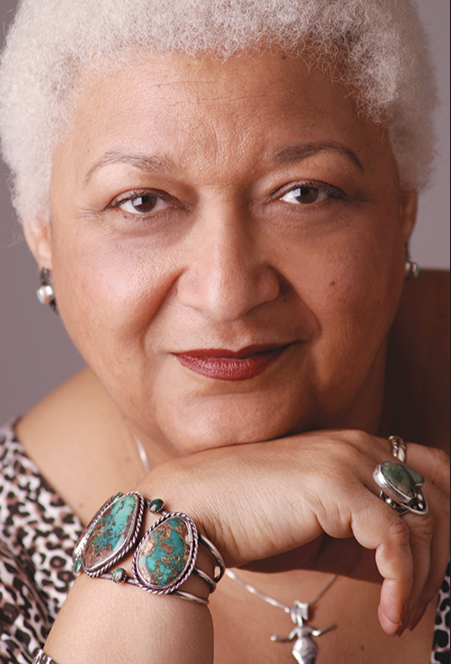
By Jewlle Gomez –
Years ago, a dear friend, Gary Page, who left this plane to become stardust, introduced me to the British TV series Doctor Who. Broadcast since 1963, it cleverly utilizes the idea of regeneration so that the same doctor character can be occupied by a series of actors over time as he travels the universe. I started watching in the Christopher Eccleston era, where he played the ninth incarnation, and I’ve continued through the subsequent five regenerations.
The theme song is not that catchy and the special effects are cozy rather than terrifying or awesome (except for the angels). But the point of the show is how we respond to terrors; how we treat each other and “the other.” Doctor #10 (David Tennent) says, “You want weapons? We’re in a library. Books are the best weapons in the world,” certifying the humanist approach the creators and writers of the series have maintained. Each doctor and the chosen traveling companion(s) has a quirky way of representing or expressing the humanist philosophy, and, until doctors #12, #13, and #14, it seemed like fans of the show were, if not believers in humanism, were at least open and interested in it.
There were many signs along the way of the creators being ahead of the heteronormative and gynophobic curve. This included Captain Jack Harkness (portrayed by gay actor John Barrowman), who is a seductive, piratical bisexual who has eternal life. He was introduced in 2005 and appeared in several episodes before he was given his own show, Torchwood.

Madame Vastra (played by Neve McIntosh) was also introduced in 2005. She is a lizard-like woman who is perhaps as old (several thousand years) and powerful as the doctor. She mostly resides in Victorian London with her wife, Jenny. Her discussion of what it means to wear a veil is a psychological and emotional marvel (Season 8 Episode 1).
Introduction of the 12th, 13th, and 14th doctors apparently threw many fans out of orbit. The 12th doctor (Peter Capaldi) is older, has gray hair, and is Scottish. Unlike the dashing “boy-bandish” previous three doctors, he has a mature, world weariness that is only relieved in the period when his traveling companion is Bill, an ebullient lesbian of color who is killed off too early.
With the introduction of a female doctor (lucky) #13 (Jodie Whittaker) and then a Black, gay doctor #14 (Ncuti Gatwa), many Whovians lost their collective cool. It was disheartening to read so many fans complain about how impossible it was for a woman or a Black man to play the doctor; how it was ruining the franchise. It is a show about a several thousand-year-old alien who time travels in an antique police box, people!
Doctor Who writers were experimenting with new things, so, maybe because doctors #13 and #14 did not experience the same traditional regeneration process used with the earlier doctors, fans never bonded with the actors. Many long-time fans turned away when the doctor no longer looked like them or resembled the boy they wanted to have a crush on. This demand for hetero/ethnic/gendered primacy in the 21st century among speculative fiction fans is a grave disappointment. It is as if fans turned up at a reading from my vampire novel wearing MAGA hats.
One of the reasons I write speculative fiction is because it invites the opportunity to imagine people acting better. Ever since Mary Shelley wrote Frankenstein, the first science fiction novel, speculative fiction in all its forms has offered non-traditional perspectives on our lives and what we might do to improve the world. The villagers gang up against Shelley’s monster with blazing torches to destroy it because they are afraid Shelley is reminding us of what fear and ignorance can do to good people.
Some Doctor Who fans remain enraged at the evolution of the doctor and refuse to watch as the show continues to explore new worlds and new doctors. Such peevishness reminds me of something the doctor said: “Anger is the shortest distance to a mistake.”
Jewelle Gomez is a lesbian/feminist activist, novelist, poet, and playwright. She’s written for “The Advocate,” “Ms. Magazine,” “Black Scholar,” “The San Francisco
Leave Signs
Published on December 4, 2025












Recent Comments