









By Dina Novarr—
I’m not sure when I stopped feeling proud to be American. Maybe it was gradual, like roots rotting beneath sturdy timber. Everything looks fine until suddenly the whole thing tips over. Or maybe it happened all at once, like an earthquake so big that the ground splits open and the tree plunges into the void. Either way, 2025 left me lost, unsure how to hold American identity in my hands without feeling like I was clutching something that might combust.

It was during this inner turmoil that I ran into Natalie Lichtman at a supplier showcase. It felt like stumbling onto solid ground. I had admired Natalie from afar during my time in the industry. She was one of those people whose name you drop casually to signal you know what’s actually good, and who actually matters. She is smart, discerning, and the kind of professional whose enthusiasm means something because it’s earned, not given. So, when I saw her pouring samples of Pathfinder, a non-alcoholic spirit I’d been curious about, the coincidence felt less like chance and more like the universe throwing me a rope. “This is hemp-based,” she told me, and I nearly laughed. Of course, it was.
What makes hemp interesting is that it wasn’t common or grown with abundance until 2018. Here is what kids should learn from American history class: The 1937 Marihuana Tax Act wasn’t really about marijuana. It was about William Randolph Hearst’s timber empire feeling threatened by hemp’s potential as cheap paper pulp. It was about Treasury Secretary Andrew Mellon’s investments and his friends at DuPont, who’d just patented nylon and didn’t need a natural fiber cutting into their synthetic gold mine. It was about Federal Bureau of Narcotics Commissioner Harry Anslinger, Mellon’s nephew-in-law, naturally because nepotism never goes out of fashion in America, drumming up enough fear about “reefer madness” to justify crushing an entire agricultural industry.
The tax worked brilliantly. It required special stamps for growers, sellers, and even physicians, set at rates so prohibitive that the legal cannabis and hemp industries simply died—not because hemp was dangerous—it had been an essential American crop since colonial times—but because powerful men decided their fortunes mattered more than farmers’ livelihoods or economic common sense.
Nothing says “land of the free” quite like weaponizing bureaucracy to eliminate competition.
For 81 years, hemp remained effectively banned, a cautionary tale about what happens when corruption wears the mask of “the good guy.” Generations of Americans were convinced that a plant George Washington grew was somehow a threat to the republic, so newspaper magnates could protect their timber investments and chemical companies could sell more plastic. It’s the kind of story that makes you wonder what else we’ve been sold about American exceptionalism.
But here’s the thing about Pathfinder, about finding Natalie again, about hemp itself: sometimes the path does correct. The 2018 Farm Bill legalized hemp cultivation, finally acknowledging what should have been obvious decades earlier, that hemp is a sustainable, versatile crop with legitimate agricultural and economic value—not because politicians suddenly grew consciences, but because the economic argument became impossible to ignore. Hemp makes sense: it requires less water than cotton, enriches soil, sequesters carbon, and produces everything from textiles to building materials to, yes, spirits.
Common sense regulation loosening for economic benefit? That’s actually democratic. That’s actually American, or at least the version of America I’m hoping to find again in 2026.
And Pathfinder is crafted from that redemption story. It is not just made with hemp, but instead made possible by hemp’s unlikely journey back to legitimacy from an essential colonial crop, to demonized substance, and to valued resource, all in the span of America’s existence. The bottle in my hand contained both the corruption and the correction, the losing our way, and finding it again.
Natalie walked me through the tasting notes—juniper, wormwood, Douglas fir—botanicals that taste like the Pacific Northwest, like American terroir. The spirit itself is complex without pretense, earthy without being crunchy, sophisticated enough for craft cocktail bars but approachable enough not to alienate. It fills the space that a spirit should fill, and creates the ritual without the hangover, the ceremony without the fog.
“We’re getting incredible traction with hospitality accounts,” Natalie said, and her enthusiasm wasn’t performative. This was someone who’d found something worth believing in, worth representing. In an industry drowning in celebrity-backed canned cocktails and cynical cash grabs, here was a product with an actual story, actual substance.
Finding her here, representing this, felt like discovering that someone you’d admired from a distance had somehow gotten even better; that their path had led somewhere meaningful, somewhere that aligned with their values. The success didn’t require compromise. I keep thinking about pathfinding as both a metaphor and a literal skill, such as how you navigate when landmarks disappear, and how you orient yourself when the North Star seems dimmed by smog and misinformation and the exhausting realization that so much of what you believed about your country’s foundations was always mythology, always PR, always timber barons and chemical companies writing the narrative.
Pathfinder emerged because America slowly course-corrected on hemp and found its way back to sanity, to logic, to recognizing value we’d artificially suppressed. The path was there all along; we’d just convinced ourselves it was illegal to walk it.
Maybe that’s what 2026 can be.
Natalie handed me her card. “Let’s catch up properly,” she said. “I’d love to hear what you’re working on.” Soon, we will catch up on where our paths have been and where they are going. But, for now, holding a bottle of Pathfinder while writing this article about her during Dry & Damp January … that’s the path I’m happy to walk. And, if I’m on it alongside people like Natalie and drinking her marvelous cocktails? That’s a direction worth moving.
Here are the two drinks for this January that Natalie shared: one dry and one damp. Should your dry January leave you feeling thirsty, I hope you find your path to hydration with Natalie’s help.

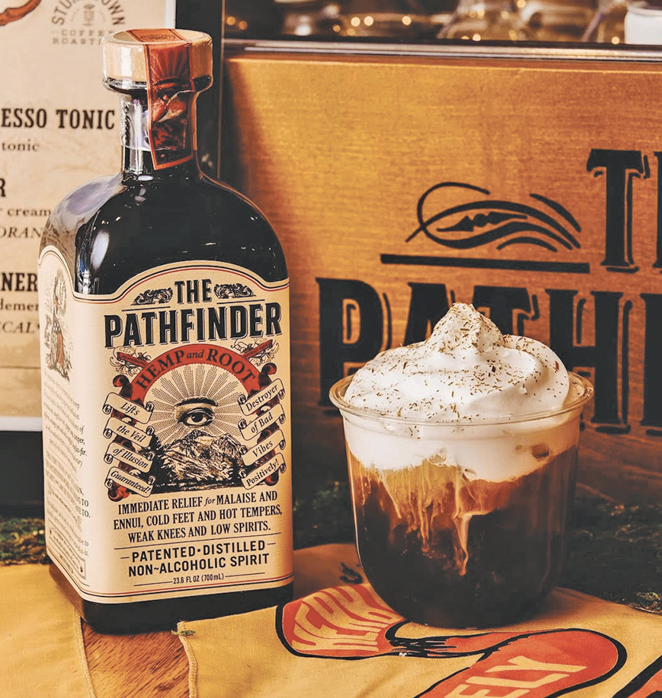
Mount Ranier
(non-alcoholic cocktail)
2 oz The Pathfinder
4 oz cold brew (Natalie uses Stumptown from Portland)
Salted Douglas Fir Coconut Cream
(see recipe)
Pour over ice in a rocks glass, top with coconut cream, and garnish with powdered Douglas fir tips and Maldon salt flakes
Salted Douglas Fir Coconut Cream
2.7 oz spiced Douglas fir syrup
15 oz (about 1 3/4 cup) coconut cream blend
sea salt to taste
Charge in an iSi canister with NO2.
(Editor’s Note: Douglas fir syrup can be homemade or purchased online. The drink would be different, but a non-dairy whipped topping with sea salt to taste could be used to top the mocktail.)
Reverie
(a low-proof cocktail)2 oz The Pathfinder .5 oz Le Cap Corse Blanc.75 oz Calvados
Build in a rocks glass with ice and a lemon twist. Or, stir all ingredients until chilled, and serve in a Nick & Nora with a lemon twist.
Cocktails with Dina
Published on January 15, 2026













Recent Comments