








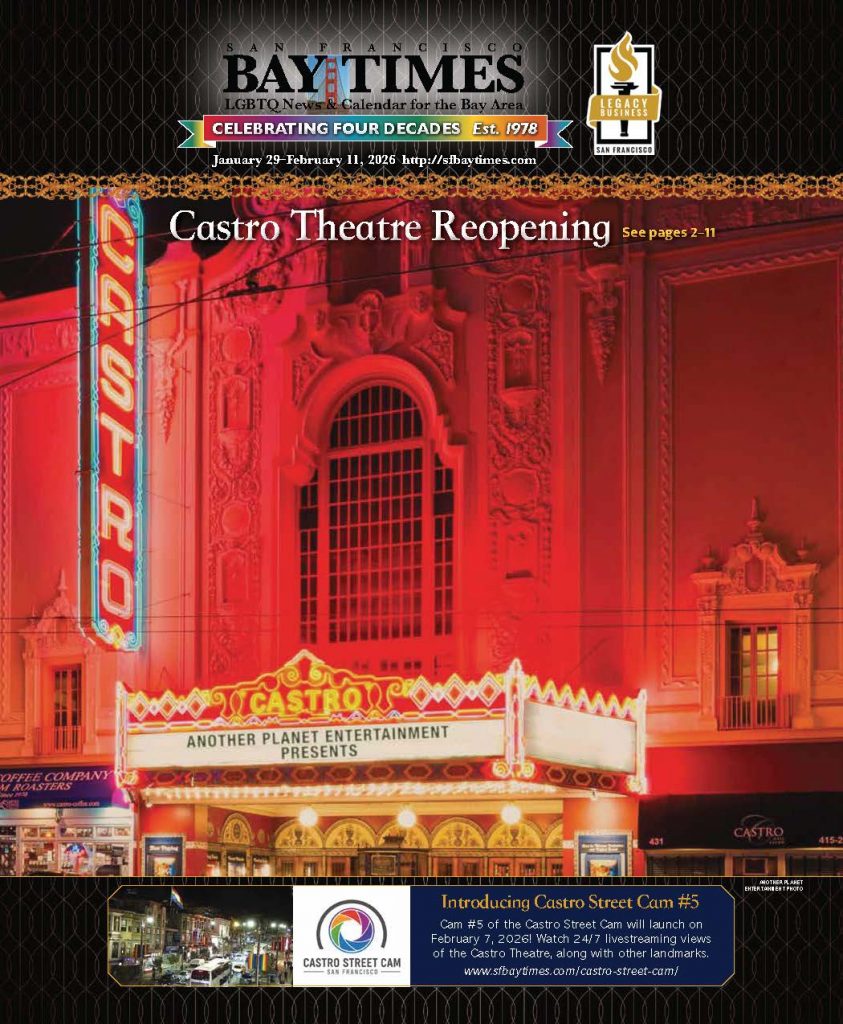
After two years of renovation and restoration work, The Castro Theatre is scheduled to hold a “Community Opening” on February 6, 2026, with a fundraiser for the Castro Community Benefit District. The long-awaited opening will begin a new chapter for the storied theater that is an architectural landmark in the Castro District. It has been an epicenter for LGBTQ+ activism and queer cinema, served as a safe space during the HIV/AIDS crisis, was the location of prominent memorials for LGBTQ figures such as Gilbert Baker and Heklina, and has been central to the Frameline Film Festival, signature concerts of the San Francisco Gay Men’s Chorus, and was the site of premieres for noted queer movies like Milk (2008).

What to Expect
The theater closed for the extensive work on February 4, 2024, with a singalong screening of the 1982 musical Victor/Victoria being the final event before the two-year closure. Just before this happened, Mary Conde, the Senior Vice President for Another Planet Entertainment (APE) that took over management and programming of the theater in January 2022, said: “In addition to restoring the magnificence of Timothy Pflueger’s original design, The Castro Theatre will now be more ADA accessible in the audience, onstage, and backstage to all. Additionally, a state-of-the art heating and air conditioning system will be installed, providing comfort and healthful ventilation. Finally, improved concessions, an expanded lobby, the restoration of the original proscenium arch and new, comfortable and flexible seating will make the Castro a venue that respects its heritage while embracing new, and ever more diverse audiences.”
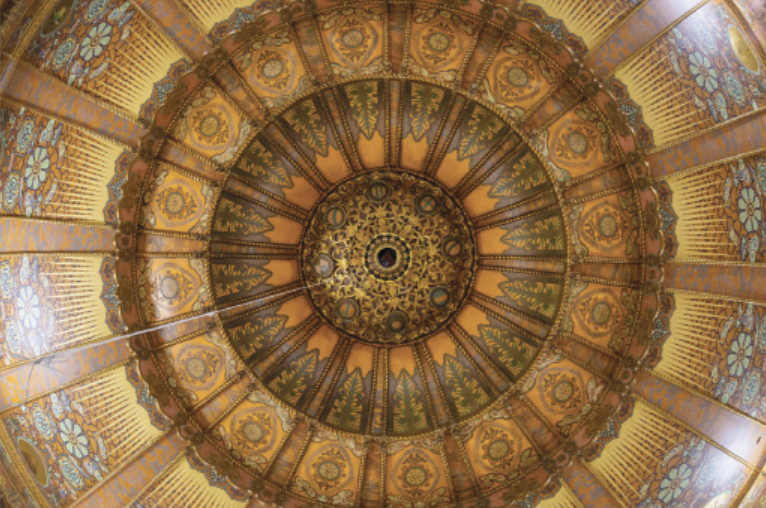
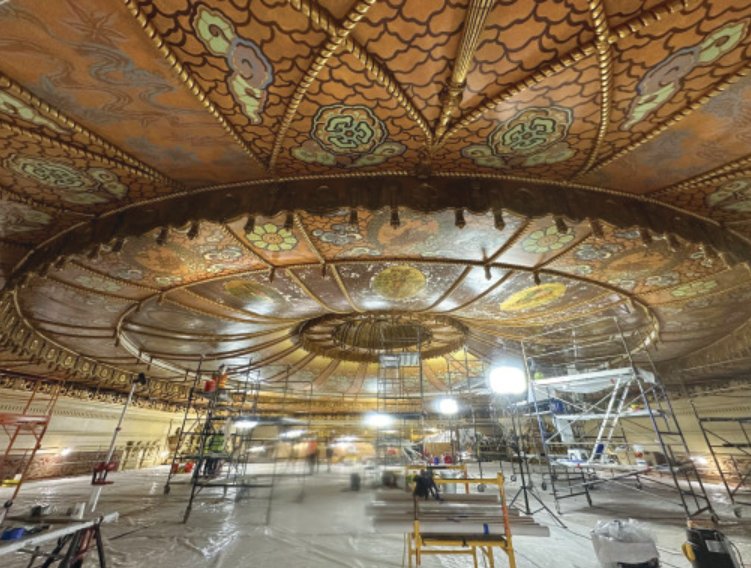
Jeff Greene, the Executive Chairman and Founder of EverGreene Architectural Arts that oversaw the preservation work, added, “One of the defining features of the Castro is the tent-like painted ceiling which has been obscured from view for decades. This element will be conserved and restored along with the unique sgraffito murals on the side walls [that] bring the whole back into harmony with Pflueger’s original vision.”
While the San Francisco Bay Times and other media outlets were permitted to view the work over a year ago during hardhat tours, the media has, to our knowledge, not been permitted entry this year so far. Several videos released by APE over the months, however, indicate that all of the goals have been achieved—with even some surprises along the way. See the videos at: https://bit.ly/4a1d4hD
From $15 Million to Over $41 Million
The first discrepancy from the original plan was the cost. At first the estimate was widely reported as being $15 million for a one-year, 15-month renovation.
As time went on, the project significantly grew in both scope and budget. By late 2025, the cost had nearly tripled to an estimated $41 million. APE, which has a reported annual revenue exceeding $100 million and is one of the largest independent concert promotion companies in the U.S., is footing the steep bill.
Discovery of an Ornate Proscenium Arch
A better surprise was the discovery during the renovation of a formerly hidden ornate gold-painted proscenium arch. Prior to the 1950s, the arch was used to frame the stage. Demo crews found it after removing an old movie screen that had covered up the back of the theater’s stage. (Sections of the screen, along with floorboards from the theater, were donated to Queer Arts Featured, which has been facilitating incorporation of these historic elements into various artworks. See the feature in this issue of the San Francisco Bay Times for more information.)
Shortly after the arch was discovered, Conde told the Engineering News-Record, “It solidifies the intention of the design that this building is meant to have curved edges—there aren’t a lot of right angles. We kept those curves intact. And [the proscenium] really makes the whole design much more cohesive.”
Interior Decorative Elements Revealed
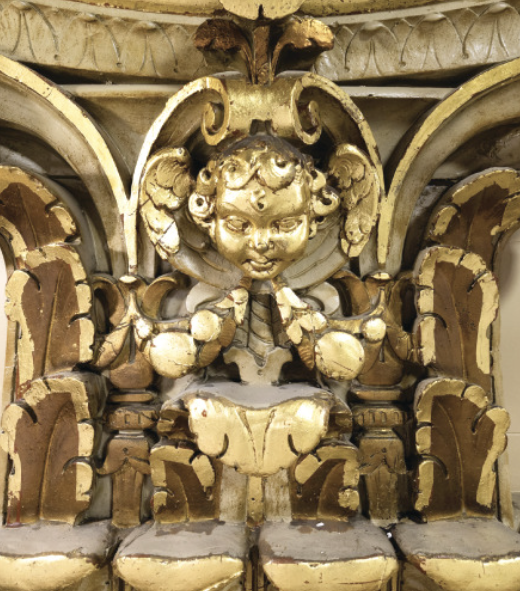
For nearly seven decades, guests at the Castro Theatre were permitted to smoke. For better and worse, the debris from that smoke and other soot accumulated on the signature “tent-like” leatherette ceiling with medallions and intricate sgraffito murals. Throughout the theater, gilded cherubs, organ grilles resembling European palaces, and detailed plasterwork were also covered in the dark matter. There was a major fire at the theater in 1937, which also could have contributed to some of the dirt and sooty debris.
Greene, during the work, said that his team had to balance maintaining “authenticity with legibility.” Conde indicated that, at least to some extent, the soot had a preservation effect. As she said, some of the plasterwork was “preserved in nicotine.” Crews were able to remove this, and, when needed, reapplied paint and gold foil.
At Least Two Long-Standing Family Legacies
The Nasser family was the original owners of the theater, and, through Bay Properties Inc., still owns The Castro Theatre. We will share more about the Nassers in a minute. The other family-owned business tied to the theater is Richmond-based Phoenix Day, a lighting and metalwork company established in 1850. They pivoted to electric lighting in 1879 when San Francisco established its first central generating station.
Phoenix Day originally crafted The Castro Theatre’s steel chandelier in 1937 to replace a previous fixture that had burned in the fire. Remarkably, the company is still in business after all of these decades and helped restore and reinstall the chandelier. The current owner of Phoenix Day is Tony Brenta and his wife Joan. Tony is the grandson of the original owner.
Another Key Moment in the Theater’s History
The theater’s reopening in 2026 will mark the beginning of a new era for The Castro. Here are just some of the key moments in the theater’s past:
1910: The Nasser brothers opened the original 600-seat Castro Theatre at 479 Castro Street. Three brothers—William, Elias, and George—had immigrated with their father Abraham and other family to San Francisco from Lebanon. They first operated a grocery store and nickelodeon near 18th and Collingwood streets.
1922: The Nasser family commissioned renowned architect Timothy Pflueger to oversee the building of the Castro Theatre at its present location, 429 Castro Street. It opened on June 22, 1922, with the film Across the Continent. (The Nasser family theater empire also used to include the Alhambra Theatre on Polk Street, the New Mission Theater, the Liberty Theater, the Royal Theater, and more. The Castro was always considered to be the “crown jewel.”)
1937: A fire prompted a remodel by Pflueger, who added the now iconic neon sign, marquee, and Art Deco chandelier from Phoenix Day.
1976: The Castro Theatre was designated as San Francisco Landmark #100.
1970s–1980s: The theater became a premier repertory house and epicenter for LGBTQ+ film, hosting the Frameline Film Festival.
1984: The Castro Theatre hosted the premiere of The Times of Harvey Milk.
2008: The theater’s facade and neon were restored for the filming of Gus Van Sant’s Milk.
2017: The theater was the site of a memorial service for Gilbert Baker (June 2, 1951–March 31, 2017), creator of the rainbow flag. (Baker’s last major interview was with Pink Triangle project leader Patrick Carney for the San Francisco Bay Times.)
2022: The Castro Theatre celebrated its 100th anniversary. Just before this time, Conde, searching for a 1400-seat venue in the city for concerts and other events, explored a partnership with the Nasser family that had been struggling to keep the theatre open, especially after the COVID pandemic. At the beginning of 2022, the partnership was solidified and it was announced that APE would spearhead a major restoration.
2023: Heated community debates took place regarding the removal of the orchestra seating. The building’s landmark status called for “fixed theatrical seating” to be at the theater. The San Francisco Board of Supervisors voted 6–4 in June of 2023, though, to amend the landmark designation to allow for replacing the old seats with motorized, retractable seating for multi-purpose use. Also in 2023, a massive public memorial took place in May to remember popular drag queen Heklina (June 17, 1967–April 3, 2023). The memorial happened both inside the theater and along Castro Street. Video of the memorial within the theater is at https://bit.ly/3M4O2pW
2024–2026: The theater is closed for renovation and restoration work. On June 19, 2024, its restored neon blade and marquee were officially relit during a Juneteenth block party. The unveiling also coincided with the opening night of the Frameline48 Film Festival.
February 6, 2026: The Castro Theatre is scheduled to hold the “Community Opening.”
February 10, 2026: Sam Smith is scheduled to begin the first night of a 20-night series of concerts at the Castro Theatre called To Be Free: San Francisco Residency.
The San Francisco Bay Times is proud to be the media sponsor for the February 6 Community Opening benefiting the Castro Community Benefit District. We hope to see you there and at other events at this prominent theatre that remains vital to the financial, cultural, and historic life of the Castro and is recognized both nationally and internationally for its continued LGBTQ+ significance. https://thecastro.com/
Castro Theatre Reopening
Published on January 29, 2026










Recent Comments