







By Stuart Gaffney and John Lewis—
A lovely baby girl was born in small-town West Virginia about 15 years ago. We don’t know her personally, but her name is Becky, and she was a very lucky little girl, surrounded by the deep and unconditional love of her parents and the support of her two older brothers and grandparents. Described as “bright and kind,” Becky was and is an excellent student, who especially loves math and science. Both Becky and her mom Heather recall that, growing up, Becky loved “girly” things. Among other things, she delighted in playing with her mom’s clothes and liked pink.
By the time of third grade, Becky had become a devoted fan of the local youth football league, attending all the games and learning all the cheer routines led by the all-girl cheerleading squad. The next year, Becky made the cheer team herself. According to Heather, she “glowed” when she received her own cheerleader’s outfit, many a “girly” girl’s dream come true.

eather also reported that Becky’s becoming a member of the cheerleading team also “dramatically increased” her “confidence and happiness” and gave her a “sense of belonging and camaraderie” for which countless youth as well as adults yearn. The experience also “taught her the importance of responsibility, trust, and team building,” a key aspect of maturing. Becky was particularly “proud to have served as part of the base for her cheer team’s pyramids” because it showed her “that her teammates trusted and relied on her in order to complete their routine.”
Becky also really loved and continues to love running and team sports—which we assert can also be a “girly” girl thing to do. Indeed, Becky’s mom Heather ran competitively and as part of a team. Becky’s fondness for running could be yet another way she emulated her mom, with whom she shares a very deep connection and to whom she can turn for anything. Growing up, Becky accompanied Heather on her runs through parks and saw her mom’s running medals on the walls at home.
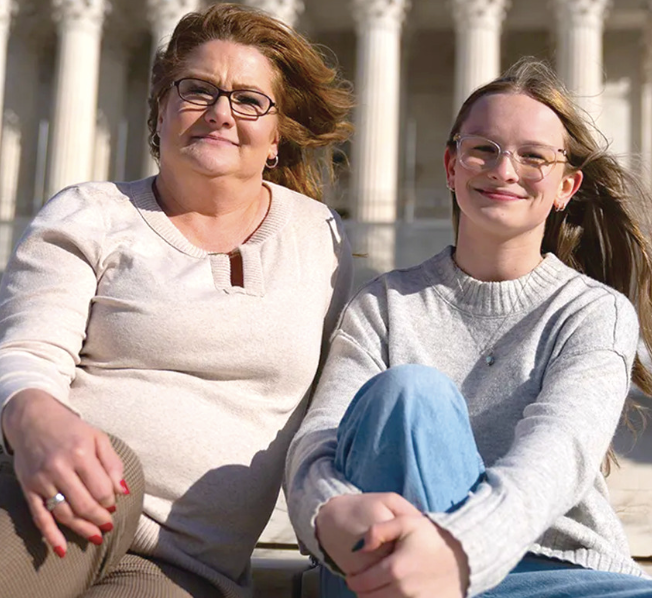
When Becky became a sixth grader and entered middle school, she joined the fall cross-county team, which allowed any girl who participated in all the summer practice sessions to become part of the team. That was lucky for Becky, because unfortunately it seems that Becky lacks the running abilities of her mom. In competitive races, Becky “finished consistently near the back of the pack,” coming in “51st out of 66 in one competition and 123rd out of 150 in another.”
Nevertheless, Becky declared that the season was “awesome.” She explained, “I felt supported by my coaches and the other girls on the team. I made so many new friends and loved competing with and supporting my teammates. We learned about teamwork, having a positive attitude, and how to have fun while being competitive.”
In the spring, Becky tried out for the track and field running team, but her coach said that she was too slow to make the team. Undeterred, she once again joined the cross-country team the next fall as a seventh grader. But things went from bad to worse with Becky by eighth grade finishing 67th out of 68 in the one meet in which she competed. Despite all of this, Heather reported that, throughout it all, she had “never seen [Becky] happier” than when she “pick[ed] her up from practices and [took] her to meets.”
When Becky didn’t make the track and field running team as a seventh grader, her coach encouraged her to try field events, and she enthusiastically took up shot put and discus. But Becky showed no innate skill at these sports as well, placing 36th out of 45 in shot put at one meet, 15th out of 25 and 35th out of 53 in discus at two other meets. However, Becky worked hard, and, in spring of eighth grade, she placed third in the state for middle school discus and sixth in the state in middle school shot put. She continued to place well, although not at the very top, in ninth grade.
Regardless of how good an athlete Becky is, she says “she feels ‘free and fully myself’ when she ‘is out on the field,’” and “breathing in the fresh air and feeling proud when [she] work[s] hard.”
You might wonder why we’ve devoted an entire column just to describing Becky. We wish we could say it’s simply because we wanted to share the story of a bright and engaged girl, whose life stands as testament to a child’s potential when surrounded by loving and supportive family and friends. Becky’s capacity “to have fun while being competitive” is an invaluable character trait, that even the fiercest competitors at any age in any endeavor would be wise to cultivate and embody. Becky’s experiences further demonstrate some of the many benefits that Title IX has provided girls by availing them of the opportunity to participate fully in athletics in an educational setting.
But unfortunately, there’s another reason we wrote this piece: Becky, her mom, and the rest of her family and friends have been forced to engage in a years-long legal struggle for her right to be “free and fully” herself and participate in school sports. The sole reason is that Becky was born with male genitalia, assigned the sex marker “male” at birth, and lives in West Virginia, one of many states that have enacted sweeping prohibitions on transgender girls participating in girls’ school sports. West Virginia’s ban prohibits any trans girl from participating in any girls’ sport, including intramural and non-competitive sports, from middle school through college, regardless of the individual characteristics of the girl or the particular circumstances of the sporting event.
Becky’s case is now before the U.S. Supreme Court, which held oral argument earlier in January. Whether Becky will be able to continue to participate in school track and field, which she dearly loves, rests in the Justices’ hands.
We know that, based on the law and the facts, Becky should win her case. In Part 2, we’ll explain why. Particularly important is the fact that Becky has no physiological advantages over other girls in sports, because Becky has taken medications to prevent her from undergoing any aspect of typical male puberty and enable her instead to experience typical female hormonal puberty. But we’ll also discuss the reasons some legal observers believe the Court’s conservative super-majority may still wrongly rule against her, as well as against another trans student athlete whose case was heard by the Supreme Court the same day as Becky’s.
Stay tuned for Part 2, and, in the meantime, let’s continue to cheer on Becky and other trans athletes both on the field and at the Supreme Court.
(All quotations come from court filings that can be found at https://bit.ly/3O1Lklw)
John Lewis and Stuart Gaffney, together for over three decades, were plaintiffs in the California case for equal marriage rights decided by the California Supreme Court in 2008. Their leadership in the grassroots organization Marriage Equality USA contributed to making same-sex marriage legal nationwide in 2015. Today, they continue to educate and advocate for marriage equality and LGBTIQ+ rights worldwide.
6/26 and Beyond
Published on January 29, 2026












Recent Comments