








Cocktails with Dina by Dina Novarr—
Stand on the corner of Market and Castro on a Tuesday evening at 6:45 pm and watch the sidewalk traffic compress. It’s subtle at first, like a density shift, bodies moving with purpose rather than drift. By 7 pm, the wave has passed, and the street exhales. The restaurants that couldn’t seat you fifteen minutes ago suddenly have tables. The MUNI drivers know this rhythm. Something is creating a Doppler effect in the Castro, and it’s keeping the neighborhood abuzz.
The Doppler effect, for those whose high school physics has faded to a gentle hum, describes the change in wave frequency based on relative motion between source and observer. An ambulance siren pitches higher as it approaches you (compression), and lower as it recedes (expansion). It’s not that the siren itself changes; it’s that motion creates the shift. Without relative movement, there is no Doppler effect—just a static tone that nobody registers because it never changes.
A neighborhood can pulse the same way, but, unlike sound waves, human traffic patterns require something worth moving towards. The ecosystem responds and you begin to understand. Catch Bistro started serving dinner at 5 pm instead of 5:30 pm with people waiting in line. Marcello’s Pizza was getting pizzas ready at 11 pm on weeknights, expecting their first big wave of the night at 11:15 pm, a crowd that materialized like a tornado of sequins and glitter. Bars have been recalibrating their happy hours, not based on industry convention, but when bodies actually appear and when they disperse. They may now set aside 10:30–12:30 am for nightcap specials to reel in the groups who want a moment to break down the performance they just saw.
There was no consultant who advised these adjustments. The neighborhood simply started conducting electricity again, and the circuit completed itself.
What we hope from this circuit is to see new restaurants, cafés, and bars opening in a cluster pattern that may make no demographic sense on paper. The Castro isn’t gentrifying in the traditional tech-money way, and it’s not a destination dining neighborhood like Hayes Valley or the Mission. Yet new concepts will be launched, all betting on the same mysterious current.
MUNI capitalized on this with added frequency to lines without the need for formal ridership studies, but instead planning against the schedule of the new heartbeat. Drivers just noticed they were passing full stops, and the next schedule adjustment reflected reality. Seeing infrastructure responding organically when something fundamental shifts is tangible growth. It is not what San Francisco is used to, which is an endless bureaucratic process after experts build a thesis through the accumulation of evidence, only after transportation frustration has garnered criticism and hit the San Francisco influencer scene.
The evidence was this: people were moving towards something at predictable intervals, then moving away in a dispersal pattern that fed the neighborhood’s circulatory system. Dinner reservations at 7 pm became impossible to secure but 9:15 pm was wide open. This was not because restaurants were empty early (they were slammed), but because the first wave had purpose and timeline. They arrived compressed, occupied space with intensity, then expanded back out into bars, late-night cafés, and the street itself.
Before this pattern emerged, the Castro had all the infrastructure of life without the animating force. The restaurants existed; the bars poured drinks; MUNI ran its routes. But it was motion without a true pulse, like people passing through rather than moving toward. A neighborhood can survive this way for a while, the way a body can survive on life support, but it’s not vitality; it’s maintenance.
You can measure the absence by what businesses didn’t open during those years. Investors are unsentimental; they read energy the way sharks read electrical fields. When a neighborhood loses its pulse, capital moves elsewhere. Some restaurant spaces sat vacant for eighteen months, then two years. It was not because they were in the wrong neighborhood, but just the wrong moment in the cardiac cycle.
What changed wasn’t demographic or economic. The Castro didn’t suddenly get richer or younger or more fashionable. What changed was the return of a heartbeat strong enough to create motion: The Castro Theatre.
The theater, dark for too long, renovated and reimagined, finally reopened its doors and became the wave source the neighborhood needed—not as a building or a business, but as a reason to move with purpose. Showtimes create compression. People arrive with intention, with tickets, and with plans that include before and after. They move towards the theatre at 6:45 pm for a 7:30 pm show. They disperse outward at 9:30 pm, still energized, still in motion, feeding the bars and late-night spots that stayed open betting on exactly this pattern.
The Doppler effect requires two things: a wave source and relative motion. The theatre provides the pulse. The neighborhood infrastructure—the restaurants that opened early, the bars that adjusted their hours, the cafés that baked that second batch—provides the medium through which the wave propagates. Neither works without the other.
Without the heartbeat, you have aimless motion and people passing through without purpose. Without the motion, you have an empty room with a pulse, like a theater with no one moving toward it. Together, however, the source and the system respond to it, and you have compression and expansion, blueshift and redshift, the living rhythm of a neighborhood that remembers how to breathe.
Stand on that corner again at 6:45 pm and you’re not just watching people walk. You’re watching the Doppler effect in action, the proof that motion around a heartbeat is what keeps the system alive. The Castro isn’t being preserved or revived through nostalgia or policy. It’s being resurrected through physics.
The theatre opened. The neighborhood moved toward it. And the frequency shifted back to life.
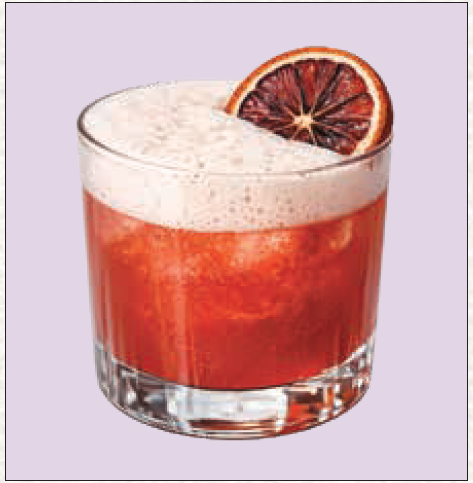
The Doppler
A cocktail that compresses, expands, and shifts in real time—just like The Castro Theatre at curtain call
Ingredients
1½ oz Redwood Empire Emerald Giant Rye Whiskey
¾ oz blood orange juice
½ oz Amaro Montenegro
A dash of honey syrup (1:1 honey + warm water)
2 dashes Peychaud’s bitters
Optional: ½ oz dry vermouth if you want a longer arc
Method
Shake hard with ice and strain into a chilled coupe.
Finish
Express an orange peel over the glass, then drop it in.
Optional garnish: a single Luxardo cherry at rest on the bottom … to make the wave
San Francisco-based Dina Novarr enjoys sharing her passion for fine wines, spirits, non-alcoholic craft beverages, and more with others.
Cocktails with Dina Novarr
Published on February 12, 2026








Recent Comments