





By Gary M. Kramer—
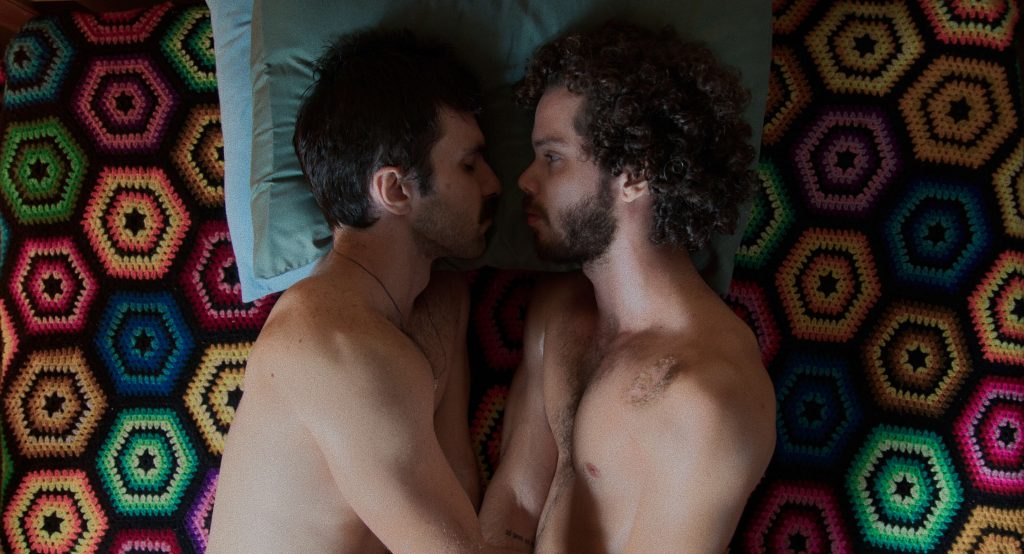
Out gay Brazilian actor Lucas Drummond casts a spell in the hypnotic, erotic film Only Good Things, available on VOD February 17.The actor plays Antônio, a farmer and cheesemaker, who takes in Marcelo (Liev Carlos), a stranger who had a motorcycle accident, and they share a tender, loving romance. Their story, set in 1984, forms the first half of the drama, which picks up decades later with an older Antônio (Fernando Libonati) dealing with the sudden disappearance of his husband, Marcelo.
In a recent interview, Drummond, who has worked extensively in film, television, and theatre, spoke with me for the San Francisco Bay Times about playing Antônio and making Only Good Things.
Gary M. Kramer: Your film first played San Francisco at Frameline last summer. What do you recall about that experience?
Lucas Drummond: I attended the screening at Frameline. It was my first time in San Francisco. I was thrilled by the city and the atmosphere. The Castro is the place. It was a fantastic experience. I always wanted to visit San Francisco during Frameline, and I was so happy to do that with such an important project in my career.
Gary M. Kramer: We see you/Antônio living on a ranch milking cows and making cheese. The other Antônio (Fernando Libonati) is urban, and lives in a luxury apartment. Can you talk about your skills with ranching and cheesemaking, or are you more aligned with the urban Antônio?
Lucas Drummond: It was a very hard process for me. I am a very urban guy. I have lived in the city my whole life. I do not have any relationship to the country whatsoever. I started preparing for Antônio almost a month and a half before we started shooting. Our preparation was divided into two parts. The first half was trying to understand these characters and build a relationship between Antônio and Marcelo and my relationship with the other actors. The second half was approximately ten days in the farm where we shot the first half of the film, doing this cowboy routine where we had to wake up at 5:30 am, milk the cows, and make the cheese and rehearse shooting and riding horses. It was a lot to learn, but it was very exciting. This is what I like about acting—trying to portray someone completely different from myself. The rhythm in the country is very, very slow. We try to portray that in Antônio. He walks very slowly. He has his own timing and tempo. He does things in a specific way. I am very anxious and dynamic. I would probably stand a month in the countryside, but, for a film, it was awesome.
Gary M. Kramer: Did you and Fernando Libonati discuss Antônio’s character, and what traits you would give each other because you’re a younger version of him?
Lucas Drummond: We had two different and separate processes. The first time we approached the script we did a reading together and discussed a lot about the character—our impressions, but not what we were planning on putting into the character. The shooting process was separate. We shot my half of the film in three weeks, and, during the last three days of shooting, Fernando arrived on set, so he had the opportunity to see what we were doing and pick up what he thought was interesting for “his” Antônio in the second part. We didn’t properly discuss, “I’m going to do this, so you should do same in the second half.” He saw how I was portraying Antônio and chose what he thought was interesting in his performance. The Antônios each have very different personalities, but I can see a lot of similarities, especially with the costumes.
Gary M. Kramer: Your performance is very internal. It does not include much dialogue. You communicate so much of your emotions though your eyes and body language. Can you talk about this kind of performance?
Lucas Drummond: The first time I read the script, I understood immediately that it was almost like a silent film. This was also very hard at the beginning, but I felt it was a process I had to dive into myself and try to understand how to portray these emotions with only my eyes and my body language. It was a great experience because of that.
Gary M. Kramer: The scene between Antônio and his father is very interesting. There are messages about masculinity and homosexuality here. What backstory did you give your character and his relationship with his father to make that scene so powerful?
Lucas Drummond: Antônio is feeling lonely for his whole life without having anyone to support him. He deals with everything himself. He had no one to teach him what love is. When I look at Antônio, I feel like Marcelo is maybe the first person in his life to teach him what love is. The kind of love Marcelo is searching for may not be what Antônio is searching for. Maybe Antônio is not ready to give all that love to Marcelo. Maybe that is why, in the second half, they are in a ruined relationship.
Gary M. Kramer: Yes, Antônio’s father withheld love from him.
Lucas Drummond: That was what I tried to create with the father, which is different from my backstory as an actor. Both my parents were very supportive of my sexuality. I had to create this backstory to understand what this character was going through. I tried to create this loneliness. [Young] Antônio has done everything by himself.
Gary M. Kramer: This is arguably your first leading role in a feature film. What are your thoughts about your career and the opportunities you get as well as the ones you create?
Lucas Drummond: I learned at a very young age not to wait for the opportunities to come. I understood that, if I didn’t make my own opportunities, it would take a long time for me to get cast in a role. I started producing my own work because I felt I had a lot of stories to tell. I wanted to contribute to queer art in the theater, on film and television, and I felt I could do something. I’m proud of what I’ve achieved, and I have a lot of projects coming up that I was either invited to do or I am producing. I believe if you produce your own work and tell stories you believe in, you will show the best of your work, and this will make people develop their desire to work with you. This has been happening in my career.
© 2026 Gary M. Kramer
Gary M. Kramer is the author of “Independent Queer Cinema: Reviews and Interviews,” and the co-editor of “Directory of World Cinema: Argentina.” He teaches Short Attention Span Cinema at the Bryn Mawr Film Institute and is the moderator for Cinema Salon, a weekly film discussion group. Follow him on IG @garyemkramer
Film
Published on February 12, 2026










Recent Comments