





By Gary M. Kramer—
It’s best not to say too much about director Steven Soderbergh’s enjoyably twisty drama The Christophers, about a once-famous bisexual artist, Julian Sklar (Ian McKellen), and his working relationship with his new assistant, Lori (Michaela Coel).
What can be disclosed is the set up: Julian’s adult, greedy offspring, Sallie (Jessica Gunning) and Barnaby (James Corden), “hire” Lori to secretly “restore” eight unfinished paintings their father started decades ago—the “Christophers” of the title, named after his then lover/muse—so they can be sold after his impending death for a huge windfall.
Lori clarifies that they want her to forge them. “Forge through them,” Barnaby spins, smarmily. Reluctantly, Lori agrees, and goes off to be interviewed by Julian in his home and studio for the assistant position that Sallie and Barnaby have “recommended” her for to their father.
A slumming Julian is first heard delivering inspirational messages on video for money before he is seen. He is both an eccentric and formidable presence, and McKellen delivers a pitch-perfect performance as the “bloviator with a bloated ego.” Lori observes what he says and does with wide-eyed expressions that speak volumes. If a picture paints a thousand words, every one of Coel’s reaction shots conveys a myriad of emotions.
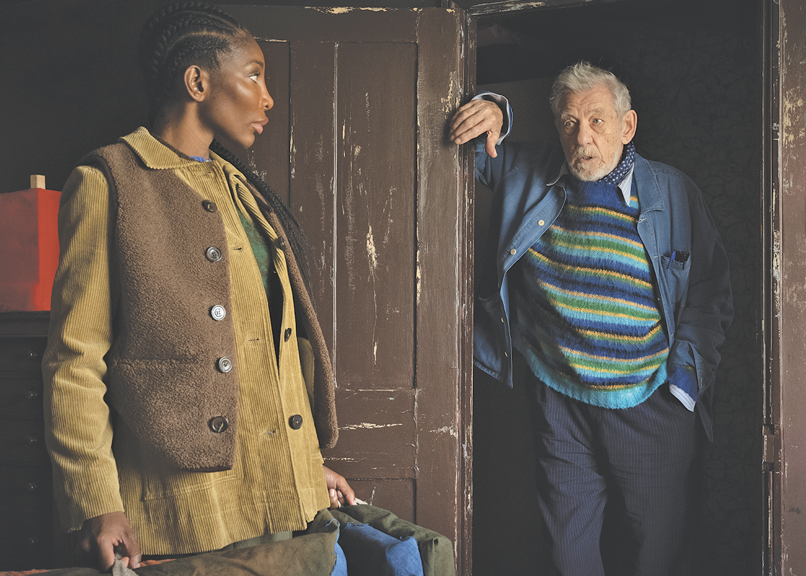
But Lori is no shrinking violet. Sallie and Barnaby seize on the fact that she hates Julian—the reason why becomes apparent later—and they know that this would not be her first job passing off her work as someone else’s.
The Christophers plays out like a chess match between two grandmasters. Julian asks Lori a question about her personal life, which she refuses to answer. She insists it is not work-related and explains that he has the power in the relationship as her employer. (She does eventually reveal that she was in a consensual relationship between three adults.) Julian also asks her one morning if she minds him appearing shirtless and in his dressing gown, and she admits that she does. He soon gets the upper hand by ordering her to destroy the very series of paintings she was planning to copy, asking her to shred them and deliver the evidence to him. Check mate, perhaps?
Soderbergh, working from a script by Ed Solomon (who wrote No Sudden Move for the director) shoots the scenes between Julian and Lori with a handheld camera that often captures the whipsawing between them. Yet, The Christophers is about more than just who, if anyone, will come out on top. There are very clever points about art and criticism, inspiration and legacy, all of which play into how the characters behave.
As Julian shrewdly asks Lori about betrayal at a critical moment, he also wonders aloud if Lori’s interest in art is actually her interest in becoming someone else. Other key questions arise: Was Julian “justifiably canceled” back in the day? And did he try to maintain control of his downfall by selling his work on the sidewalk for less than their value in what he claimed was an appropriate commentary on the business of art? And why did he keep those 8 unfinished paintings for 25 years if all he wanted to do was to destroy them? Lori challenges Julian perhaps for her own gain, but also, perhaps, for him to realize what his actions as an artist and a person mean. When Julian discusses his relationship with his model, Christopher, it is a heartfelt recollection of the arc of their romance. Lori also has some ideas about the paintings and how Julian’s coming out informed them.
Both characters have an agenda that slowly comes into focus over the course oftheir working relationship. Julian learns something about Lori that might give him the upper hand, but Lori uses her position to leverage things with Julian (as well as with Sallie and Barnaby.) As these reversals of fortune play out, the film gets more delicious to see who will outwit the others. (Hint: Blackmail does come into play at one point.) The Christophers keeps twisting and twisting until the final reveal, which may not be entirely surprising, but is still very satisfying.
The film can be a bit stagey as it unfolds largely in Julian’s home/studio, where Julian and Lori have a series of extended, but never uninteresting, conversations. McKellen and Coel ably go toe-to-toe in their scenes together. Viewers will be hanging on their every word, their every gesture, and their every expression, because both actors are so captivating. Their push-pull dynamic is on display in one of the film’s best scenes where Lori encourages Julian to paint “badly”—only to discover that his deliberate efforts prove otherwise.
If the supporting characters are all pretty one-dimensional—Sallie and Barnaby are completely, amusingly transparent, especially when they claim they are not thinking about “The Christophers” on an occasion where Julian mentions them—Gunning and Corden are fun to watch particularly because they get more desperate as thing get more complicated.
The Christophers is a modest drama that yields great pleasure. It even provides a little food for thought.
© 2026 Gary M. Kramer
Gary M. Kramer is the author of “Independent Queer Cinema: Reviews and Interviews,” and the co-editor of “Directory of World Cinema: Argentina.” He teaches Short Attention Span Cinema at the Bryn Mawr Film Institute and is the moderator for Cinema Salon, a weekly film discussion group. Follow him on IG @garyemkramer
Film
Published on April 9, 2026









Recent Comments