







By Cocktails With Dina by Dina Novarr—
There is a story I keep coming back to. It happened on the other side of the country, yet it feels like it belongs to our own history, starting in Central Park in 1999.
Two male chinstrap penguins at the Central Park Zoo, Roy and Silo, were observed trying to hatch a rock—not metaphorically, but an actual rock that was incubated with devotion and kept warm in shifts. When zookeepers replaced it with a dummy egg and the pair took excellent care of that too, someone had the presence of mind to give them a real one, from a mixed-sex couple who couldn’t manage two at once. Roy and Silo incubated it for 34 days. They raised the chick, a female named Tango, for two and a half months. The whole thing was documented in keeper notes the way you’d record any other penguin behavior, because that’s exactly what it was: penguins doing what penguins do, being devoted, raising a family, and figuring it out together.
Now that we are well into June, with additional flags up in the Castro and the city dressed in color again, I keep finding myself returning to the animals. This is not as a metaphor, or as an advocacy talking point, but as evidence—the oldest kind there is—that love in its full, improbable, inconvenient spectrum has always been native to this earth.
Same-sex pairing and bonding behavior has been documented in more than 1,500 species. Let that number sit for a second, as it includes mammals, birds, fish, and insects. It is not an aberration. It is not confusion. It is not a blip in the data. It is, to put it plainly, part of the natural world. It’s the oldest Pride parade on record, and it has been running for a very long time without our permission or our blessing.
Off the coast of Oahu, at a windswept reserve called Kaena Point, 31% of Laysan albatross nesting pairs are female-female. These are birds that mate for life. Nearly a third of the colony is made up of two females choosing each other, building a nest together, raising a chick season after season with quiet, unglamorous dedication. No legislature approved it. The trade winds just kept blowing and the albatrosses kept doing what they’d always done.
Biologist Lindsay Young, who has spent years studying these pairs, found that female-female pairs fledged fewer offspring than male-female pairs, but it was a better alternative than not breeding at all, which tells you something about both the pragmatism and the persistence of love.
And then there are the bonobos.
If penguins represent devotion and albatrosses represent quiet commitment, bonobos represent something else entirely: radical, joyful, consensual inclusivity. Our closest primate relatives, sharing roughly 98.7% of our DNA, engage in same-sex affection and sexuality across the board, regardless of gender, as a form of social bonding, conflict resolution, and sheer apparent pleasure. “[S]ame-sex behavior is not something bizarre, aberrant, or rare,” biologist Vincent Savolainen noted. “It’s everywhere; it’s very useful; it’s very important.”
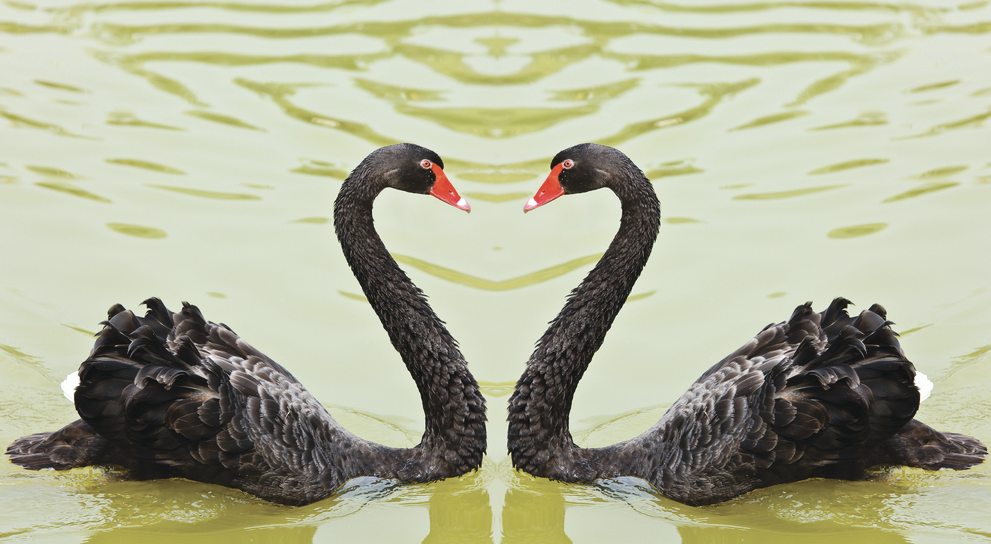
Let’s talk about black swans for a moment, because they are, frankly, iconic.
Male black swan pairs sometimes steal a nest from a mixed-sex couple, or one male mates briefly with a female, and once she’s laid her eggs, the two males raise the chicks themselves. Scientists believe this offers a biological advantage: Chick survival rates appear to be higher when raised by male-male couples, possibly because there’s an additional male defending the nest. There are then two dads, in the Australian Outback, unbothered.
Different species arrive at it for different reasons: partnership, parenting, social cohesion, pleasure, survival. The common thread is that it keeps showing up.
Pride Month, at its best, is this: the annual insistence that what has always been true deserves to be seen, that love in all its forms is not a deviation from nature. It is nature, written in feathers and fins and the patient warmth of two penguins in a zoo in Central Park who just wanted to raise their kid. The animals never needed a parade. But we do, because we are the only species on this planet that has ever tried to legislate love out of existence, and the only one that has ever had to fight in the streets to put it back.
So, here’s to the ones who fight. Here’s to the ones who just quietly live. Here’s to Roy and Silo, and the albatrosses of Kaena Point, and every black swan who built a better nest. Here’s to June, which in San Francisco smells like fog and sunscreen and someone’s speaker playing something very loud from a very small balcony.
Here’s to what nature knew all along.
The Naturalist
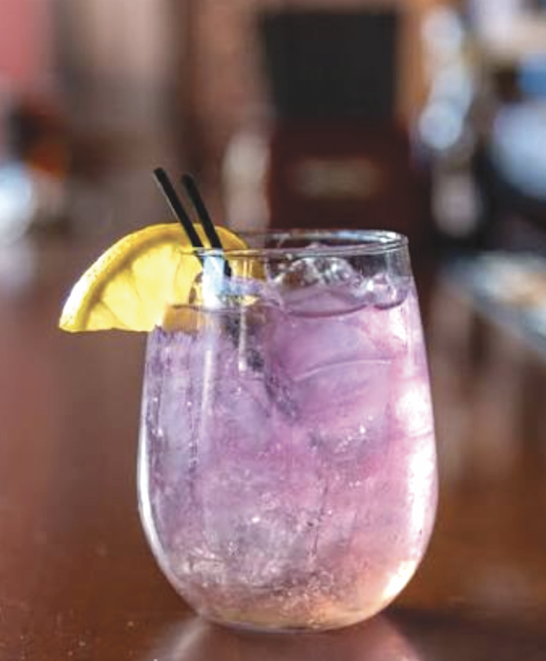
Butterfly pea flower is a botanical native to Southeast Asia. It brews into a tea that is a deep, improbable cobalt blue, until you introduce citrus. Add lemon and it shifts before your eyes: blue to violet to blushing magenta-rose, depending on how much acid you use. There is no dye, no trick; just the elegant mechanics of pH change.
It felt right for this column. It is a drink that carries its color shift, not as performance, but as chemistry and as simply what happens when certain things come together.
It is paired here with St. George Spirits Botanivore Gin, made just across the bay in Alameda. It includes nineteen botanicals, such as coriander, cilantro seed, carrot seed, and black peppercorns. It is aromatic and complex in a way that reads as of the earth: foraged, considered, and entirely itself.
1½ oz St. George Botanivore Gin (or any botanical gin)
¾ oz butterfly pea flower tea, brewed strong and cooled
½ oz St-Germain elderflower liqueur
¾ oz fresh lemon juice
½ oz simple syrup (1:1)
2 oz sparkling water or dry tonic, to finish
Combine gin, tea, St-Germain, lemon juice, and simple syrup in a shaker with ice. Shake well and strain into a chilled coupe or over a large rock. Top gently with sparkling water or tonic. Watch the citrus work its way through, blue into violet, violet into rose. Garnish with a lemon twist expressed over the glass, then draped along the rim.
No garnish is required. The drink is already doing something beautiful on its own.
San Francisco-based Dina Novarr enjoys sharing her passion for fine wines, spirits, non-alcoholic craft beverages, and more with others.
Cocktails by Dina
Published on June 25, 2026













Recent Comments