










By Gary M. Kramer—
The amusing Mexican comedy The Divine Tragedy, now available on demand, has Christián (Artús Chávez) moving in with his half-brother Roy (Pablo Gómez) after his husband Carlos (Rosendo Gazpel) files for divorce. Christián, a former actor, is depressed, and his despair only increases at Roy’s. His half-brother is a sex and drug addict who earns money operating a candle business with his roommate Rosita (Helena Puig), who has an unusual way of telling people’s futures.
Out writer/director Sergio Tovar Velarde’s film also includes Esteban (Christian Ramos), a hunky upstairs neighbor that Roy fancies, and Jacobito (Eduardo España), Roy’s gay best friend, along with plenty of drugs and sex and tears.
The filmmaker spoke with me for the San Francisco Bay Times about making The Divine Tragedy.
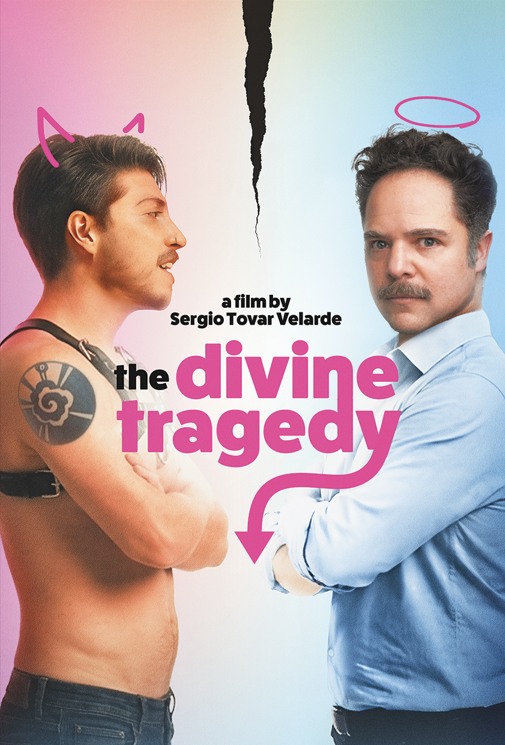
Gary M. Kramer: What inspired this odd-couple comedy and the characters of Christián and Roy?
Sergio Tovar Velarde: The idea came to me for different reasons—my sister had to move in with me at Zona Rosa, the gay neighborhood in Mexico City. She is younger than me, but more conservative. She was shocked by some of the people wandering around the neighborhood. Seeing her evolving into someone more open-minded was sort of the inspiration. I have been both characters. I wanted to express the heartbreak of the older brother and the lack of structure of the younger one. It was a way of reflecting myself. I wanted to show that, after all the differences, there may be some similarities, because we are humans.
Gary M. Kramer: What can you say about casting two actors, Artús and Pablo, who are partners in real life, as brothers?
Sergio Tovar Velarde: We met Pablo in his first tape, and I found him to be wonderful for the character. I introduced him to Artús, and there was this chemistry. They were very supportive of what the other needed. I was blown away when they came to me and said that they had become a couple in real life; they fell in love in the process of making the film. They just got married a few months ago. I am happy to have introduced them. They met during the first rehearsal, and they said the spark was instantaneous. They kept it from everyone during the shooting. It was a nice surprise.
Gary M. Kramer: Can you discuss your visual approach to the film? You favor Dutch angles to keep things off kilter. The interiors are often cluttered to express the characters’ cluttered lives.
Sergio Tovar Velarde: We worked out what the best way is to approach this. The standard way is to focus on the horizon. I started exploring the use of tilting the camera and using Dutch angles because the composition can gain a lot of depth. I was inspired on a rollercoaster at a theme park. Instead of a dolly moving in, I could twist [the camera] to see what results that would have. There are infinite ways of shooting, but this had a narrative purpose. I put viewers in a vertiginous situation. It gives a sense of instability. It is not a conventional approach, so it can feel weird. But it creates the emotion that nothing is stable.
Gary M. Kramer: What can you say about all the drug use in the film?
Sergio Tovar Velarde: [Laughs] Oh, you noticed! It’s a bold approach. There are different psychoactive substances in the film. I’m not saying every gay guy is a junkie, but I do believe it is becoming more frequent to find a connection between gay sexual interactions and psychoactive substances. I’m not judgmental about that; it is more of an observation. I wanted to be accurate about what I perceive. Some people have lost their ability to connect with others if there are no substances involved. We need to look at this and reflect and understand why people do certain things.
Gary M. Kramer: Likewise, there are copious sex scenes and nudity on display. Can you talk about the emphasis on that?
Sergio Tovar Velarde: I take photos and make portraits of naked people and film sex scenes because I grew up with a lot of art books and saw lots of nudity in painting and sculptures. There is something bold in showing naked bodies, but that doesn’t make them less respectful. I make important decisions during intimate moments in my life. I wanted the emotions to be profound and honest, and I want viewers to feel this is being made by someone who is open-hearted and willing to share and celebrate that we are all flawed. The film is a big hug to the darker areas of ourselves and a celebration for second or third opportunities or as many opportunities as we need to find love.
Gary M. Kramer: Both Roy, who seeks sex not love, and Christián, who is reeling from a breakup, need to love themselves to be loved. What are you saying about how gay men behave in relationships?
Sergio Tovar Velarde: That’s what they both have in common. They will be failing and failing over and over until they understand what the real source of the problem is. It has nothing to do with how many men, or how much money they used to have. It has to do with something much more honest. If you think you are different from someone, if you dig deeper, there will always be a point of connection. Roy is looking for sex because he likes it, but I leave the question of is it really fulfilling unanswered.
Gary M. Kramer: What can you say about developing the film’s humor, which is quite broad?
Sergio Tovar Velarde: I find this group of people like a family that shares these spaces and help each other in a hostile world. This is a comedy, but it feels like farce and absurdity, and it is campy and naïve and perverse. It’s a very specific combination. One of the things I appreciate in making my films is not that they are perfect—I stopped striving for that a long time ago—but I want them to be exploratory, and curious and interesting and different. I make films with heart, and honesty, and with lots of vulnerability. Almodóvar has been a huge inspiration for me. One of the most daring things in this film is not the sex scenes and drug usage; it’s the tone of the film, the genre, and the acting, which is subtly funny. It’s a comedy but it is also dark sometimes. It is not that often that you see these sordid and dark universes in a heartfelt comedy. It’s bittersweet. I believe that there are many films that portray much more explicit sex scenes and drug use. I believe the true controversy with this film relies on the fact that it’s not often that you get to laugh at a film that also navigates these dark topics.
Gary M. Kramer: You appear in a cameo in this film. Can you talk about your career agenda both in front of and behind the screen?
Sergio Tovar Velarde: When I decided I wanted to be a filmmaker it was not because I wanted to make movies, it is because I wanted to act in the movies I make. I am more of an actor than a writer/director. When I have a chance, I like to play a character in my films, I enjoyed playing a lawyer here. I met my lawyer in real life, and I got real lines from him. All the actors are required to dub dialogue after shooting but some didn’t show up, so, if you look at the credits, you hear my voice eight times. It is a true, independent gay Mexican film.
© 2026 Gary M. Kramer
Gary M. Kramer is the author of “Independent Queer Cinema: Reviews and Interviews,” and the co-editor of “Directory of World Cinema: Argentina.” He teaches Short Attention Span Cinema at the Bryn Mawr Film Institute and is the moderator for Cinema Salon, a weekly film discussion group. Follow him on IG @garyemkramer
Film
Published on November 19, 2026















Recent Comments