




By Gordon Edgar—
One of the things that has changed the most in my thirty-plus years of working a cheese counter is the size of cheese available. When I started, cheddars almost always came in forty-pound blocks and stores were expected to know how to deal with them. Gruyère came in low quality “cuts” or nicely aged seventy-pound wheels. Parmigiano Reggiano? Your choice was an eighty-pound wheel or a twenty-pound quarter, and the quarter wheel was wholesaled at about 20% more.
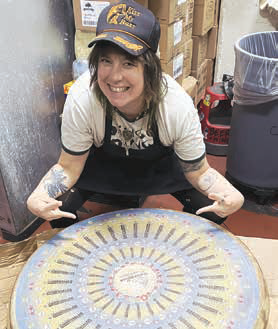
Increasingly, a lot of stores have lost the skills that were once required and they don’t even have the tools they need to deal with cheese of size. This isn’t the place to criticize others, but I really like being able to pass those monger skills on to others. That’s why I ordered the biggest traditional cheese I could recently: a two-hundred-pound Swiss Emmentaler.
Most Emmentaler cheeses, like Gruyère, are partially skimmed. There is nothing wrong with that. Cheesemakers use the cream for other things and have done so for centuries. Though lower in fat, these aren’t the monstrous “diet cheeses” designed in labs for a low-fat cheese market that doesn’t really exist. These are cheeses that evolved over hundreds of years along with the needs of the people who made them.
But I bought a twelve to fifteen month-aged Rahmtaler, a version of Emmentaler that dates back to the 16th century. Only three producers (https://bit.ly/4mA8Vax) still make this style where the fat is not skimmed off; indeed, in some months, extra cream may even be added. Alpine-style cheeses are meant for melting and the extra fat makes this an even more amazing cheese than usual: silky, rich, nutty, earthy, and floral. Rahm-
taler and Emmentaler are not strong cheeses. They are the basis for the recipes of non-name-controlled cheeses such as Maasdammer, Jarlsberg, or even the domestic Swiss you get in your sandwiches at your local deli. But the flavor of an Emmentaler is a hundred times more interesting when heated up.
I should also mention that there is a campaign to “Save the Emmentaler”:
https://bit.ly/4ceoeAO
The campaign exists, in part, because there are less and less traditional producers every year. Yes, the cheese that gives us the iconic image of cheese—yellow and holey—can be considered endangered. Some recipes date back to the 13th century and it would be a shame not to appreciate this influential wonder.
I’ll be honest. A 200-pound wheel is not easy to deal with. Usually—despite my aforementioned protestations of traditionalism—I buy quarters or eights. For worker safety-sake, four workers lifted our wheel up onto the counter, and everyone took turns cutting it with a handmade wire, long enough to reach all the way around the wheel. If a cheese worker has a little imagination, just touching this wheel can put you in touch with centuries of history.
For you cheese eaters, you can get in touch with that history as well. While it lasts, it is $19.99/lb, down from the 34.99/lb price it demanded during the worst of the tariffs. I am not sure where the regular price will land when the dust settles, but this is a terrific deal. By the time you read this, we will probably have around 160 pounds of it left. You don’t have to run to the store to get a piece, but check it out before the end of the month.
Gordon Edgar loves cheese and worker co-ops and has been combining these infatuations as the cheese buyer for Rainbow Grocery Cooperative since 1994. He serves on the American Cheese Society Judging and Competition Committee and is a member of the Guilde Internationale des Fromagers. Edgar has written two books on cheese—”Cheesemonger” (2010) and “Cheddar” (2015)—and lives in San Francisco with his adorable white mini schnauzer named Fillmore Grumble. He writes about grief, and sometimes cheese, at https://bit.ly/42IwYf0
Over the Rainbow Cheese Counter
Published on April 9, 2026










Recent Comments