




By Gary M. Kramer—
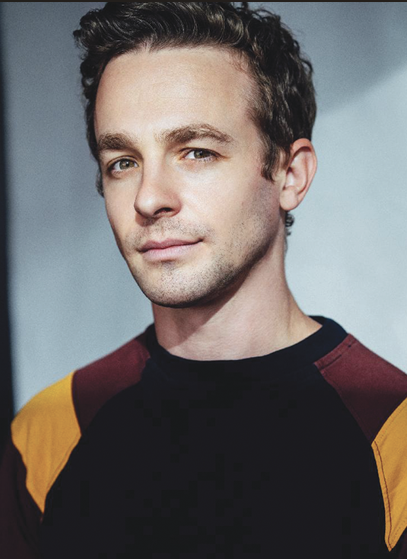
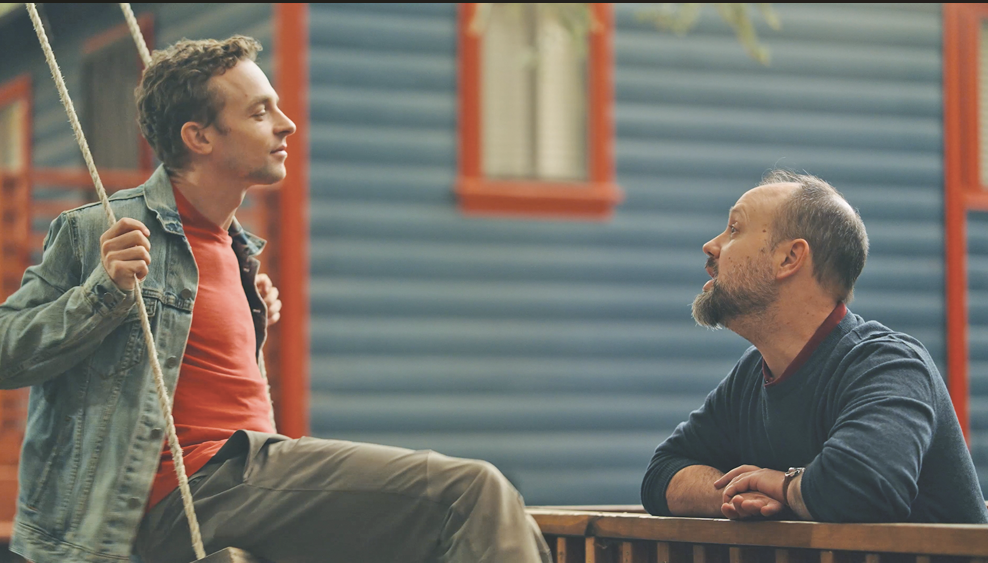
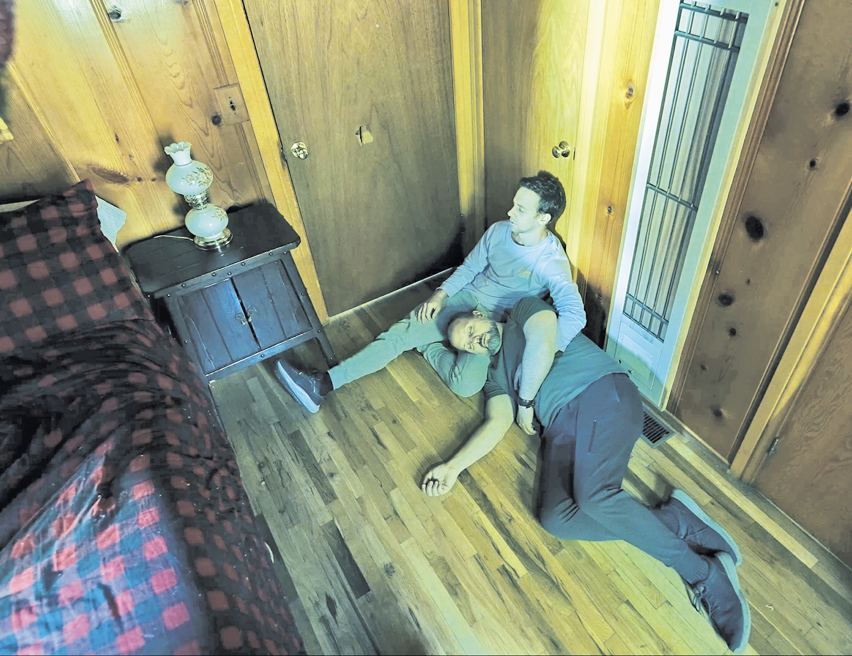
The up-and-coming actor John Brodsky delivers an impressive performance in the gay romantic thriller Shadows of Willow Cabin, available May 26 for streaming on AppleTV, Amazon, Google, Rakuten, and Hoopla. The film has Devon (Brodsky) meeting Albert (Bryan Bellomo) for a romantic getaway at Albert’s family’s cabin. While things start out well, with wine, talk, dancing, and some hot tub time, by day three some weird events start happening and Devon and Albert become trapped in the house without power, food, and water.
Brodsky gets to show his versatile skills in Shadows of Willow Cabin, which leans into horror tropes in its second half, especially after Devon has an unsettling shower. The actor also gets to flirt, cry, perform Shakespearean text, and more as Devon works through some trauma. Brodsky has been a valuable supporting player in B-movies including Black Site Delta, but he is also showcased well in various short films, such as Day 39, and as the lead in the gay romance Some Kind of Paradise. The openly gay actor’s short,
Something Still, which he wrote, is now making the festival rounds.
Brodsky spoke with me about his films for the San Francisco Bay Times.
Gary M. Kramer: You keep an air of mystery about Devon. How did you calibrate your performance in the film? He starts out upbeat and flirty, but eventually he shifts to despair as things get scarier.
John Brodsky: I actually attribute that a lot to the way in which we shot it. Joe [Fria, the director] was focused on shooting in order as much as possible. We had two weeks before principal photography, so I didn’t have much time to think about character. I think that worked well because Devon and Albert are just starting to get to know one another as Bryan and I were as actors. It felt very symbiotic in that way. I think what I really relied upon was my instincts. I allowed for the imaginary circumstances to just happen when they did.
Gary M. Kramer: How did you identify with Devon, who can be quite mercurial?
John Brodsky: Growing up, I was always so sensitive to opinions of other people, and how I was perceived. I think I learned from an early age how to have a thicker skin or learn how to be more forthcoming. I’m definitely more of a lover, not a fighter, and these types of roles where the character has to go back and forth between the more sensual to the more straightforward and direct come from having to survive. As I’ve gotten older and more mature, I just fight for something that I believe in, even when it might be hard. I want to be liked, and I want to like other people, and ultimately share love and all that. And, so, I think that’s kind of what resonated for me the most with Devon, is how he ultimately just wants to love and take care of people and things, and, when he is confronted with things, he just kind of calls it out, and does not let people kind of walk all over him. That definitely resonated with me a lot, too.
Gary M. Kramer: The film addresses issues of mental health and shame specifically, as well as sins of the father trauma that is passed down to the characters. There is considerable talk about sex and sin. What observations do you have about the dark themes in this film?
John Brodsky: I grew up Catholic, and went to Catholic school, and church, and there was a lot of emphasis on morals, and abiding by a way in which one should live their life. But human beings are messy. We go through traumatic experiences, whether they’re big traumas or little traumas, and people get hurt by one another—even under the best circumstances. I think that, a lot of times, people have the best intentions, but intention doesn’t necessarily change impact. Because of that, people can suffer and have experiences that shape them. I went through some major shifts in my life and learned how to sort of navigate that according to what I believed. I tried really hard to not let other people’s ideas affect the way in which I thought my life needed to be lived. I think that’s something that Devon, and particularly Albert, really struggle with. Devon has tried very hard to be himself in an environment that hasn’t really allowed for him to do that, and he has to act above his baseline in order just to be accepted. He wants to help Albert and not necessarily try to fix him, but, in a sense, save him. I can relate to that to a degree, too.
Gary M. Kramer: How would you fare without power, food, and water as Devon and Albert must at one point in the film? Are you a survivalist?
John Brodsky: I think I would initially have a panic attack. I don’t have the best survival skills. But I think, once I kind of settle into the reality of the situation, I would be more accepting of it, and try to be more problem-solving.
Gary M. Kramer: It is interesting that your work often focuses on grief and loss and transformation. What makes those themes so interesting to play?
John Brodsky: I’ve always understood that things don’t last, and life is precious, as trite as that can sound. The work that I naturally gravitate towards feeds something in me that I want to be able to articulate and mirror back to others—grief, existentialism, and loss. Because, in this life, nothing stays the same. We’re constantly changing and evolving, and, whether we’ll be forced to evolve and change, or whether it happens naturally, it has to occur for us to move on in this existence. I think that that’s a beautiful thing, as hard as it is. These are the things that I look for in my art, and what I want to talk about and express,
Gary M. Kramer: Speaking of your art, you wrote a short, Something Still, which is now starting its run on the festival circuit. Can you talk about that and creating your own work to showcase your talents as an actor/writer?
John Brodsky: In my early 20s I found a partner and was exploring the different sides of gay life in New York City—and all the joys and horrors that can come with it. A lot of it was stemming from an understanding that things might not have been great in my relationship and my partner and I kind of pushed things under the rug. I started writing from the perspective of what it would be like if we broke up. It was very therapeutic. It just gave me a whole new point of view of what I was going through, but also what he was going through, or what I imagined him going through, based on my relationship to him. I got to see a perspective that I wouldn’t have really gotten to see if I hadn’t had the time and the patience to just sit with it.
© 2026 Gary M. Kramer
Gary M. Kramer is the author of “Independent Queer Cinema: Reviews and Interviews,” and the co-editor of “Directory of World Cinema: Argentina.” He teaches Short Attention Span Cinema at the Bryn Mawr Film Institute and is the moderator for Cinema Salon, a weekly film discussion group. Follow him on IG @garyemkrame
Film
Published on May 21, 2026









Recent Comments