





Cocktails with Dina by Dina Novarr—
Somewhere off the coast of Africa, a hunk of brown algae the size of a small country decided this was its year. The Great Atlantic Sargassum Belt is currently drifting toward Florida, Mexico, and the Caribbean in what researchers are calling a record-breaking bloom, nine million tons and climbing, which in scientist-speak means “we are mildly panicking but in a peer-reviewed way.”
Nine million tons isn’t a beach nuisance. It’s a geological event with a smell. Once sargassum washes ashore and starts decomposing, it throws off hydrogen sulfide, science’s polite way of saying the ocean burped up a deviled egg and instantly regretted it. Tourism boards from Cancún to Pompano Beach are locked in a Sisyphean rake-off, clearing beaches at dawn only to watch the seaweed reclaim its territory by lunch.
People, however, are actually doing something useful with it. Researchers at the University of the West Indies are extracting sodium alginate from sargassum to make biodegradable packaging. A pair of Cal Poly grads built a company called Ecoplasticity around sargassum-based coatings that could replace plastic linings in food containers. Engineers have pressed it into particleboard for interior construction. Companies like Carbonwave are turning it into vegan leather. None of this is solving the crisis at the scale it’s happening—most of it is still lab-to-pilot stage—but it’s proof the stuff isn’t purely a liability. It’s underused raw material that happens to smell terrible on the way in.
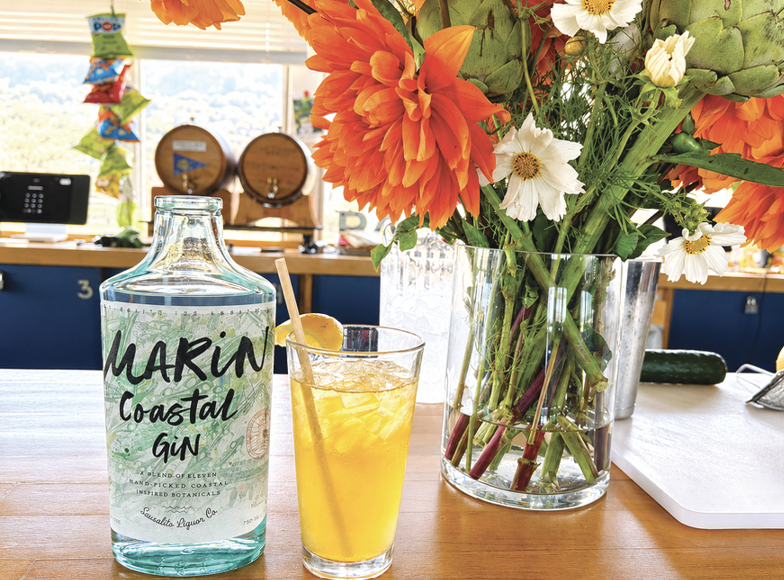
While the sargassum crisis represents a massive environmental challenge, some are finding creative uses for seaweed. This includes, by way of the Golden Gate Bridge, a craft gin that finds harmony in what others treat as waste. Marin Coastal Gin, made by Sausalito Liquor Co , is built around foraged nori seaweed, and it did not get there by accident. Founder Scott Jampol spent a decade in marketing at OpenTable before deciding he was done. It was not a midlife crisis, he’ll tell you, but an educated change of direction. At fifty years old, and instead of buying a motorcycle, he enrolled in Moonshine University in Louisville, partnered with a master distiller, and spent a year formulating a gin that tasted like Northern California instead of your grandmother’s medicine cabinet. There’s a version of this story where a guy in his fifties quits his job and everyone quietly worries about him. This is the other version, where he reclaims his time doing something he actually loves and it turns out great.
The gin itself consists of nori seaweed foraged along the Sonoma coast, angelica root and seed sourced from Strong Arm Farm in Santa Rosa, California orange and lemon peel, and two types of junipers, all going into the still together. It comes out at 45% ABV, and, by design, it doesn’t taste like the ocean. Jampol has said as much himself that the goal was never a briny gin; it was a smoother, brighter one, with the nori working quietly in the background instead of announcing itself.
It is, in every sense, the anti-sargassum: a seaweed that shows up, does its job, and doesn’t demand a state of emergency from the local governor. But the thoughtfulness doesn’t stop at the botanical bill. The vessel itself is a masterclass in circularity, housed in 100% recycled glass from Spain, and sealed with a fully compostable 50% cork-50% charcoal stopper that looks more like a design choice than a waste-management solution. It’s a sharp reminder that, while seaweed belongs in the surf, our packaging does not. By building a bottle designed to return to the earth or the furnace rather than the tide, it challenges the convenient fiction that our trash simply “disappears” once it leaves the bin because, unlike the Sargassum Belt, our empty bottles have no business reclaiming a coastline three thousand miles away.
Call it what it is: a reminder that most of what ends up fouling our oceans, plastic, runoff, and our own dirty laundry started on land. Sargassum blooms are a symptom as much as a menace. The fix isn’t glamorous. It’s raking beaches, funding weird bioplastic startups, and, once in a while, a guy in Marin deciding at 50 that the smartest thing he could do with his life was to distill some seaweed into something worth drinking.
Dirty Laundry
A riff on the White Linen, minus the pretense of anything staying clean.
1.5 oz Marin Coastal Gin
1 oz fresh lemon juice
0.5 oz St. Germain Liqueur
0.5 oz simple syrup
0.5 oz Cynar amaro
3–4 cucumber slices
3–4 oz club soda
Combine everything but amaro and club soda in a shaker. Muddle cucumber, add ice, and shake. Double strain over ice into a collins glass. Top with club soda and float the amaro on top. Watch the amaro drip down over the white linen! (Recipe by Michael Hodge, Co-Founder, Sausalito Liquor Co.)
San Francisco-based Dina Novarr enjoys sharing her passion for fine wines, spirits, non-alcoholic craft beverages, and more with others.
Cocktails with Dina
Published on August 13, 2026









Recent Comments