





As 2025 drew to a close, Horizons Foundation hosted the organization’s 22nd annual State of the Movement event virtually on Thursday, December 4, offering a candid yet forward-looking assessment of LGBTQ political realities. Horizons President Roger Doughty moderated the 90-minute discussion and Q&A with four powerhouse national LGBTQ leaders: Shelby Chestnut, Executive Director of the Transgender Law Center; Kevin Jennings, CEO of Lambda Legal; Kierra Johnson, President of the National LGBTQ Task Force; and former San Francisco Bay Times columnist and NCLR leader Kate Kendell, who is now the CEO of The Gill Foundation. The mood was sober but not defeatist.
Doughty’s introduction set an emotional register, describing a “fraught moment” marked by budget cuts, hostile federal actions, and escalating legal threats to the broader LGBTQ community. “We’re seeing the weaponization of every part of the federal government,” Doughty said. “I personally used to avoid the use of the word ‘weaponization’ because I always thought that it sounded often overstated. Now it is not overstated.” Yet, he continued, the LGBTQ movement has endured existential crises before and prevailed through persistence, creativity, and collective courage. This dual message—grave danger paired with historical resolve—ran through the entire conversation.
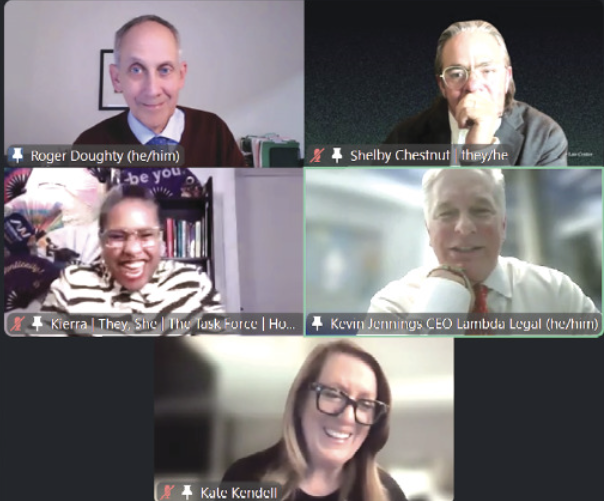
A prompt asking panelists to summarize the state of the LGBTQ movement in three words provided a compact map of contemporary sentiment. The Gill Foundation’s Kendell characterized the movement’s trajectory as “forward but murky.” She conveyed confidence that progress will continue, but warned that the path is obscured by volatility and noted that the speed and scale of recent changes require many of us to relearn the landscape—a testament to the crisis-driven transformation now underway.
Transgender Law Center’s Chestnut offered a more agency-centered perspective with the phrase “building trans power.” They pointed to explosive growth in youth organizing—exemplified by a spike in GSA (Gay Straight Alliance) clubs—as evidence that anti-trans attacks are catalyzing new forms of leadership rather than suppressing them. Their framing subtly repositioned the movement from defensive response to hopeful expansion.
The National LGBTQ Task Force’s Johnson deepened this point with the notion of a “leaderful” movement. Rejecting hierarchical models, she described a distributed ecosystem in which queer and trans people are central, not only within LGBTQ organizations but also across progressive movements. Her assertion that “no one was prepared” for the current onslaught reframed disorientation as a shared condition. The task, she argued, is not retrospective blame but rapid, collective preparation.
Lambda Legal’s Jennings injected a sharper, confrontational note with his summary—“kicking their ass.” His remarks emphasized litigation as an active battlefield and highlighted the fragility of legal protections under a far-right Supreme Court. Yet he underscored the symbolic power of even narrow wins, such as having a trans attorney argue recently before the court for the first time in history. His overarching theme was strategic realism: victory is difficult but possible, and each legal effort builds long-term capacity.
Shifting from diagnosis to strategy, Johnson critiqued the way “intersectionality” has often functioned as jargon. She saw a turn toward genuine intersectional practice: collaboration across labor, immigration, democracy protection, education, and care movements. Kendell offered a historical perspective, comparing today’s crisis to the AIDS epidemic and describing how activists, facing government mockery, built lifesaving infrastructure from the ground up. Movements have survived worse, she said, and carry “muscle memory” from past struggles. The message: draw strength from history, show up fully, and be able to answer, “What did you do?” when future generations ask.
Chestnut extended this analysis by describing the post-marriage-equality vacuum in which the trans community became the primary target before the movement had recalibrated. Their focus on material survival—housing, food, healthcare—signaled a shift from rights-based advocacy to broad community well-being. They added that recent progressive electoral wins show that campaigns can still succeed with pro-trans, pro-worker, and anti-poverty platforms, arguing that economic concerns drive voter behavior more than ideology. Progressives must therefore highlight economic issues and counter narratives that portray LGBTQ rights as zero-sum.
Jennings’ historical and financial analysis reinforced the need for generational planning. Citing decades-long conservative strategies and a Supreme Court likely to remain hostile for another generation, he stressed that the LGBTQ movement must rely on itself through sustained grassroots funding and legacy giving. “Let’s be really honest,” he said. “Corporations are fair-weather friends. Mainstream philanthropy? Excuse my language, [they] could give a s–t about LGBT causes. The reality is that less than 1% of foundation giving in this country goes to LGBT causes, and most of it comes from LGBT funders like the Gill Foundation and Horizons Foundation. So, the only people who are gonna save us are ourselves.”
Taken together, the discussion portrayed a movement under immense pressure yet undergoing profound strategic evolution—increasingly intersectional, materially grounded, historically informed, and oriented toward long-term power-building.
To watch the State of the Movement, go to https://bit.ly/4qTXnQj
Published on January 15, 2026











Recent Comments