




Greg Sarris is an accomplished author, scholar, and tribal leader who has dedicated his life to the preservation of Native American heritage, storytelling, and self-governance. He serves as the Tribal Chairman of the Federated Indians of Graton Rancheria and as the President of the Tribe’s Economic Development Board, such that his work is key to the Graton Resort & Casino in Rohnert Park that he helped create. Of Native American, Filipino, and Jewish descent, he was adopted at birth and has, for his entire adult life, lived openly as a gay man.

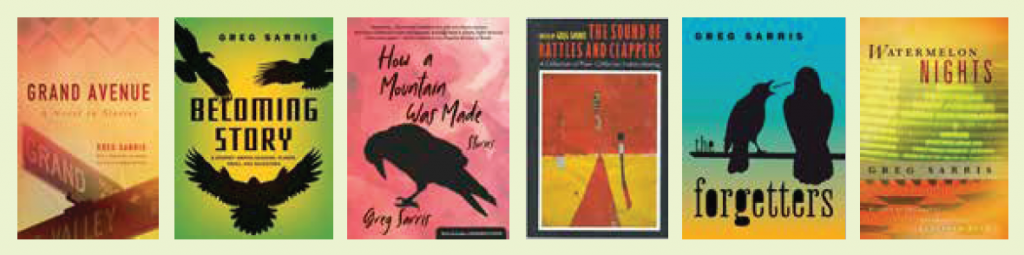
Given the demands of his tribal leadership work, he could solely focus on those efforts, but he is a prolific writer who has become a major voice in contemporary literature, film, and theater. He has authored widely acclaimed books, including the essay collection Keeping Slug Woman Alive and the short story collection Grand Avenue, which he adapted into an award-winning HBO miniseries co-executive produced by Robert Redford. His subsequent publications, such as Watermelon Nights, How a Mountain Was Made, and Becoming Story, highlight deep connections to ancestral places and oral traditions.
His creative contributions extend into public media, script doctoring with the Sundance Institute, and serving as the former Chair of the Board of Trustees for the Smithsonian National Museum of the American Indian. He currently serves on the UC Board of Regents and on the Sundance Institute Board. (Still more information about Sarris’s incredibly multifaceted work is at: https://www.greg-sarris.com/)
A New Sprawling Epic
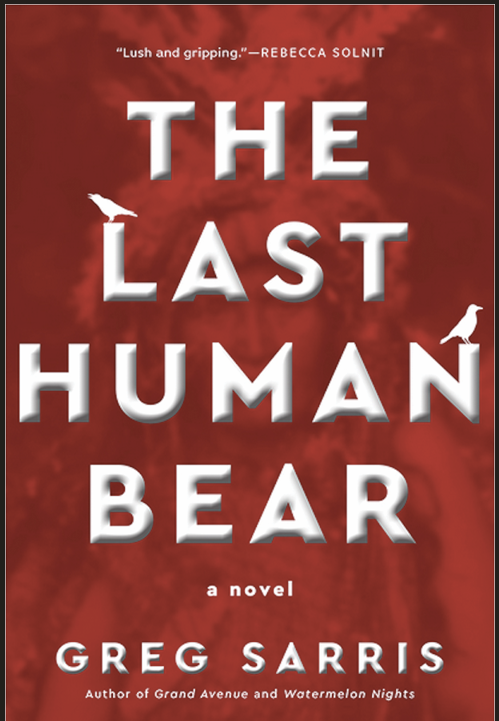
His latest novel, The Last Human Bear, is his third and is a highly anticipated work given that his previous novel was published 28 years ago. The Last Human Bear is a sprawling epic centered on Mary Hatcher, a young Native Pomo woman coming of age in 1930s California who grapples with a haunting and mysterious family legacy. Rumors surround Hatcher that her stepmother has passed down the ancient, inescapable ability to shapeshift into a “Human Bear”—a formidable being capable of menacing and poisoning its enemies.
Spanning from the Great Depression well into the twenty-first century, the novel follows Hatcher as she tenaciously carves out her independence while passing between Native and non-Native societies. As she navigates complex romantic entanglements and the shifting dynamics of both inherited and chosen family, she is constantly pursued by the internal fear of whether her inherited power dooms her to cause harm, a journey that ultimately culminates in a haunting final act.
Dedicated to His Mothers
The details of Sarris’s own life read like a novel, and one marked by great achievements along with tragedy. He dedicates the book to his birth mother Bunny Hartman, who was from a wealthy family but just 17 and unwed when she had him and died shortly thereafter following a transfusion of the wrong blood type. The name of Sarris’s father was not included on his birth certificate.
In the early 1980s as a graduate student at Stanford University, Sarris learned that his biological father was Emilio Arthur Hilario. Hilario was of Filipino, Miwok, and Pomo descent. One of Hilario’s relatives on his father’s side, Tom Smith, was a well-known Pomo and Coastal Miwok healer.
Sarris also dedicates the book to Mary Mape, who, with her husband George, adopted Sarris shortly after his birth. The couple later had three biological children. George was an alcoholic and abusive toward his adopted son, who was sent to live with various foster families, including some who were Native American. At the age of 12, Sarris met Pomo basket weaver Mabel McKay, who taught him about American Indian customs and tradition.
Strong women figure prominently in Sarris’s novels, and The Last Human Bear is no exception.
Excerpt From The Last Human Bear
Sarris’s latest work begins:
“I’m curious why you want to know about me. The Indians would say anyone listening to me got a lot of nerve, especially the old Indians. No end to the stories they’ll tell you about me and my numerous and abominable crimes.
The latest being I put a spell on John Benedict and evened the score after all these years. That’s what my sister’s granddaughter Darlene claims, and she ain’t even one of the old-timers. Yeah, Darlene claimed I done nothing less than expected: poisoned. Poisoner, it’s what Indians here call a witch.
The detective didn’t believe it. Laughed, said John Benedict was old, ninety plus. Natural causes, what else. Wouldn’t laugh, say the old Indians. Wouldn’t laugh if he knowed what we know about this woman who calls herself Mary Hatcher. No, sir, wouldn’t laugh at all, not if he knowed she was a poisoner, but a poisoner of the worst kind, a Human Bear.
Me, I want to die. Or at least be able to. That’s why I’m talking. You see, that’s the agreement; I can’t go until I pass on this business. That’s the way it is for us kind of people. But as you’ll see, I’m the last link. I have no cape, no bearskin, to turn over to you. All that’s left is a story.
Here’s my predicament: What if the story stops with you? What if what I say falls on deaf ears? Still, a story has life, even if it’s slammed between the covers of a fat book; and if that’s true, then I only hope listeners will treat my story fair.
Understand, I’m not talking to plead my innocence, not in the death of John Benedict or whatever else I’m supposed to have done. No, sir. Neither am I tricking you, though I know that’s the way it is with poisoners.
I told you up front what I am and why I’m talking. I will say John Benedict figures in the story. He figures strong. Ha! A white man at the heart of an Indian’s story. But if I understand anything, it’s that the heart has no limits. It’s everywhere. At the same time, it’s no bigger or lesser than anything else. The hair on a man’s arm, for instance. You could trace things from that until you seen the web that is this world.
Funny, folks used to say a good poisoner is someone born with a broken heart. That wasn’t the case with me. I wasn’t born that way. Of course, you might not believe that. Not from her that’s got hell’s songs in the hollow of her throat. But try. That’s where the story starts.”
The first two chapters may also be read at https://bit.ly/4gxfWIa
Readers who continue will be transported to migrant field worker camps, Depression-era rancherias, and cinematic Sonoma landscapes as the life journey of Hatcher unfolds and reveals the loss of old Native cultures in the face of a slow genocide. The indelible final act, in which Hatcher must unburden herself in order to die, is gripping and thought-provoking.
See Sarris in Person
Sarris is participating in a number of readings and interviews concerning his latest work at several bookstores throughout the Bay Area over the next several months. He will be in San Francisco at City Light Books on July 23, and in Oakland at Clio’s Books on July 30. For more information about these and his other appearances, go to https://bit.ly/44Ub5JN
Arts & Entertainment
Published on July 16, 2026









Recent Comments