









By Dina Novarr—
In Bombay, Diwali comes with a debt. A neighbor shows up at your door with a plate of sweets, and, by nightfall, you owe her a plate back: Kaju katli for her besan ladoo, or gulab jamun for his barfi. Nobody keeps a spreadsheet, but everybody knows who’s been delinquent.
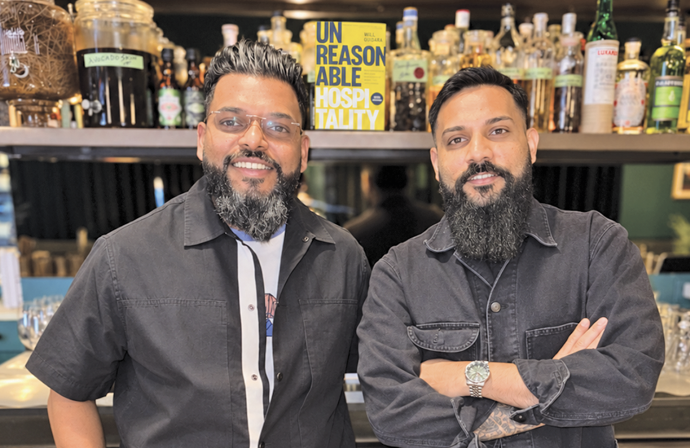
“You walk through the neighborhood and you can smell everything being fried and baked,” says Roger Gomes, who grew up participating in what might be the sweetest form of neighborhood diplomacy. Roger now runs Tiya, a modern Indian restaurant in San Francisco’s Marina District. “If you open a box of mithai right now, it takes me straight back home.”
That plate of sweets only works if someone brings it. And, in San Francisco, many of us celebrate a long way from the neighbors who taught us how. Some left home for school or work. Some left because home didn’t have room for who we are. Either way, the plate doesn’t show up on its own.
So, we build new neighbors and families. And, occasionally, we build a cocktail that tastes suspiciously like dessert.
If you’ve been calling Diwali “Indian Christmas,” we need to talk. There are no reindeer and no Santa, but there are considerably better sweets. Diwali, or Deepavali, means “row of lamps.” It falls around the new moon of the Hindu lunar month associated with Kartik in many North Indian traditions; other regional calendars use different month names. In 2026, the main celebration falls on Sunday, November 8. Festivities will begin Friday with Dhanteras, when families will clean their homes and traditionally purchase metal objects for good fortune. Sunday will bring Lakshmi Puja, when homes will glow with clay oil lamps called diyas and doorsteps will bloom with rangoli, intricate patterns made from colored powders, rice, and flower petals.
Celebrations continue with regional observances, including Gujarati New Year and Bhai Dooj, which honors the bonds between siblings. Diwali doesn’t have one tidy origin story, either. In North India, it celebrates
Rama’s return to Ayodhya after 14 years of exile, his path illuminated by rows of lamps. In parts of South India, Krishna’s victory over the demon Narakasura takes center stage. Jains commemorate Mahavira’s liberation, while Sikhs observe Bandi Chhor Divas, celebrating the release of Guru Hargobind.
Getting an entire subcontinent to agree on one origin story was apparently too ambitious. Getting everyone to celebrate was much easier. There are different gods, different heroes, and different regions, yet there is a shared invitation: Light something, share something, celebrate. And, if the occasion calls for sweets, nobody needs convincing.
Izler Thomas knows something about leaving home. When Gomes first asked the young bartender to move from Bombay to Delhi for a job, Thomas’s older brother called in a panic. “Roger, are you sure? He’s never stepped out of Bombay.”
Gomes was unimpressed by the protective-brother routine. If Thomas didn’t venture out and learn to survive on his own, how would he survive anywhere? Besides, Gomes had people in Delhi. They would look after him.
Thomas went.
Today, at 27, Thomas is the beverage director at Tiya and was named Eater San Francisco’s 2024 Bartender of the Year. It’s an impressive trajectory for someone whose brother once worried about letting him leave Bombay.
Ask Thomas about the recognition, however, and he redirects the spotlight to his team: Gomes, teammates Sourabh Patil (affectionately known as “Sour”) and Umesh, and their friend Siddhant.
“We are the A-team,” he says, describing a lineup that looks like the Indian Avengers assembling in the Marina.
Gomes naturally would be casting himself as Nick Fury. Apparently, once you’ve followed a man from Bombay to Delhi and landed on the same team in San Francisco, you stop questioning his superhero casting decisions. Underneath the Marvel references is something more meaningful: a family built one shift, one service, and one shared ambition at a time.
San Francisco knows a thing or two about improvised families. It is a city of immigrants, transplants, and artists who arrived with two suitcases and the conviction that somewhere, surely, there had to be room for them. Some came for careers, others for love, and still others because being themselves back home required an exhausting amount of negotiation.
For the LGBTQ+ community, chosen family can mean far more than a social circle. It’s the people who show up when relatives don’t, who make space at their tables, who remember your birthday and ask whether you’ve eaten.
In San Francisco, finding six friends available on the same evening can require a Doodle poll and three weeks’ notice. Diwali’s tradition of opening your home and sharing what you have feels practically revolutionary.
At Tiya, this particular chosen family has found a deliciously unconventional way to keep those connections alive.“We won’t eat the sweets,” Thomas says, “but we’d be more than happy to drink them.”
Indian sweets here aren’t necessarily destined for a silver platter. Sometimes they end up in a mixing glass. When the kitchen once served a besan barfi opera cake, Thomas noticed the cooks discarding the trimmings. Rather than let a perfectly good dessert meet the trash, he asked them to hand over the scraps. The result was a cocktail built around chickpea-flour fudge, chocolate, and whiskey—a marriage of pastry-shop nostalgia and barroom ingenuity that avoids becoming cloyingly sweet.
There’s something wonderfully fitting about that origin story. A cook passes along something that might otherwise be discarded. A bartender transforms it. What began as a kitchen leftover becomes something worth sharing. The neighborhood sweet exchange has simply acquired a liquor license.
For his part this year, Thomas has shared a recipe for his Besan Barfi Old Fashioned, a spirited reinterpretation of a traditional Indian sweet. The basic idea is delightfully indulgent: bourbon meets ghee, chocolate-layered besan barfi, demerara syrup, and aromatic bitters. The combination brings together the nutty, buttery character of Indian sweets and the familiar warmth of an Old Fashioned.
The secret is fat washing, a technique in which flavorful fat is mixed with alcohol, chilled until the fat solidifies, and then strained away. The bourbon retains some of the fat’s flavor without becoming a glass of melted butter. Think of it as sending your whiskey to an indulgent spa, followed by a cold plunge. If you’re wondering whether your grandmother would approve of putting perfectly good barfi into bourbon, that’s a conversation best had after the first round.
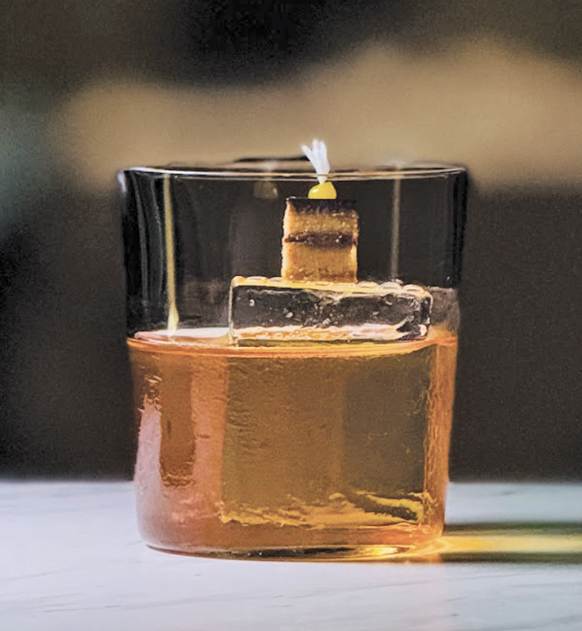
Besan Barfi Old Fashioned
Recipe by Izler Thomas, Tiya
For the Premix
(approximately six servings):
375 ml (12.7 ounces) bourbon
30 ml (about 1 oz) demerara syrup
20 ml (about ⅔ oz) Angostura bitters
75 g (a little over 2 1/2 ounces) ghee
40 g (about 1.5 ounces) chocolate-layered besan barfi, plus small pieces for garnish
1. In a lidded, freezer-safe container, combine the bourbon, demerara syrup, and bitters.
2. In a small saucepan over low heat, gently melt the ghee with the besan barfi, stirring until well combined.
3. Pour the warm mixture into the bourbon and stir thoroughly with a bar spoon. Cover.
4. Freeze for approximately 12 hours, or overnight, until the fat has solidified.
5. Remove the solidified fat from the surface, then strain the liquid through
a nut-milk bag or fine filter until no visible solids remain.
6. Pour 2½ ounces of the premix over a large ice cube in an Old Fashioned glass. Garnish with a small piece of besan barfi.
(Note: Thomas recommends using the recovered fat for no more than one additional batch. Keep the preparation refrigerated after filtering and follow appropriate food-handling precautions.)
Listening to Izler and Roger reminisce, I realized there’s something beautifully impractical about Diwali. People spend days preparing food that will be given away, clean their homes only to fill them with guests, and light tiny lamps against an enormous darkness, knowing perfectly well that one little flame can’t illuminate an entire street.
And they do it anyway.
One diya flickers, smells faintly of ghee, and illuminates roughly the square foot it’s sitting in. A row of them changes the whole street. That’s the mathematics of Deepavali. It was never about one lamp.
Gomes puts it another way. Festivals exist to bring people together, and bartenders exist to turn an evening into a memory.
“If some cocktail can do that,” he says, “why not?”
San Francisco-based Dina Novarr enjoys sharing her passion for fine wines, spirits, non-alcoholic craft beverages, and more with others.
Cocktails with Dina
Published on November 5, 2026















Recent Comments