






By Jan Wahl—
Lloyd Bridges is trying to stop a crash in the 1980 movie Airplane! His life flashes before his eyes as he deadpans, “Looks like I picked the wrong week to quit sniffing glue.” It’s the kind of movie line that all of us can relate to, okay, not all of us, but me.
Some movie lines just stay with us.
When “Bad Girl” Rita Hayworth describes herself in Gilda (1946), she lets us know: “If I was a ranch, I would be the Bar Nothing.” Yet another tough gal, Jan Sterling, in Ace in the Hole (1951), had a zinger befitting her character. When Kirk Douglas says to her, “What’s the matter with you? Don’t you ever go to church?” She replies, “Nah. Kneeling bags my nylons!”
I’m totally aware it’s the writers who carve these gems of our language, but the actors breathe life into them. Comedy is so often made better by these zingers. For example, in the marvelous The Man Who Came to Dinner (1941), Jimmy Durante says to nurse Mary Wickes: “Meet me upstairs in five minutes and don’t forget the rye bread.” By itself, it may not be funny, but when said by Durante, I guarantee you’ll laugh!
Song lyrics are a great place to put in unforgettable lines. In Blazing Saddles (1974), Lili Von Schtup (Madeline Kahn) sings: “I’ve been with thousands of men, again and again, they sing the same tune. They keep coming and going, and going and coming, and always too soon, right girls?”
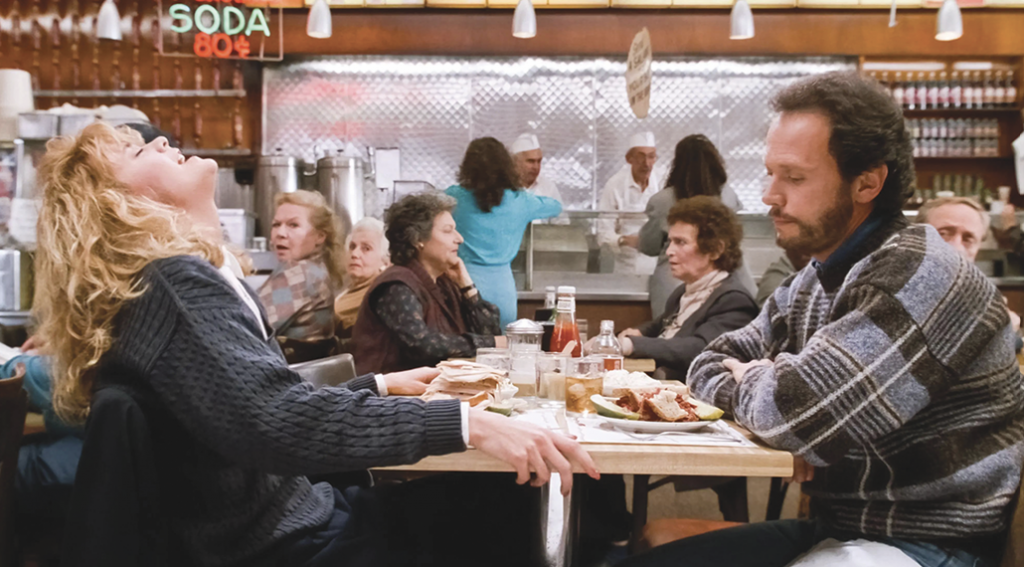
The late great Rob Reiner had his mother, Estelle Reiner, utter one of the best and most memorable lines of When Harry Met Sally (1989), which he directed. Watching Meg Ryan fake an orgasm in a deli, Estelle as an onlooker says, “I’ll have what she’s having!”
Often a catchy putdown finds its way into movies. In Dames (1934), secretary Joan Blondell kicks out a pushy woman by saying, “Get out of here, Duchess. As long as there’s a sidewalk, you’ll have a job!” Mae West made a career of lines like this: “Is that a pistol in your pocket, or are you just glad to see me?” and, “I used to be Snow White, but I drifted.”
It may seem as if the older stars in movies are easier to quote, but, when dialogue was more important than action, it gave us more to choose from. Take two movie romances that make it easier to be seductive: Casablanca (1942) with its “Here’s looking at you, kid,” and Bette Davis in Now, Voyager (1942): “Let’s not ask for the moon; we have the stars.”
Nobody does character descriptions like classic Hollywood. In Singin’ in the Rain (1952), Cosmo Brown sums up Lina LaMont: “Can’t act, can’t dance, can’t sing … a triple threat.” Carole Lombard was once asked about Clark Gable in bed: “They call him the King of Hollywood, but one inch less and he would be the Queen of Hollywood.” It didn’t make the movie cut, but you get the idea. Far more poignant is Tootsie’s (1982) Dustin Hoffman confessing to Jessica Lange, “I was better with you as a man pretending to be a woman than I ever was as a man.”
Alcohol and drugs often make for good comedy writing. In 1962, television’s ultimate playboy Jackie Gleason quipped, “Drinking removes warts and pimples. Not from me. But from those I look at.” Humphrey Bogart, trying to make a Time magazine interviewer understand him, said, “There’s only one trouble with the world. We’re all one drink behind.”
Words are the best way stars can describe their view of Hollywood. Ethel Barrymore told a reporter, “The people are unreal here, the flowers are unreal, they don’t smell; the fruit is unreal, it doesn’t taste of anything. The whole place is a glaring, gaudy, nightmarish set built up in the desert.” Warren Beatty still believes Hollywood is a place where you can make an entire career out of baloney, and Marlon Brando called it “a cultural boneyard.” But the most famous description ever comes from Oscar Levant: “Strip the phony tinsel off Hollywood, and you’ll find the real tinsel underneath.”
Jan Wahl is a Hollywood historian and film critic on various broadcast outlets. She has two Emmys and many awards for her longtime work on behalf of film buffs and the LGBTQ community.
Off the Wahl
Published on July 30, 2026









Recent Comments