










By Gary M. Kramer—
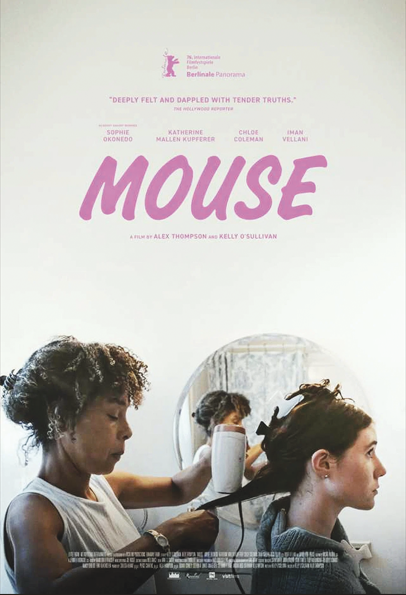
Mouse, opening November 13 in the Bay Area, isa moving drama about Minnie (Katherine Mallen Kupferer), who loses her best friend, Callie (Chloe Coleman), the summer before her senior year of high school. To cope, Minnie spends time with Callie’s mother, Helen (Sophie Okonedo), and their heart-to-heart chats provide connection through loss as well as a mother-daughter relationship each of them is missing.
Minnie also meets Kat (Iman Vellani), a potential girlfriend, who helps her process her grief and have some good times. These bonds, as well as a musical tribute Minnie prepares for Callie, help the awkward teenager find her voice. Mouse hits all the right emotional notes as the characters grapple with their feelings. Okonedo and Kupferer are fantastic, and out actor David Hyde Pierce provides strong support as Minnie’s drama teacher.
Co-directors Alex Thompson and Kelly O’Sullivan spoke with me for the San Francisco Bay Times about their powerful new film.
Gary M. Kramer: What were you like as teenagers? And what was your relationship like with your mother or parents?
Alex Thompson: I love this question! Go first, Kelly.
Kelly O’Sullivan: I was a huge theater kid. I did all the plays and musicals and competitive speech. My relationship with my parents—I don’t know that I was rebelling, but I definitely went through a period of hating authority, and I am still not over it. I think my mom and I fought a good amount.
Alex Thompson: It seems like part of growing up was to hate your parents, but I really resisted that. I was a big theater kid too. My middle school did not have a theater program. I was an amazing student, extremely precocious, and read way too many books, but then I just did not do anything. I made movies for every assignment. My parents were worried about me. I starting to become the kid from The Goofy Movie, pushing away, wanting privacy, and that felt anathema to the big happy family that I had grown accustomed to. I have a very positive relationship with my parents now, though. They were very patient with me. I did find an outlet in middle school. The orchestra would do themed concerts, so I would dress up like Elvis. This was my theater outlet, which saved me.
Gary M. Kramer: What prompted you to tell this story of grief and loss, and create the characters of Minnie and Helen? Can you discuss developing the surrogate mother/ daughter relationship between Minnie and Helen? It helps and hurts both of them.
Kelly O’Sullivan: I was really interested in the idea of a character, Minnie, who feels like an understudy in her own life. I moved away from that, and I was curious about what happens to two people who are so defined by one person, Callie, when that person is taken away from them. They lean in and collapse into each other. Alex and I talked about how Minnie and Helen are both outsiders in this community for different reasons. Minnie has always been Callie’s sidekick, but Helen comes from a totally different place. She is a British woman, a classically trained pianist, who came to Arkansas to have a family. When that family falls apart, she becomes an outsider again.
Gary M. Kramer: What can you say about creating the tone of the film, which is melancholy but hopeful?
Kelly O’Sullivan: It is really important that, in all of my writing, comedy is just as present as melancholy and drama. It is how I deal with the world; I deal with hard times through humor. That’s integral to how I think about a story, especially when it comes to absurdity. The funeral photos sequence, and the whole talent show—everyone means it so much that it almost borders on the absurd.
Alex Thompson: With Saint Frances, our first film, the ethos was to get out of the way of the script because there were opportunities for catharsis as well as humor. You could sneak in more cinematic language as long as the audience didn’t feel manipulated. At the end of the day, the rule was: “Stay out of the way of an authorial visual flair.” We wanted to create a sneakier depiction, to indirectly guide the audience rather than be too prescriptive on how the audience should feel. I don’t like movies where I can tell this is the scene I’m supposed to cry or laugh. We don’t have to make a big pivot for a joke; it can just exist in the scene.
Gary M. Kramer: Can you talk about the idea of healing through theater, which was also a component of your previous film, Ghostlight?
Kelly O’Sullivan: Theater is an outlet for expression. Theater in Ghostlight versus Mouse is that it is a successful outlet for the lead character in Ghostlight, but, for Minnie, it sort of is not working. Her big performance at the end is an outlet, but she’s trying to be someone else and she discovers she can’t be. The way I thought about theater in Mouse was that the drama teacher, Mr. Murdaugh, is somebody who can really see her and sees what is going on between her and Helen and that it might be costing each of them in ways they don’t totally realize. He is a place of safety and comfort. In Mouse, theater was Callie’s world, where she excelled. Minnie tries to fit in, and it is not a great fit.
Gary M. Kramer: The film is about living in the past and the present and looking to the future. What observations do you have about memory and moving forward?
Alex Thompson: When we were filming Callie, we wanted these images of her to stay with the audience. You don’t know this is the last time you would see this person. So, we lingered on her back when she turns away from Minnie in the sleepover scene or the way Minnie watches her singing “Everything Is Coming Up Roses” with light streaming through the window in the living room.
When my grandmother passed away, I had this thought—the minute she becomes nonverbal, the memories will stop. It will all be memory. There will be no new memories. The excavation you find yourself in when someone is gone [is that] every little thing has potential to be the most meaningful thing, but it is never enough. We wanted to create the sense that Callie is resonating through the whole film.
Kelly O’Sullivan: It was important not to sanctify memories of people or have this memory of the person who is going to take on this angelic quality. The community starts to do that in Mouse. It is more satisfying and painful but also joyful to remember the flawed people they were and preserve the real people rather than the temptation to make them out to be holier than they were.
Gary M. Kramer: Minnie obviously wants to be a substitute for Helen’s daughter. What are your thoughts about their relationship?
Kelly O’Sullivan: I really see why all the people in the film take the actions they do. Minnie comes from a household where her mom is stretched so thin. You see why Minnie wants to go to this aspirational place of Helen’s house, which is dedicated to Callie. It makes sense why Minnie wants Helen as her mom. When they do become more like mother and daughter, that is when things start to break apart. Minnie feels what it is like to be Helen’s daughter. It comes with a lot of pressure and expectations that she can’t fill. I have so much sympathy, and love characters and why they do what they do. I felt that way in high school. It took the wisdom of age that my parents are awesome, and I’m grateful for them.
Alex Thompson: We talked a lot about this. When you are young, you rebel against the things you have. I had a great house, and I wanted to go to my friend’s house because he was allowed to watch PG-13 movies and I wasn’t. There is a part of Helen that sees something familiar in Minnie as it relates to Callie—not just that Callie was the center of their world, but that they were different than Callie. Helen talks about how [her husband] Mark (Christopher R Ellis) and Callie have this charisma that she and Minnie don’t have. There’s a familiarity that, in a less tragic setting, they would be able to emphasize with one another on a personality level, that either could be the titular mouse.
Gary M. Kramer: Why did you make Minnie queer? It tracks, and her budding relationship with Kat helps her cope and grow. I was moved by the line Kat says to Minnie, “I want you to know me without her.”
Kelly O’Sullivan: When I was writing the story, and first thought of Minnie, I instinctually knew that she was queer. Minnie doesn’t quite know who she is. She doesn’t have the clarity of thought that she is queer until she meets Kat. There are little hints in the beginning when she and Callie share a look when Mr. Murdaugh is being talked about as being gay. It just made so much sense when she and Kat find each other. Kat is not Callie. Callie was a straight person with a boyfriend and Minnie is not. Minnie is going to go live a totally different life than what Callie was going to live and it is part of her differentiating herself from Callie in that she is her own person with her own sexuality.
Gary M. Kramer: Minnie is smart but has very little self-worth. “No one has believed in me,” she says at one point. She finds her voice by connecting with Helen and Kat and even Mr. Murdaugh. What was your intention with how she blossoms over the course of the story?
Kelly O’Sullivan: The arc was that she tries as hard as she can to fit herself into this mold and, over the course of singing the song, she sings it for herself. It is an act of heroism, and there is something bold about Minnie putting herself on stage in a vulnerable position ready to be looked at for the first time as herself. She starts to admit to herself what she wants. She starts to claim exactly what she wants.
Alex Thompson: I don’t know that I believe Minnie’s statement that no one has ever believed in her at face value. I don’t know that she knows how much [her mother] Barbara (Tara Mallen) and Callie believe in her. But that’s what being that age is. Growth can be as simple as piecing together your identity and understanding preference or the tiniest glimmer of sexuality. I love how tentative those steps are and how small that arc can be while still being satisfying.
© 2026 Gary M. Kramer
Gary M. Kramer is the author of “Independent Queer Cinema: Reviews and Interviews,” and the co-editor of “Directory of World Cinema: Argentina.” He teaches Short Attention Span Cinema at the Bryn Mawr Film Institute and is the moderator for Cinema Salon, a weekly film discussion group. Follow him on IG @garyemkramer
Film
Published on November 5, 2026















Recent Comments