




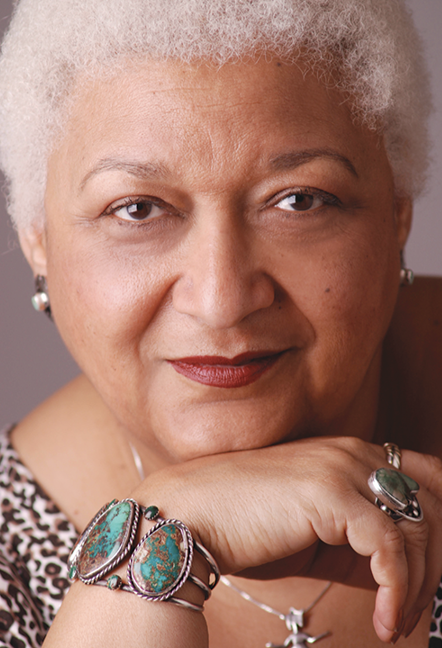
By Jewelle Gomez—
I’ve been a cat lesbian all of my life, until several years ago when our last sweetie left us. We made it through the pandemic without succumbing to the puppy impulse, but my spouse thought she’d like to work with a therapy dog in hospitals with young patients. There’s a rigorous training, but it seemed just the thing for a retired health care provider.
So, two years ago we adopted what we thought would be a medium-sized dog, but she’s currently sixty pounds and as strong as a dray horse. A standard poodle, she’s affectionate, smart, and I’m pretty sure she speaks three languages: English, French, and ASL.
The difference between having a cat and having a dog companion is significant. Felines are kind of private beings; most urban cats don’t go outside or interact with cats not of their household and are fairly content to entertain themselves.
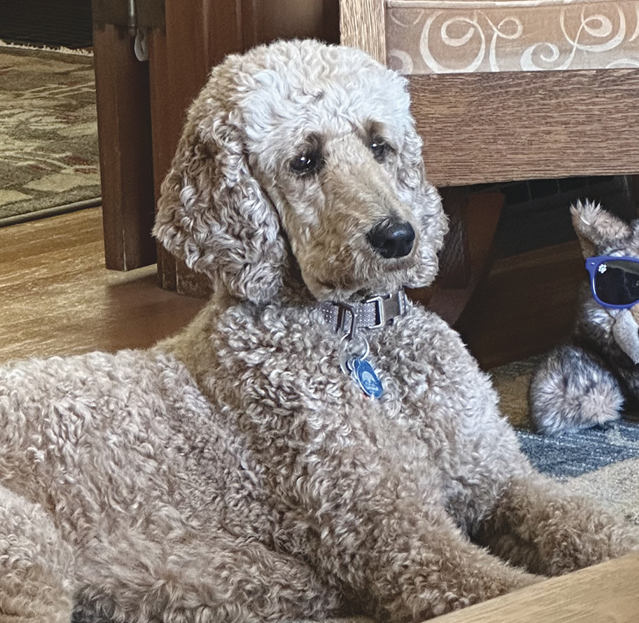
Dogs, being pack animals, require company. So, our dog gets to play with her “cousins,” the dogs of my sister-in-law who lives nearby. And, since my spouse and I are in our seventies not our twenties, she also goes to the Dog Social Club Collective (https://dogsocialclub.com/) a couple times a week. It’s an Oakland nonprofit that provides hours of outdoor play and walks with Elijah who handles a large pack of dogs who are learning their “Ps and Qs” with the expertise of an Iditarod musher. And yes, of course, our puppy is the best, most beautiful dog … yadda, yadda, yadda.
I didn’t come to this appreciation easily. Growing up, I watched Southern sheriffs on the TV news use huge German shepherds to brutalize Civil Rights activists—adults and children. When I was about thirty, a large rescue Doberman broke free from his human and lunged at me, leaving scratches, bruises, and skittishness, but no major physical damage. Another time a perverse guy let his Rottweiler jump against a chain link fence to intimidate me. Odd the things that men think are impressive.
Despite this history, I’ve come to feel such a connection to our (huge) puppy that I understand the depth of care it takes to serve a dog companion well. Along with that, I appreciate the world of humans she’s opened up for me.
I’ve discovered that most dog people are interested in each other and their dogs. Folks stop on the street to talk to others walking their dogs. It doesn’t matter what breed of dog, and, just as importantly, it is irrelevant who the dog’s companion is at the other end of the leash. The other day, a young woman in a tailored suit pulled up to the Social Club to collect her pup. On her face was the scowl of someone who knows she should be on a business call and knows her boss knows she’s not there. But when a dog—not even her own—bounded out toward her, all the tension evaporated.
I stopped trying to list the innumerable varieties of folks I’ve seen chatting to each other on the street and in parks about their dogs and (happily) it’s a MAGA nightmare. I don’t imagine they’re discussing immigration or taxes or queerness. But they could be if they gave each other a chance to be heard. They also made sure their voices and temperatures didn’t increase enough to irritate their dogs. I know that, if we can love all different kinds of animals, we could love all different kinds of people.
Jewelle Gomez is a lesbian/feminist activist, novelist, poet, and playwright. She’s written for “The Advocate,” “Ms. Magazine,” “Black Scholar,” “The San Francisco Chronicle,” “The New York Times,” and “The Village Voice.” Follow her on Bluesky, Facebook, and IG @vampyrevamp
Leave Signs
Published on February 12, 2026









Recent Comments