




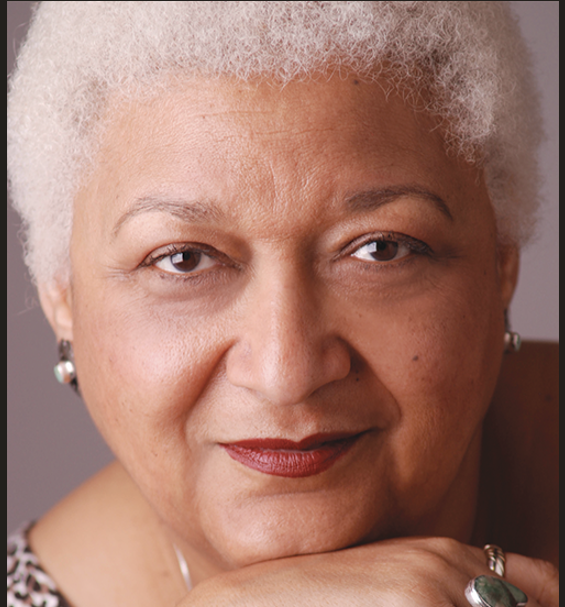
By Jewelle Gomez—
My most favorite thing to read is detective fiction; unlike life, it almost always has a satisfying resolution to the mystery. This has been true for me since I got my first library card and haunted the Bookmobile, which arrived in my tattered neighbourhood every Thursday at 4 pm. It wasn’t until I was much older that I realized I missed seeing myself (colored and queer) in the stories.
Then I read Valerie Miner’s Murder in the English Department (1983). Minor’s breakthrough novel drew ire from some for its depiction of a not-so-perfect, intrepid, acerbic lesbian professor in Berkeley fighting misogyny to gain tenure then fighting against a murder charge. The women’s movement still felt too fragile to reveal our flaws. Then came Sarah Schulman’s murder mystery, After Delores, (1988) taking place in San Francisco. But a few short years and a more noirish setting made us embrace her funny and unpredictable characters.
I also like television murder mysteries, preferably with a British accent. But finding queer people of color in either medium hasn’t always been easy. Cheryl A. Head’s Motown lesbian detective series continues with Find Me When I’m Lost, and proves that ex-lovers can be a pain no matter how mature we are. In addition to murder, the book explores how complicated loyalty can be.
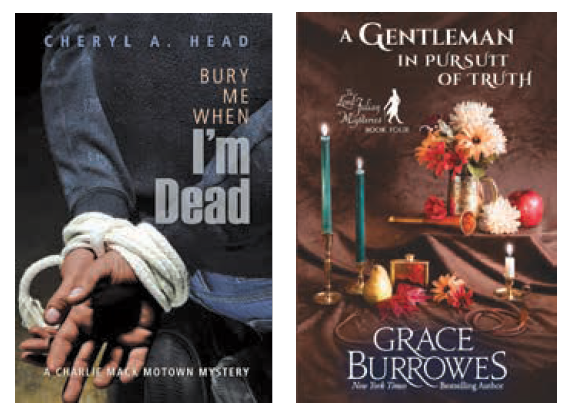
In this era spotlighting police brutality, it’s great to read Penny Mickelbury’s series about an urban Hate Crimes Unit led by a lesbian lieutenant who works with her Black journalist partner and experiences a hopeful perspective on policing. Mickelbury, who is also a playwright, has several detective series, but the most recent in this series, You Can’t Die But Once, is my fave.
Lately, though, I’ve been reading mostly period mysteries as part of my research for my next novel that takes place in Victorian London and features people of color, criminals, and queer people. So, it’s been a lovely surprise to bump into queer characters in commercial Victorian era mysteries when I’ve not been expecting them. There hasn’t been as much luck in finding lesbians in mainstream mystery novels from this time period except what one can extrapolate when a woman is called a “bluestocking,” meaning she reads, supports social reform, rides a bicycle, and regularly attends political/literary salons.
Gay men seem to pop up more openly. Recently, I read a series by Grace Burrows, who generally writes historical romance, but her “Lord Julian” series features a physically and psychologically damaged titled soldier returning from fighting Napoleon who uses his tracking and deduction skills to solve mysteries in his country village. In several of the volumes, his brother, a Duke, appears; he’s the nearest thing to a king in the rural environs and is also a deeply closeted gay man. Number 4 in the series is delicately written as Lord Julian faces down a brutal blackmailer and reinforces the value of the love between the Duke and his longtime paramour, a country squire. It also spares no anxiety about what these two titled and entitled lovers must do to avoid complete censure (at best) in their community or the hangman’s noose (at the worst).
Another surprise for me was the “Colin Pendragon” series by Gregory Harris in which he cleverly calls to mind the quick-witted preternaturally gifted detective Sherlock Holmes and his chronicler, Dr. Watson. In this six-book series, however, Colin Pendragon is erudite, handsome, not a drug addict, and is unapologetically in love with his companion Ethan Pruitt. You can tell that as soon as they step into the same bathtub together. All these books are readily available, but the author seems not to be creating any more.
Each year when we march there’s always a sign that reads, ‘We Are Everywhere.’ And the truth is we are and we were from the beginning of time—rich, poor, of any ethnicity—we can always be found.
Jewelle Gomez is a lesbian/feminist activist, novelist, poet, and playwright. She’s written for “The Advocate,” “Ms. Magazine,” “Black Scholar,” “The San Francisco Chronicle,” “The New York Times,” and “The Village Voice.” Follow her on Instagram and X @VampyreVamp
Leave Signs
Published on July 16, 2026









Recent Comments