




By Stuart Gaffney and John Lewis—
For decades, the City of San Francisco and the State of California have led the way to ensuring that places open to the public are smoke-free. We’ve collectively done so to protect people from the now indisputable harms of secondhand cigarette smoke. According to the Centers for Disease Control (CDC), over 480,000 people in the United States still die from the effects of cigarette smoking annually, with over 41,000 people losing their lives from the effects of secondhand smoke.
Through our elected officials, Californians have passed laws that mandate that our workplaces, hotels, children’s playgrounds—and indoor restaurants, cafés, and bars—are all smoke-free. State law also ensures that everyone may ride public transit without being exposed to secondhand smoke, both on the vehicle and while waiting at a bus stop or on a train platform.
In San Francisco we’ve gone further, with our Board of Supervisors in 2010 voting unanimously to mandate that all San Franciscans have smoke-free access to nearly all spaces open to the public across the city—whether it be while having a meal on a restaurant patio, taking a walk in the park, going to the farmers’ market, or waiting in line at an ATM. You can’t smoke while playing a round of golf on a public course, fishing off the pier, or taking in the view of Alcatraz from Fisherman’s Wharf. Public housing is smoke-free, and common areas of multi-unit residences are as well. The laws are so comprehensive that you can’t even smoke in a tobacco shop or at a charity bingo event. Under city and state law, vaping is also prohibited in smoke-free public spaces.
We know firsthand the harms of being exposed to secondhand smoke daily in our lives, not only in the apartment building where we lived for 25 years and at the office, but in public spaces as well. And we know what a difference it makes to be free from it now nearly everywhere in the city.
But there’s a glaring exception to these life-saving smoke-free laws: patios at bars and taverns are not covered. A new ordinance, introduced on April 7, 2026, by Supervisor Myrna Melgar and co-sponsor Supervisor Danny Sauter, would close that gap. Over 50 Bay Area cities, including Oakland and San Jose, already have laws ensuring these venues are smoke-free. It’s time for San Francisco to join them.
Particularly powerful evidence supporting Melgar’s ordinance is the scientific research documenting how unhealthy the air quality is in bar patios where smoking is permitted. A 2022 UCSF study, cited in the ordinance’s official findings, found that “six of the nine bar patios visited” for the research “had peak readings in the EPA ‘unhealthy’ air quality range, or higher,” and one patio, where cigar smoking was allowed, “registered in the ‘hazardous’ range.”

If we as a city protect our citizens from secondhand smoke in wide open outdoor spaces such as parks, golf courses, and city wharfs and piers—often sparsely occupied and subject to San Francisco’s famous fog and wind—it makes no sense to subject people who simply wish to go to a bar with friends and enjoy the outdoor patio to demonstrably unhealthy and sometimes hazardous levels of secondhand smoke. And it’s particularly harmful to bar employees, who are exposed to such smoke for hours on a daily basis and who may fear losing their jobs if they speak up for nonsmoking laws.
Particularly compelling, too, is the fact that we as a city already ensure that people may dine smoke-free at any restaurant or café with a patio or other outdoor eating space. If smoking is prohibited in these spaces—after all, a cigarette after dinner or smoking in a café while sipping coffee and reading (or writing) a great novel was once considered sacrosanct—it makes no sense to permit it at bar patios.
We understand how some bar owners may be particularly resistant to this change. Melgar’s ordinance acknowledges that many businesses feared that the city’s groundbreaking 1994 smoke-free legislation to protect workers from secondhand smoke would cost them customers. But, 32 years later, whether or not a business makes it in San Francisco has nothing to do with the 1994 ordinance. The city remains a culinary paradise and nightlife hub, with residents and visitors alike flocking to its innumerable eateries, clubs, and bars, even though they can’t smoke inside any of them.
Finally, the effect the new ordinance will have on future generations is perhaps the most compelling reason to pass Melgar’s legislation today. The ordinance notes how the 1994 legislation was considered “highly controversial,” but, three decades later, it’s simply the norm.
We remember the old days when smoking was ubiquitous. Smoking was permitted on airplanes. We once rode on an air-conditioned bus with windows that did not open and had only one non-smoking row, wondering what the point of it really was. And we recall eating at restaurants where the people at the next table were smoking and hoping against hope that, after each cigarette, they would not light up again.
It was just the way it was. But today we’ve reached a new consensus, and young people would find the presence of smoking in such places and myriad others unimaginable. Creation of this new norm, along with public health education, has saved countless lives. Adult smoking rates have declined a whopping 73 percent over the last sixty years, according to the American Lung Association.
One lingering memory we have of days gone by is that of going to evening baseball games and seeing the stadium lights illuminate a blue-grey cloud of secondhand cigarette smoke hanging over the field in the late innings. Those clouds have become a thing of the past, and now’s the time to lift the blue-grey haze hovering over bar patios in San Francisco today. It’s a matter of simple common sense.
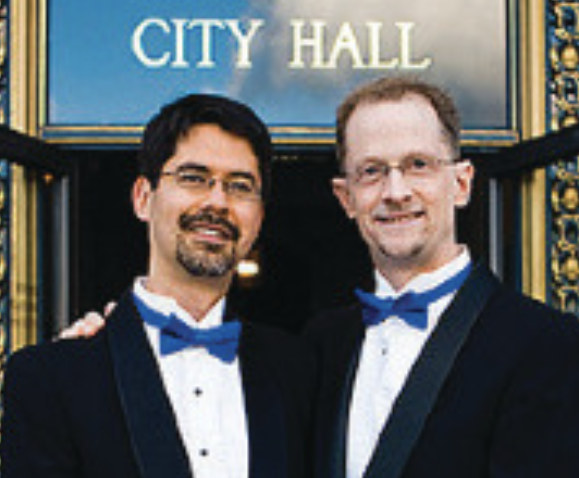
John Lewis and Stuart Gaffney, together for over three decades, were plaintiffs in the California case for equal marriage rights decided by the California Supreme Court in 2008. Their leadership in the grassroots organization Marriage Equality USA contributed to making same-sex marriage legal nationwide in 2015. Today, they continue to educate and advocate for marriage equality and LGBTIQ+ rights worldwide.
6/26 and Beyond
Published on April 23, 2026








Recent Comments