











By Zoe Dunning—
His name was BJ, short for Bananas Junior, and he was the most popular resident of Mr. Bloomingdale’s seventh-grade biology classroom. Unlike the fruit flies, the ant farm, and the hamsters, who came and went, BJ had survived more than twenty years of curious students like me poking at his hard shell, touching his scaly feet, and feeding him overripe banana slices.
I fell in love with tortoises fifty years ago thanks to BJ. Today I write this column from the Galápagos Islands, where Galápago is old Spanish for tortoise. I’ve been learning a lot about Charles Darwin’s 1835 visit here and his theories on evolution and adaptation, and I think we can apply some of these lessons to the recent midterm election results.
Over the past few days, I’ve visited two giant tortoise breeding centers on Santa Cruz and Isabela islands. Conservationists oversee the hatching of thousands of tortoise eggs (after much trial and error, they discovered that hair dryers are the best way to maintain the proper temperature—take that, AI!). Once hatched, these young tortoises are fed and nurtured in age-based pens, like separate nursery and elementary school classrooms.
The first thing I noticed was that each young giant tortoise had a number painted on its shell in one of three colors. The guide explained that the color indicates the tortoise’s species (there are 13–15 different species of Galapagos giant tortoises). All species hatch with flat, oval shells and are indistinguishable. When they reach seven years, they will be transported to the environment their species originated from. This is important because they are less likely to survive in a habitat their species is not adapted to.
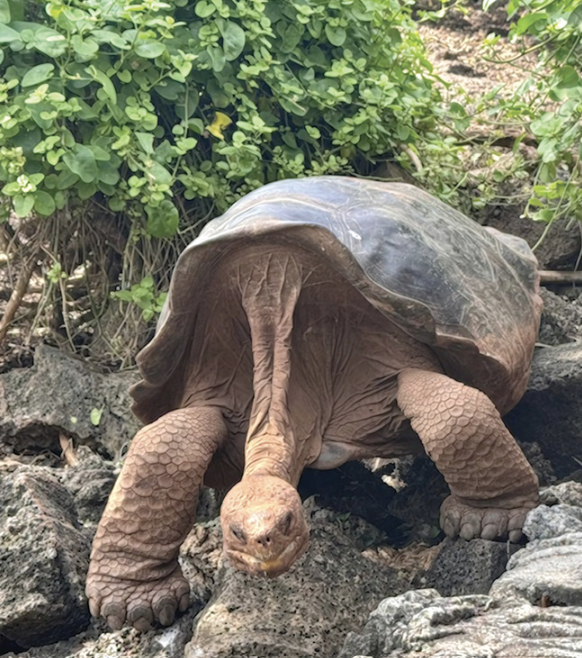
In general, there are two primary shell shapes: domed and saddleback. Domed tortoises have heavy, dome-shaped shells, short necks, and short legs, adapted to graze on grasses and low-lying vegetation on large, humid islands and in lush lowlands. Saddleback tortoises have shells that curve upward at the front like a saddle, paired with longer legs and necks for climbing rocks on drier, more arid islands and for feeding on higher tree cacti, prickly pear pads, and leaves during dry periods.
Darwin’s theory is that survival isn’t about being the strongest (or how many poor, half-assed pull-ups you can perform, Secretary Hegseth). It suggests that those best suited to the environment have the greatest chance of survival. Which brings me to the recent midterm election.
In 2026, the environment looks very different from what it did two years earlier. We are facing the high costs of housing, gasoline, groceries, and utilities, much of it a consequence of Republican-led tariffs and the deeply unpopular Iran war the Trump Administration began. In 2024, illegal immigration was a top concern for voters. In 2026, thanks to ICE tactics—raids, arrests, deportations, and even the killings of U.S. citizens—the public is more afraid of the government than of immigrants.
Different environments require different adaptations. Each tortoise species adapted to survive in its environment. Neither shell shape nor neck length is inherently better or worse. It works because that was what it took to survive in its environment.
Applied to the midterms, no single ideology or candidate profile ruled the day. Consider the Texas and Michigan Senate races. State Representative James Talarico, a white, moderate Presbyterian seminarian in Texas, focused his campaign messaging on economic affordability, ending corruption, and replacing divisive culture wars with a common purpose. Abdul El-Sayed, an Egyptian-American, progressive Muslim epidemiologist in Michigan, prioritized the concerns he heard: money out of politics, money in your pocket, and Medicare for all. Each brought strong backgrounds and skills to address their states’ changing concerns and needs. Their GOP opponents were conservative white men who replayed old culture wars and conservative talking points that worked in 2024 but fell flat this year.
This happened in state after state on election night. Senate, congressional, and gubernatorial races brought fresh Democratic candidates who listened to and spoke to the top concerns of voters—concerns generated by the GOP’s policy decisions and behavior.
So, what is our lesson for 2028? The breeding center is not raising those adorable young tortoises to be identical. The conservationists are preserving the distinct populations so they can release them into the appropriate locations and environments, where they can thrive.
For Republicans, the same strategy that swept them into power has become a liability as domestic and global conditions have changed. For Democrats, the party must continue to provide a diverse slate of candidates who are in touch with their communities.
Zoe Dunning is a retired U.S. Navy Commander, a leader in the repeal of Don’t Ask, Don’t Tell, and the former 1st Vice Chair of the San Francisco Democratic County Central Committee. She lives in Oakland with her rescue dog, Bobo, and is writing her memoir, “Incompatible” (working title).
Do Ask, Do Tell
Published on November 19, 2026
















Recent Comments