






By Bill Lipsky—
His was a success story to which aspiring performers have longed for at least since Thespis trod the stones of the Theatre of Dionysus in 534 BC. One morning in 1887, acclaimed vaudevillian Tom Heath “sauntered into the post office at Wichita, Kansas” to ask the clerk if there was any mail for him and his troupe. A few days later, the entertainer who became renowned as Stuart, “the Male Patti”—his namesake being Adeline Patti, the “Queen of Voice”—was a singer with McIntyre and Heath’s Minstrels.
Born in Missouri on September 22, 1868—he later claimed it was 1875—Everett Stuart showed a promising talent for both singing and female impersonation at an early age. He grew up in Galena, Kansas, where his father, a Civil War veteran, worked as a lead miner, and he enjoyed wearing women’s clothes early on, attending a local masked ball dressed as a “female fashion model” when he was 14. Soon after, he was hired as the clerk of the Galena Post Office for $20 a month.
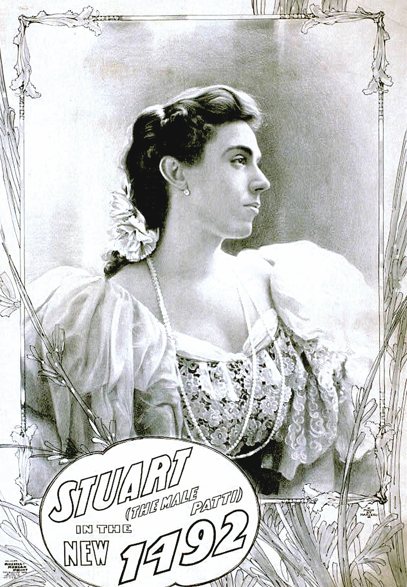
Stuart may have made his first appearance as a female impersonator in 1884, when he entered a talent contest dressed as a woman. From then on, the Joplin Globe shared that, after he died in Hollywood on January 5, 1937, he “liked to don female attire to visit skating rinks and other places and pose as a girl, singing in his rich soprano voice.” No one seemed concerned. When he turned 17, the Galena Weekly Republican reported, without disapproval or ridicule, that “Everett Stuart is very much a lady.”
Only a year after his discovery in Wichita, Stuart was a featured performer with Emerson’s Minstrels, appearing at the grand opening of San Francisco’s new Bijou Theatre at 729 Market Street on August 6, 1888. It was a promising debut in a city that loved female impersonation more than any other. “They closed the box office just as the curtain went up,” the San Francisco Chronicle told readers in its review of the entertainment, “not having even standing room to dispose of.”
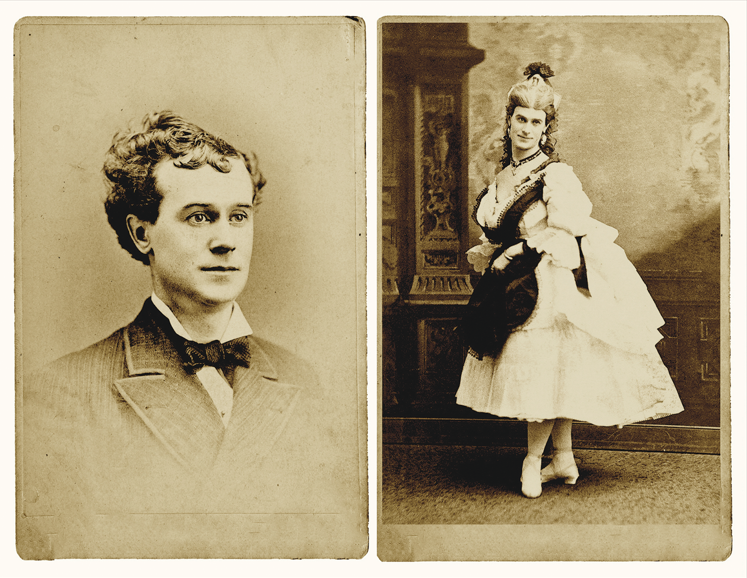
The Chronicle gave Stuart a good notice, but the show’s headliner was Francis Leon. Born Francis Patrick Glassey on November 21, 1844, he began his singing career as a boy soprano at New York’s St. Stephen’s Church when he was eight years old. He left home six years later to become a minstrel,
rose to fame for his elegant, convincing female impersonations, then formed his own company with Edwin Kelly (1835–1898), his business partner and “great and good friend,” when he was 19.
Despite Leon’s “fragile” appearance—many considered him “effeminate and womanly” even in men’s clothes—and the fact that he and Kelly worked, lived, and traveled together for years, there was never a hint of scandal about their relationship, although there were occasional clues. In 1867, when Kelly was on trial for killing a rival troupe owner in self-defense, newspapers reported that Leon “wept like an auntie” and “buried her face in silk shawls” in the courtroom.
After many years of touring the United States as the world’s highest paid female impersonator, the two men sailed for Australia in 1878, where their partnership ended two years later. Leon returned home, billing himself professionally as “The Only Leon” because so many performers not only were copying his act, but also using his name. Kelly, however, remained behind, now the lover of fellow American actor W. H. Leake; they are buried together in Adelaide.
Leon was not minstrelsy’s original female impersonator, only its greatest. Marshall S. Pike (1818–1901) was the first to trod the boards in woman’s attire—and whiteface—in 1843, as a member of the Albino Family. After the group changed its name to the Harmoneons and its makeup to burnt cork, he also was the first such performer to entertain at The White House—where he amused President James Polk in 1847—and the last until Shi-Queenta Lee performed there in 2016, excepting, perhaps, J. Edgar Hoover.
It was Leon, however, who revolutionized female impersonation in America, transmuting it from a comic burlesque of women into a true art form. “The first of the beautiful, totally feminine female impersonators,” he owned as many as 300 dresses—he refused to call them costumes—all in the latest fashion, costing as much as $400, heavily insured, and properly accessorized with fans, lace, shawls, and elegant jewelry. “Heaps of boys in my locality,” one reviewer enthused, “don’t believe yet it’s a man in spite of my saying it was.”
During his prime in the 1870s, the New York Clipper proclaimed Leon “the best male female actor known to the stage [because] he does it with such dignity, modesty, and refinement.” In its 1888 review, the Chronicle
agreed he was “the best impersonator of a woman, [although he] has lost his voice and relies mainly upon his acting, which is capital.” He remained “the dean of minstrel female impersonators” until he retired in 1900. He died in Chicago on August 19, 1922.
Among the greatest performers Kelly and Leon ever hired for their troupe was Thomas Dilward, one of only two Black Americans known to have performed with otherwise all-white minstrel companies before the Civil War—and so the first to don female garb. Billed as “The African Tom Thumb”—he stood between 23 and 36 inches in height—and as “Japanese Tommy” for reasons lost to time, he was acclaimed as a versatile performer who sang, danced, and played the violin, often impersonating operatic prima donnas.
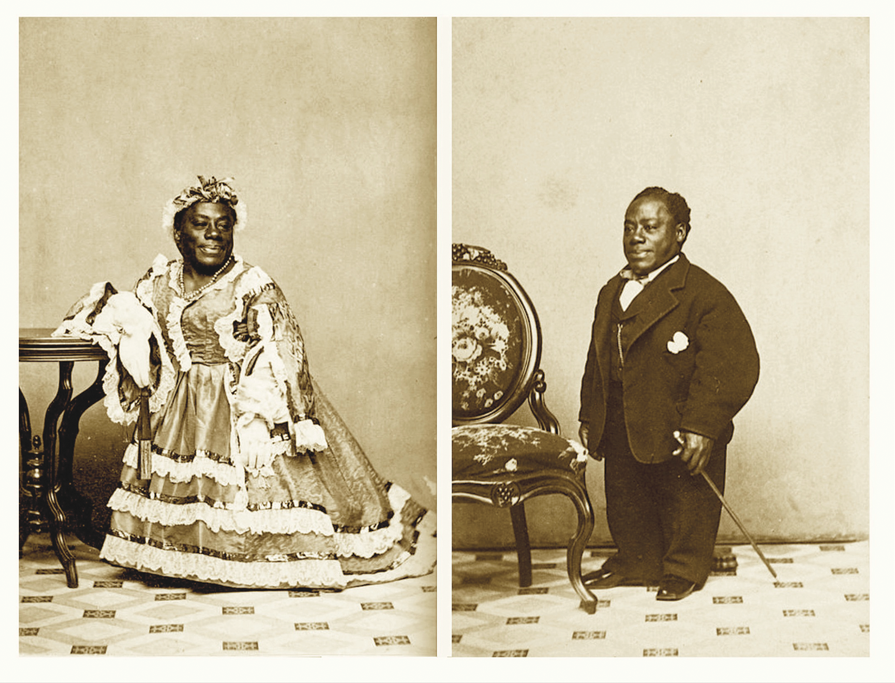
Dilward’s last known appearance was with the Criterion Minstrels on March 5, 1887, the year that Stuart began his career. Among his other accomplishments, according to A Dictionary of Americanisms, published by John Russell Bartlett in 1877, he created the expression hunky-dory, meaning “superlatively good” and “said to be (or to be derived from) the name of a street, or a bazaar, in Yeddo,” now Tokyo, Japan. He died at the Colored Home and Hospital in New York on
July 9, 1887.
Stuart returned to San Francisco in 1894, four years after his debut, the star attraction at the Orpheum Theatre, 119 O’Farrell Street, for eight consecutive weeks. He left minstrelsy soon after to appear as Queen Isabella, “the Daisy Queen,” in a touring company of the comic burlesque 1492, which featured Lillian Sterling as Don Jose, Sadie Girard as Don Almo, and Stella Gilmore as Don Ferdinand. Stuart, the Wichita Daily Eagle reported on November 6, 1898, “carried himself with queenly dignity throughout the performance.”
One of the most popular stage productions of its era, 1492 featuring Stuart toured for years, then he turned to vaudeville. In 1904, after Leon had retired, the New York Dramatic Mirror hailed the man known as “the Male Patti”—because he “could hit high C like eating cake”—as “the premier impersonator of the fair sex of the present day.” His last public appearance was in an “Old Timer’s Act” in New York in 1932, 45 years after his professional debut. He never married.
Bill Lipsky, Ph.D., author of “LGBTQ+ Trailblazers of San Francisco” (2023) and “Gay and Lesbian San Francisco” (2006), is a member of the Rainbow Honor Walk board of directors.
Faces from Our LGBTQ Past
Published on March 26, 2026













Recent Comments