





By Gary M. Kramer—
Director Cate Shortland’s spectacular drama, Somersault, remains as potent today as it was on initial release twenty years ago. This incredibly compelling drama, available for streaming March 27, 2026, in a new restoration, features an astonishing performance by Abbie Cornish as a self-destructive teenager struggling with her sexuality.
The film is also visually superb, with gorgeous cinematography and impressionistic effects that comment on the thoughts and emotions of the finely drawn characters.
The film opens with Heidi (Cornish) leaving home after being caught in bed with her mom’s boyfriend. She heads off to the resort town of Jindabyne to find a man she once knew with the hope that he can provide her with a job. However, as with most of her decisions, things do not quite work out well, or as she planned. Heidi is soon stranded in a strange town in the off-season, and without much money or the prospect of a job. Her only plan for finding a place to sleep is to go home with a guy.
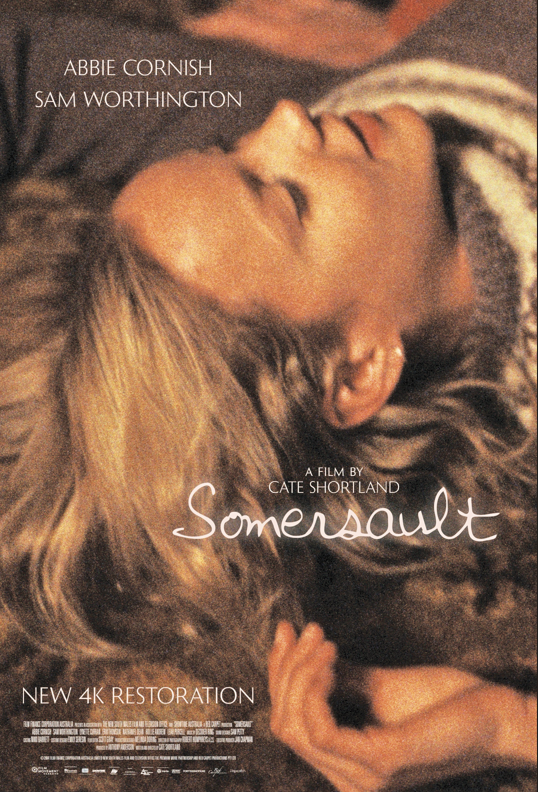
After spending the night with someone she met in a bar (who dumps her quickly the next morning), Heidi eventually meets Joe (Sam Worthington), a good-looking guy who tentatively begins a relationship with her. They check into a local inn, and, after a night together, Heidi clings to the connection she makes with this stranger. Craving attention and affection, she is curious about seeing more of Joe—and yet his feelings towards her are not as easily revealed or returned. Like Heidi, Joe is also a bit at sea in his life. He has difficulties communicating with his folks and his friends, and he, too, is searching to find himself.
Somersault parallels the two characters’ lives when they are each alone, showing their daily routines, and providing nice visual links that draw these disparate people together. When Heidi picks up a pair of ski goggles and looks at the sky through the scarlet lens, Joe is later seen holding up a wine glass for a similarly diffused perspective. While they have little in common, the film suggests, they perhaps share the same lack of self-worth, and self-awareness.
Shortland is as interested in creating a mood, as she is focusing on plot, and thankfully her mastery at composing shots reveals much about her characters. Shooting Heidi through a glass of beer suggests that she has to get drunk to numb her emotional pain—and perhaps exhibit her sexual promiscuity—and the effect of this narrative shorthand is very satisfying.
However, Somersault also provides Joe and Heidi with dramatic outbursts that allow them to define their characters. When Joe tells his best friend why he hangs out with him, his candor is quite shocking. This scene, along with the curious exchanges he has with a gay neighbor, explains how Joe’s self-hatred manifests itself, and his cavalier attitude towards Heidi makes more sense as a result.
Likewise, Heidi’s confrontation with Irene (Lynettte Curran), the owner of the inn where she stays, is pretty intense and effective. Lashing out at Irene because she is called on her own bad behavior, Heidi ultimately realizes that she must grow and change.
Somersault is a powerful little film that sneaks up on viewers. One of the most disquieting exchanges takes place in a car one night when Heidi is warned by the father of her friend Bianca (Hollie Andrew) to stay away from his daughter. The film has the effect of a sucker punch.
Ultimately, for all of Shortland’s visual splendor, the key reason for the film’s success is Abbie Cornish’s remarkable performance. Her expressions as seen through a window streaked with rain, or while she is silently looking at a unicorn card in her scrapbook, recalling happier times, are absolutely heartbreaking. And while her despair is frequently palpable, it is her seemingly innocent appearance that masks a devious and deeply troubled young girl that is what is so captivating.
Cornish’s dazzling performance is well-matched by Worthington’s more internalized portrait. While the actor is very appealing here, Somersault is Cornish’s film all the way. She is the reason to see the film, and flip over it.
© 2026 Gary M. Kramer
Gary M. Kramer is the author of “Independent Queer Cinema: Reviews and Interviews,” and the co-editor of “Directory of World Cinema: Argentina.” He teaches Short Attention Span Cinema at the Bryn Mawr Film Institute and is the moderator for Cinema Salon, a weekly film discussion group. Follow him on IG @garyemkramer
Film
Published on March 13, 2026









Recent Comments