






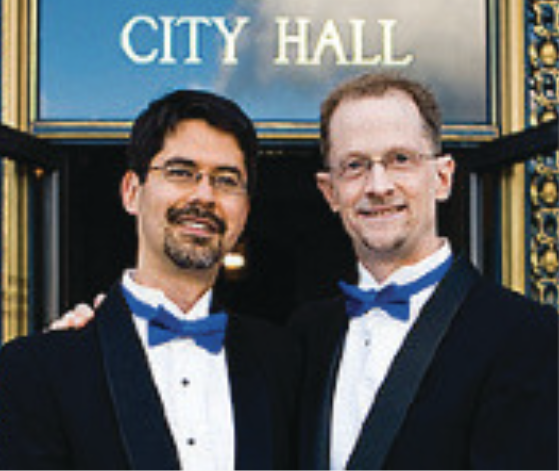
By Stuart Gaffney and John Lewis –
The superb new Slate podcast When We All Get to Heaven tells the story of the pivotal role the San Francisco MCC (Metropolitan Community Church) played as a queer church and an indispensable part of the broader LGBTIQ+ community during the height of the HIV/AIDS crisis of the 1980s and early 1990s. But the podcast is not just a look at the past; it is extremely relevant today. We cannot recommend it highly enough.
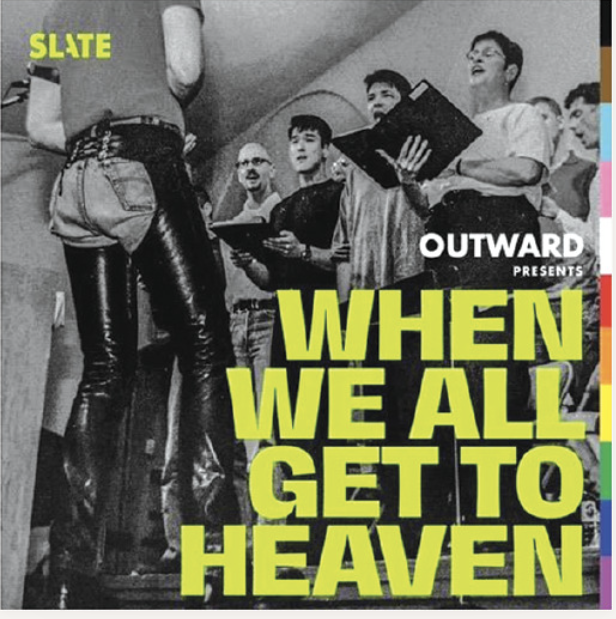
As religious historian Lynne Gerber, who created the podcast with her colleagues Siri Colom and Ariana Nedelman at Eureka Street Productions, describes it, the podcast provides us a first-hand look at “a community that knew how to face loss and make hope in hard times … something all of us are going to need to learn how to do if we’re going to get through the existential crises in front of us” today.
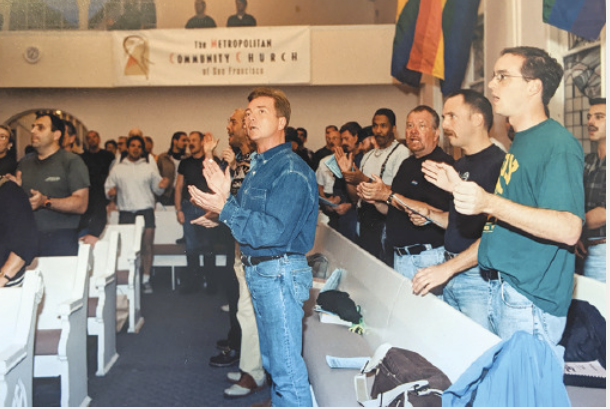
The podcast recounts how, in the 1980s, the SF MCC served as a place of refuge without exception for all those who needed comfort, care, hope, and camaraderie, regardless of whether or not they were Christian. It tells “stories of people, of relationships, of crises, of fear and fury, and faith,” of laughter, and the myriad ways people “channeled their grief.” Gerber emphasizes that, like the MCC in the 1980s, “When We All Get to Heaven is a podcast for all of us—religious or not, queer or not, HIV positive or not, alive in the early AIDS years or not … . Whether you’ve spent half your life in a church or would never enter a real live one, we invite you to spend some time with this one.”
With her wry sense of humor, Gerber describes how she herself is “a Jewish girl from Long Island,” who is not “constitutionally … capable of” joining a church, and who is not LGBT herself but very much embraced as queer by the MCC. She confesses MCC members’ “combination of utter queerness and utter Christian-ness messed with my head,” but she was profoundly moved when she attended services and became a friend of the church.
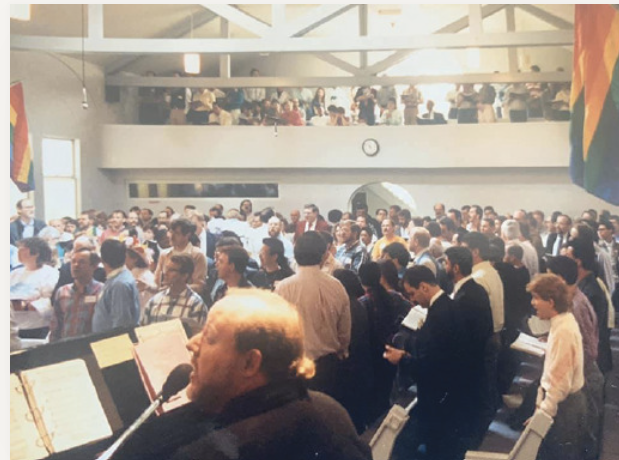
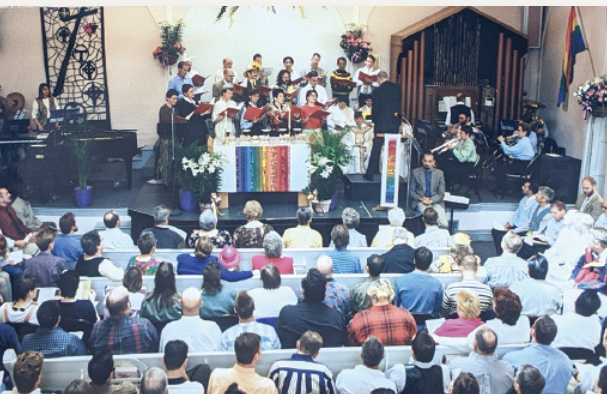
Remarkably, the podcast presents the actual voices of MCC leaders and members at the time—and their stirring music—giving us a front row seat to part of 1980s San Francisco. Thanks to the leadership of the late Keith Wismer, the SF MCC began recording its church services back in 1987 so that members who were too sick or otherwise unable to attend services could listen to cassette tapes of them at home and still feel connected to the community. In all, an astounding 1,200 cassettes were made from 1987 to 2003 and preserved.
However, when the church relocated several years ago, the tapes were slated for the garbage bin until longtime congregant Steve Ferrario, who understood their worth, “picked all these tapes out of a trash pile.” As such, listening to the podcast “feels like stepping into the room with this community, shoulder to shoulder, across time,” as described by Slate’s Christina Cauterucci.
In appreciating the relevance of the recordings to today, we noted how historian Gerber describes the 1980s as a time when the LGBTIQ+ community faced triple crises: 1) a “medical crisis of a novel, brutal, fatal disease with no treatment and no cure”; 2) a “social crisis hitting mostly marginalized people—queer folks, drug users, people of color”; and 3) a “political crisis of a government that seemed indifferent to AIDS, contemptuous of people with it, and doing close to nothing to support sick people or the search for treatment.”
We see striking parallels to attacks on the trans community by Trump and his allies today: roadblocks to life-affirming medical treatment, targeting one of the most vulnerable minorities in our country, and relentless vilification and marginalization. Many other groups are also suffering disproportionately under the Trump administration in their own ways and feel very vulnerable because of who they are. We all face threats to basic democratic institutions and our core civil liberties.
The podcast reveals how the MCC as a church in the 1980s embodied “sheer insistence on possibility and the commitment to gather and to cultivate a sense of hope through years where they had no idea how this would turn out. They had no idea that the dying would ever end,” as Gerber recounts.
And now, as Gerber explains, “we’re [also] in a moment where we have no idea how this is going to go and where it’s going to end up and how we get there.” For Gerber, figuring out “the practices of what it takes to hang in through that in a community with a sense of imaginative possibility that insists on everybody’s place in it,” as the MCC did, is vital.
Gerber hopes that podcast listeners will learn “that there are communities of queer people who have been through really hard things before, and this is how they got through them.” For Gerber, making “the space to imagine and to cultivate possibility on our own terms” is an “incredibly important” but “undervalued” component of social and political movements. According to Gerber, “If we’re gonna get through this, we have to hold on to each other again.”
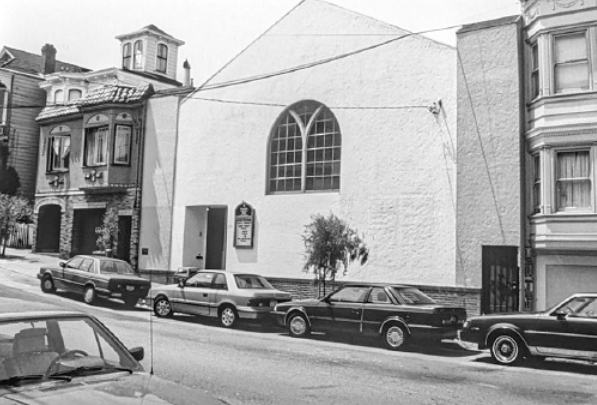
The very creation of the MCC in 1968 in the face of an extremely hostile broader church environment is just such an act of “imaginative possibility.” But, as Gerber stresses, her vision today is “not replicating MCC. It’s insisting on making a space that MCC insisted on making that could look a lot of different ways.”
The podcast’s title When We All Get to Heaven derives from the 19th century hymn of the same name, which the MCC embraced as their own. The podcast features an extraordinarily spirited rendition of the hymn sung by Ron Davis and the MCC congregation. Gerber underscores “the sheer audacity of the ‘we,’ [and] ‘we all,’” declaring that
“[t]his song is about us. All of us. The promise of this place is for all of us.”
For queer Christians, the lyrics might carry the particular meaning of claiming their place in the Christian heaven, even as they were demonized and despised by many in the broader church. Today, it can stand as an encouragement for “all of us” to embrace “imaginative possibility” for a better today and tomorrow. We invite you to give yourself and your loved ones that gift for the holidays, the new year, and beyond. Happy listening!
You can find the podcast on many podcast apps and at the following two sites:
https://bit.ly/4j7e8Vl
https://www.heavenpodcast.org/
John Lewis and Stuart Gaffney, together for over three decades, were plaintiffs in the California case for equal marriage rights decided by the California Supreme Court in 2008. Their leadership in the grassroots organization Marriage Equality USA contributed in 2015 to making same-sex marriage legal nationwide.
6/26 and Beyond
Published on December 18, 2025









Recent Comments