








By Dina Novarr—
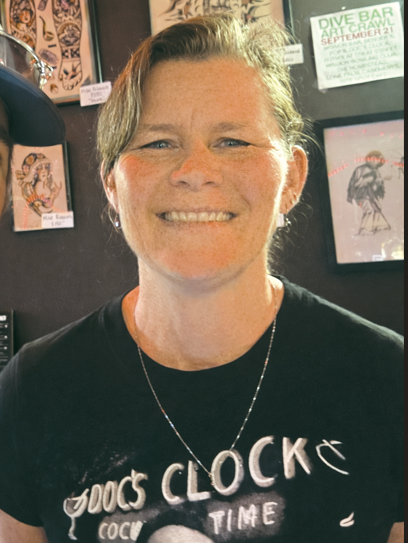
We talk a lot about women in history as though their significance is safely in the past: trailblazers, alive only in portraits on walls. Carey Suckow is a different kind of story: a woman doing the work right now, in the Mission, in real time, in a city that is simultaneously celebrated for its innovation and notorious for grinding just like the people who made history interesting. She is not turning the bar industry into something palatable. She exists inside it, on her own terms, and has done this for twenty years. And she’s raising daughters who will know what it looks like when a woman refuses to make owning the room an apology.
“Owning a business is something you can’t turn off,” she told me for the San Francisco Bay Times. “There is always some kind of issue that has to be dealt with.”
She says it matter-of-factly, the way you do when something has been true for so long it’s just assumed. But the weight of it lands anyway. Being a woman in the bar industry is its own particular gauntlet. Being an owner in the bar industry, as a woman, for twenty years, means you have been navigating a space that was not designed for you, and doing it long enough to make it your own.
“Being a woman owner is tough, and has been tough for 20 years,” Suckow says. “My kids see how hard I work and I doubt they would want to go into this business for themselves.”
There’s something wry in the way she says it, but also something real. Her daughters are growing up watching their mom do the thing most women are quietly discouraged from doing: taking up space, owning something, and refusing to make themselves smaller for anyone’s comfort. That’s its own kind of curriculum.
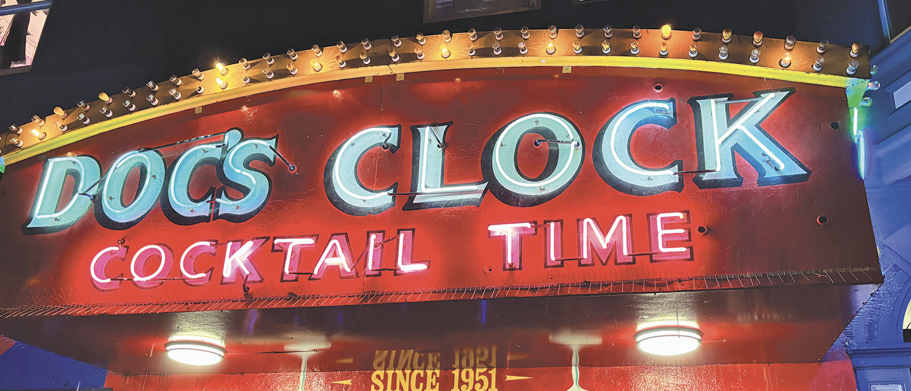
Doc’s Clock isn’t just a bar. It’s a San Francisco Legacy Business and a certified San Francisco Green Business, designations that reflect a commitment to the city that goes beyond pouring good drinks. For two decades, Suckow has hosted Doggy Happy Hours to support local animal rescue groups. This past October, Barbie Night’s proceeds went to Mission Action, a local community organization. Every year, a different cause gets the nod.
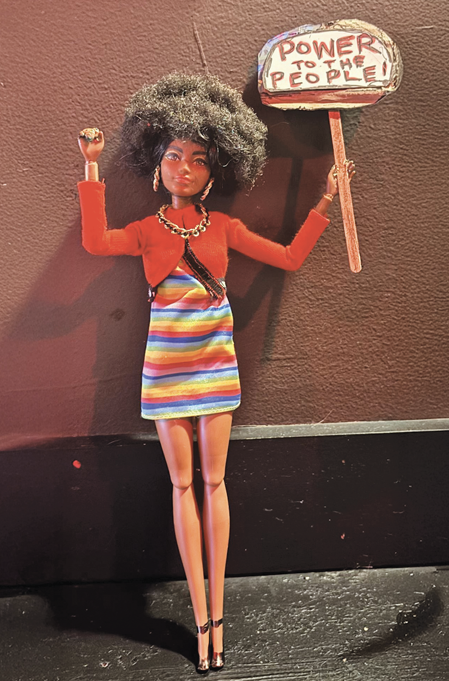
What is Barbie Night? It is an Unrealistic Beauty Standards & Gender Restrictive Norms Mutilation Night. Think dismembered limbs on a glitter-streaked table; a Barbie doll re-costumed as Frank N. Furter with a decapitated Ken head at her feet; a Black Barbie with a natural afro, fist raised, holding a sign that reads “Power to the People”; a clown-faced Barbie, eerie and beautiful and nothing like what she started as. Participants show up, pay a cover, get a Barbie kit, and go to town.
The event is participatory art, social commentary, and a community night out all rolled into one chaotic, paint-stained evening. And it’s happening in a bar in the Mission where people are drinking, laughing, and making something weirdly profound out of a plastic object that’s spent sixty-plus years telling little girls what they should look like.
The subversion is not accidental. Suckow is a female bar owner who closes up at 2 am and comes home to daughters she is actively trying to raise without the weight of impossible standards. Barbie Night is personal and political. It’s relatable, reflectable, and the type of event a neighborhood institution holds when they understand their constituents’ values.
Likewise, amid a city drowning in twelve-ingredient craft cocktails with house-made shrubs and Japanese ice programs, Carey Suckow’s Paloma is a quiet act of defiance: two ounces of Madre Mezcal, equal parts grapefruit juice and 7UP, served long in a Collins glass with a lime. That’s it. There’s a certain arrogance baked into the craft cocktail era and the implication that complexity equals quality, that a bartender’s intervention is always an improvement on simplicity. Suckow’s Paloma pushes back on that. It says: sometimes the work of time-tested, generationally-approved soda and fresh citrus is enough to move the needle. Sometimes the intervention is knowing when to get out of the way.
The choice of Madre Mezcal as the base is fitting in ways that go beyond flavor. Madre describes itself as a celebration of Mother Earth. It is an artisanal mezcal made in the rural hills of Oaxaca, crafted with intention using nature’s most intrinsic elements, reflecting the essence of nature in its purest form. It is a spirit that is about honoring the source: the agave, the land, the hands that made it. Nothing is added that doesn’t belong. The name itself, Madre, means mother. And here it is, being poured behind the bar of a woman who is, above all things, exactly that.
The pairing isn’t just thematic. It’s structural. Madre is built on the idea that something rooted, something that came from the earth without apology, is worth celebrating. So is Doc’s Clock. So is Carey Suckow.
Doc’s Clock Paloma
2 oz Madre Mezcal
2 oz equal parts grapefruit juice and 7UP
Shake and pour over ice in a Collins glass and garnish with a lime.
San Francisco-based Dina Novarr enjoys sharing her passion for fine wines, spirits, non-alcoholic craft beverages, and more with others.
Cocktails with Dina
Published on March 26, 2026







Recent Comments