





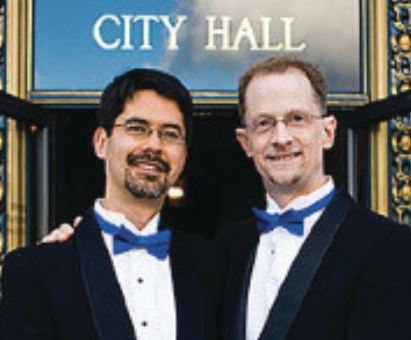
By John Lewis and Stuart Gaffney—
For the last two years, the archconservative supermajority of the U.S. Supreme Court has dealt severe blows to the LGBTIQ community in a number of areas: health care for transgender youth, trans participation in school sports, conversion therapy, and the ability of conservative religious parents to interfere with the inclusion of educational materials presenting positive content or images of LGBTIQ people in public school curricula. The reasoning of the decisions was often very convoluted, suggesting results-driven outcomes. The Court just began its new term and will decide at least two more cases pertaining to LGBTIQ rights. We’ll discuss the first case here in Part 1 and the second case in the next issue of the Bay Times in Part 2.
The first case, St. Mary Catholic Parish v. Roy, will be heard on November 3, 2026, and will shed light on the degree to which the Court’s supermajority, all of whom were raised Catholic, will further carve out religious-based exemptions to state anti-discrimination laws.
The case concerns the state of Colorado’s equal opportunity guarantees in its publicly funded, universal pre-K school program, one of the leading such programs in the country. The government program offers every four-year-old child in the state the opportunity to attend up to 15 hours of free preschool per week. Unlike many public programs elsewhere, Colorado gives parents the freedom to enroll their children, not only in public preschools, but also in accredited private schools, “including religious preschools providing religious education.” Indeed, many religious schools, including Catholic schools, are part of the program.
To participate in the publicly funded program, every preschool must meet requirements regarding health and safety, teacher training and qualifications, and other quality control measures. In addition, each school must “provide eligible children an equal opportunity to enroll and receive preschool services regardless of race, ethnicity, religious affiliation, sexual orientation, gender identity, lack of housing, income level, or disability.” As the state puts it in its legal brief, these provisions “ensure that all Colorado parents—Catholic, Jewish, Muslim, gay, or straight—can trust that their four-year-olds will not be turned away from publicly funded preschools because of religion, sexual orientation, gender identity, or other protected characteristic.”

Unlike many other religious schools, St. Mary Catholic Parish’s preschool decided not to participate in the program because it prohibits four-year-olds of LGBTIQ parents and gender-diverse four-year-olds from attending the school, and it knew this open discrimination against these children would violate the program’s equal opportunity guarantees. Instead of accepting that its exclusionary policies prevented it from receiving public funding—or alternatively simply welcoming any four-year-old who wanted to attend the school—the school and the Archdiocese of Denver sued, claiming they had a right to exclude the children based on the school’s religious tenets. Parents of one of the four-year-olds who attended the school also sued.
The Archdiocese claims that its “religious practices” are “rooted in love and concern for the person,” but such an assertion rings hollow, especially when considering the four-year-olds whom the case ultimately concerns. Would children attending St. Mary’s understand why their best friend could not go to preschool with them, simply because their friend had two mommies or daddies or was a boy who had long hair and liked to wear pretty dresses to school?
This case should be a straightforward case in which the Supreme Court upholds Colorado’s equal opportunity protections in its publicly funded preschool program because of the separation of church and state. But we know with the Republican Supreme Court supermajority, it will not be. We’ll be following this case closely and report further on it after November’s oral argument. In the next issue, for Part 2, we’ll discuss another case the Supreme Court will decide this term, which regards Washington state’s efforts to ensure the safety of runaway transgender youth. Stay tuned!
John Lewis and Stuart Gaffney, together for over three decades, were plaintiffs in the California case for equal marriage rights decided by the California Supreme Court in 2008. Their leadership in the grassroots organization Marriage Equality USA contributed to making same-sex marriage legal nationwide in 2015. Today, they continue to educate and advocate for marriage equality and LGBTIQ+ rights worldwide.
6/26 and Beyond
Published on October 8, 2026










Recent Comments