




By Dina Novarr—
October is LGBTQ+ History Month, a time to celebrate the people who broke barriers and made room for the rest of us to live a little more freely. And while plenty of tech billionaires are busy building rockets, bunkers, and vanity projects for an audience of one, Grindr has decided to invest in something closer to home: our bodies, our health, and, naturally, our sex lives.
On September 30, 2026, Grindr announced a $250 million agreement to acquire
PurposeMed, the parent company of Freddie, a telehealth provider specializing in HIV prevention and sexual health care. An app famous for headless torsos, questionable opening lines, and remarkably efficient Tuesday nights is getting serious about health care.
Nobody saw that coming in 2009. But it’s a reminder that queer communities have always been good at building the things the rest of the world forgot to build for us. And sometimes, the best relationships begin with a little chemistry.
During the AIDS crisis of the 1980s and 1990s, activists, caregivers, and organizations like ACT UP demanded access to experimental treatments, challenged government inaction, and forced the medical establishment to rethink how patients take part in their own care. When institutions moved too slowly, the community organized. When the world looked away, the community showed up.
Grindr buying Freddie isn’t a modern-day ACT UP demonstration, and it certainly comes with a business model. But it rests on the same idea: health care works better when the people who need it have a voice in how it’s delivered.
Founded in Canada in 2020, Freddie has helped more than 55,000 patients access care, including PrEP, the medication that reduces the risk of acquiring HIV through sex by about 99% when taken as prescribed. Grindr connects nearly 16 million monthly active users worldwide. One knows how to connect people. The other knows how to connect them with care. And unlike the guy who says he’s “five minutes away” while still on his couch, both parties appear to have a plan.
The deal, expected to close in late 2026, would bring Freddie’s testing, prescriptions, and medication delivery into Grindr’s growing health business. Imagine finding PrEP information in the same app where you were just debating whether Marco’s jawline is real. Connecting with Freddie would stay voluntary and that matters.
Remember those sexual health pamphlets in clinic waiting rooms? They usually were glossy, beige, and often showed a straight couple holding hands on a beach, fully clothed and deeply bored. If you were queer, you were lucky to make the footnotes, usually under “high-risk groups.” That’s why medical representation matters. It’s more than a rainbow sticker on the clinic door. It’s an intake form that knows you exist. It’s a provider who understands PrEP, doxyPEP, and the occasional complicated weekend without clutching a clipboard like pearls. It’s care that doesn’t make you explain your identity before addressing your health.
There are questions worth asking. Grindr has faced criticism over health data privacy before, and putting medical services this close to a dating platform demands exceptionally strong protections. Trust is earned, especially in a community that has spent decades fighting for it. The future of queer health care also has to reach trans and nonbinary people, queer women, and people living where their identities still put them at risk.
But the potential is enormous. Grindr wants to connect 10 million LGBTQ+ people globally with HIV prevention resources by 2028. Whether it delivers remains to be seen. For now, it’s a company born from queer social life recognizing that connection means more than finding someone to go home with. Sometimes it means making sure everyone gets home healthy.
Progress has been made from the clinic pamphlet to the smartphone, from whispered questions to open conversations, and from afterthought to intended audience. Now that’s worth raising a glass to.
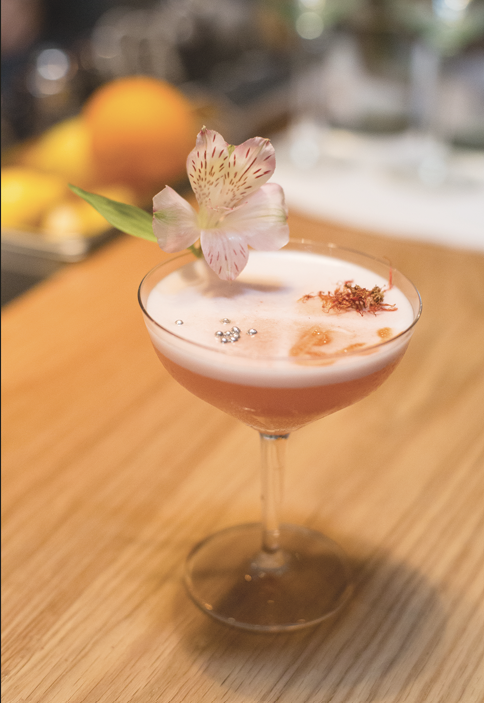
Bedside Manner
Meet Bedside Manner, a golden botanical elixir for those who appreciate good chemistry, better company, and someone who asks how they’re feeling afterward. The star is yellow chartreuse, the herbal liqueur made by Carthusian monks from a 1605 manuscript for an “elixir of long life.” These celibate men have been perfecting the art of pleasure for centuries. It is iconic. St. George Botanivore Gin brings Bay Area character, while
chamomile, ginger, honey, and lemon make it bright, herbal, and comforting.
1½ oz St. George Botanivore Gin
½ oz yellow chartreuse
¾ oz freshly squeezed lemon juice
½ oz honey-ginger syrup (see recipe)
½ oz chilled chamomile tea
small pinch of ground turmeric
garnish: lemon wheel and fresh thyme or an edible flower
Honey-ginger syrup: Combine equal parts honey and water with sliced fresh ginger. Warm gently, steep, strain, and cool.
Shake all ingredients with ice for about 12 seconds. Double strain into a chilled coupe and garnish.
Now you are ready to raise a glass to the activists who demanded better, the communities that built better, and the next generation finding new ways to care for one another. To Grindr and Freddie: May good business and community well-being share the same bed. And to the rest of Silicon Valley: The next great innovation might not need a rocket to Mars. Sometimes it just takes knowing your audience and offering a little better bedside manner.
Happy LGBTQ+ History Month, darlings. Go make some history. And don’t forget your checkup.
San Francisco-based Dina Novarr enjoys sharing her passion for fine wines, spirits, non-alcoholic craft beverages, and more with others.
Cocktails with Dina
Published on October 22, 2026









Recent Comments