









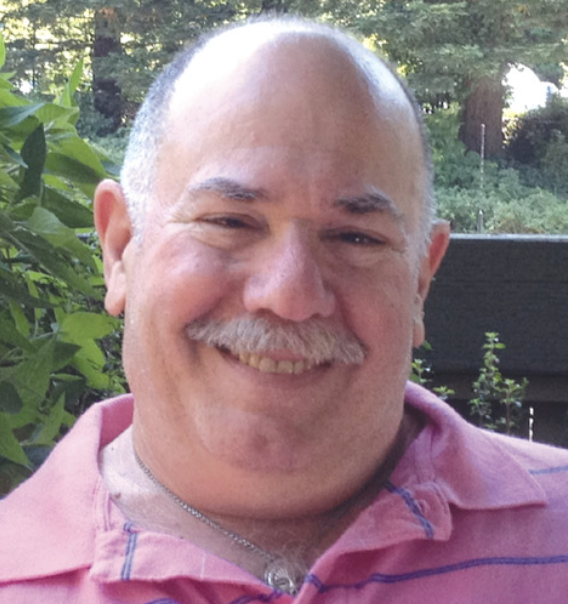
By Dr. Bill Lipsky—
(Editor’s Note: The following is part six of Bill Lipsky’s timeline of LGBTQ+ history starting with the 19th century. The first part ran in the June 11, 2026, issue of the San Francisco Bay Times.)
By the 1990s, LGBT San Franciscans had established many of the networks, organizations, and strategies to secure the “inalienable rights” of “life, liberty, and happiness” to which all of us are entitled. To affirm life in the new decade, out-loud activism would continue to move the response to the HIV/AIDS epidemic from an “on your own” grassroots survival program to major, life-saving medical advancements.
To protect liberty, the LGBT community and the city would work together to expand human rights to everyone, although a conservative state governor consistently vetoed legislation to guarantee them. To enable the pursuit of happiness, an emerging visibility and new organizations created by previously overlooked or marginalized groups would finally end the misconception that LGBT San Francisco was a monolithic community, represented only by middle-class white gay men.
While the Castro would remain the heart of the city for gay men, the Mission District became a vibrant place for radical queers and lesbians. We were now truly becoming a community of communities, but there was much more to be done.
1990
The New Eagle Creek Saloon, the city’s first Black-owned gay bar, opened at 1884 Market as “a friendly place with a funky bass for every race.”
When delegates from 20 states and five countries attended the first National Bisexual Conference, held at San Francisco’s Mission High School, Mayor Art Agnos issued a proclamation “commending the bisexual rights community for its leadership in the cause of social justice” and declaring June 23 to be Bisexual Pride Day.
Joined by activists from around the world, ACT UP San Francisco staged massive demonstrations at the Sixth International Conference on AIDS, protesting ongoing government inaction, discriminatory travel bans against HIV-positive individuals, and the lack of adequate representation by women and people of color in clinical trials.
The World Health Organization removed homosexuality from its International Classification of Diseases.
1991
On Valentine’s Day, the day that the city’s domestic partnership law went into effect, some 275 same-sex couples registered at City Hall.
California Governor Pete Wilson vetoed Assembly Bill 101, allowing private businesses to continue firing or refusing to hire people because of their sexual orientation.
1992
The Deaf Gay and Lesbian Center opened to provide guidance, advocacy, and TTY accessibility for the city’s deaf and hard-of-hearing LGBT communities.
Directed by openly LGBT San Francisco filmmaker Debra Chasnoff, Deadly Deception won the Academy Award for best documentary short film.
The city’s Police Commission fired Chief of Police Richard Hongisto after learning he had directed officers to confiscate copies of the San Francisco Bay Times that featured an article critical of his leadership.
Roberta Achtenberg resigned from the
San Francisco Board of Supervisors to become Assistant Secretary of the U.S. Department of Housing and Urban Development; she was the first openly LGBT person confirmed by the Senate for a high government office.
1993
At the American Psychiatric Association’s annual convention, demonstrators from Transgender Nation protested the classification of “transsexualism” as a mental illness in the latest edition of the Association’s Diagnostic and Statistical Manual of Mental Disorders.
San Francisco hosted its first annual Dyke March to “fight for freedom, for power, for sisterhood, for love, for control of our bodies, for self-defense, for dignity, for human rights, for our children, for joy, for liberation, for sex, for equality, for justice, for our lives, for all women forever!”
Activist and safer-sex educator Pedro Zamora joined the cast of MTV’s reality series The Real World: San Francisco; he was one of the first openly gay men living with HIV/AIDS to appear on weekly television.
Created simply to save lives, the San Francisco AIDS Foundation’s “Life, Liberty, and the Pursuit of Happiness” poster sparked controversy. Critics who figuratively draped themselves in the American flag denounced the poster’s image of two men literally draped in the flag—one holding a condom—even though the models showed less skin than a standard swimsuit ad. Other safer-sex campaigns from the era included “Be A Rubberman” (1990), “Sex is Good” (1991), and “Be Here for The Cure” (1992).
Cheryl Chase/Bo Laurent founded the Intersex Society of North America to “create a community” of peer support and to end shame, secrecy, and unwanted surgeries for infants and children.
Mayor Frank Jordan declared a state of medical emergency that allowed the city to fund Prevention Point, which could now legally distribute clean syringes to those who needed them.
1994
Wearing “We Are One Family” sweatshirts, members of the Gay Asian-Pacific Alliance and Asian-Pacific Sisters marched in San Francisco’s Chinese New Year Parade, a first for Asian LGBT groups.
Mayor Jordan signed a city ordinance that prohibited discrimination in employment, housing, and city contracts against anyone based upon his/her/their gender identity.
The San Francisco Women’s Building hosted Maestrapeace, a street festival to celebrate its new five-story-tall feminist mural, which honored more than 600 heroines.
Governor Wilson vetoed a statewide domestic partnership bill.
Deaf trans activist Drago Renteria organized the first Deaf Lesbian and Gay Awareness Week.
1995
Envisioned by San Francisco architect Patrick Carney, the Pink Triangle atop Twin Peaks overlooking the Castro was installed by volunteers and thereafter has been an annual event and installation as part of Pride in June.
Donna Sachet, now First Lady of the Castro and a Bay Times columnist, became Absolute Empress XXX of the Imperial Court.
The Harvey Milk Institute, a nonprofit community-based center, was founded to provide learning opportunities for the LGBT community, “who felt that their needs and interests were being ignored by schools of higher education.” Courses included Queering Culture, Prostitution 101, and Lesbian and Gay Parenting, as well as art, ethics, safer sex, film, and more.
San Francisco became only the fourth city in the United States to pass legislation to explicitly prohibit discrimination against transgender people.
1996
The James C. Hormel Gay & Lesbian Center opened in San Francisco’s new Main Public Library “to promote and provide access to the documentation of lesbian and gay history and culture.”
For the first time anywhere in the world,
a Catholic church, Most Holy Redeemer, officially organized participation in a pride parade.
Affectionately known as the “Swish Palace” for the enormous “SP” neon sign on the roof and the large number of gay men who worked under it, the Southern Pacific Railroad left its Italian Renaissance-style headquarters building, completed in 1917, at 65 Market Street.
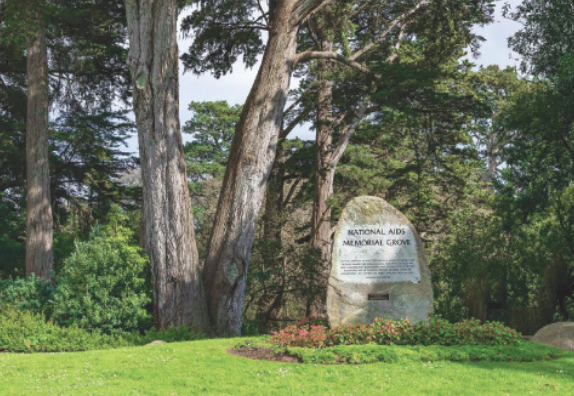
Five years after work on the site began, Congress officially recognized Golden Gate Park’s historic DeLavega Dell as the National AIDS Memorial Grove, although it was not listed on the National Register of Historic Places. It honored, Congresswoman Nancy Pelosi stated at the time, “all who have been touched by HIV/AIDS, but more importantly, it forever keeps their spirit, their love, their stories with us and so future generations never forget.”
1997
The Equal Benefits Ordinance required that all companies having contracts with the city offer the same benefits to their employees with domestic partners that they offered to their married employees.
San Franciscan James Hormel became the first openly gay American ever nominated and confirmed to the high office of Ambassador.
KQED broadcast The Castro, which showed how the neighborhood became the intergalactic center of the LGBT universe.
1998
Tom Ammiano was elected the first openly gay president of the Board of Supervisors.
1999
Finocchio’s, home to one of the most famous female illusionist shows in the world, closed after 63 years in North Beach.
San Francisco became the first city in the U.S. to include transition-related medical care in its health benefits for municipal employees.
2000
California voters passed Proposition 22, which stated, “Only marriage between a man and a woman is valid or recognized in California.”
Bill Lipsky, Ph.D., author of “LGBTQ+ Trailblazers of San Francisco” (2023) and “Gay and Lesbian San Francisco” (2006), is a member of the Rainbow Honor Walk board of directors.
Faces From Our LGBT Past
Published on October 22, 2026






Recent Comments