









By Tom LeNoble, with contributions from Suzanne Ford—
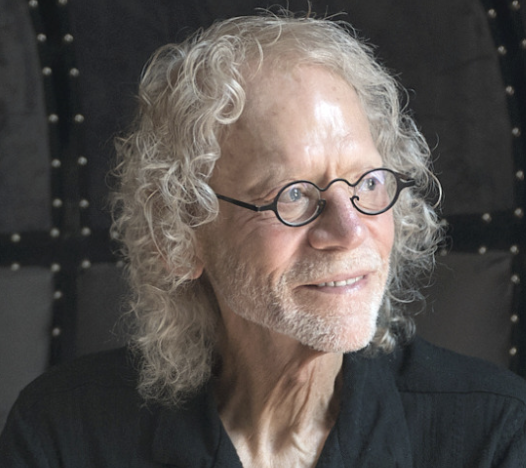
Susan Stryker has spent much of her life asking questions about the world we live in, particularly the assumptions we make about gender, identity, and what it means to be human. As a historian, author, filmmaker, educator, and activist, she has helped preserve transgender history while challenging us to consider how the world might be different.
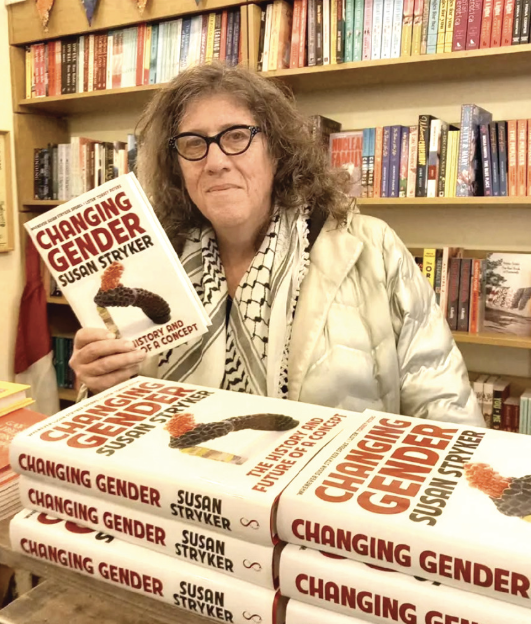
Her newest book, Changing Gender: The History and Future of a Concept, takes readers beyond the familiar debates about gender and explores how the concept itself developed, how it shapes our lives, and why our understanding of it can change.
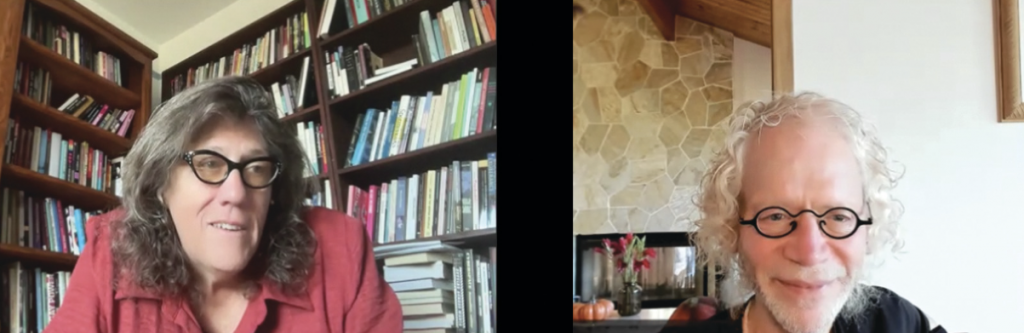
Tom LeNoble: Susan, congratulations on Changing Gender. You have spent decades researching, documenting, and helping shape our understanding of transgender history. What inspired you to write this particular book now, and what did you discover during the writing that challenged your own thinking?
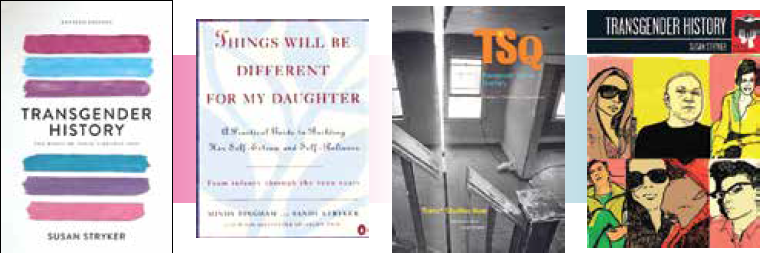
Susan Stryker: I originally thought of it as a longer version of the little Transgender History book I had already written. But given the political climate we’ve been in for the past ten years, and the profound polarization around these issues, I felt that people couldn’t even agree on the frame of reference they were using. There were competing paradigms of reality at stake.
That made me realize I needed to focus, not so much on the facts I wanted to put into a historical narrative, but on the framework of gender itself. Where does this word come from? What have we used it to mean? What is the history of how we have thought about these issues through this particular term?
Because the book was intended for a general audience rather than an academic one, I decided to interlace the historical narrative with personal stories that could bring some interiority and subjectivity to these issues. I didn’t want to shy away from complicated ideas, but I wanted to explain them through illustrative anecdotes and storytelling.
As I began writing from the perspective of interrogating the framework of gender itself, the style that emerged was this eclectic, kaleidoscopic approach. I hope people will find it engaging and entertaining, as well as informative and inspiring.
Tom LeNoble: Your book explores how the meaning of gender has evolved throughout history. For someone who has never questioned what gender means, what would you most like them to understand after reading your book?
Susan Stryker: The most basic thing is gaining an awareness that how we think about things has a history. There was a time when people thought the sun revolved around the Earth. Then there was this enormous shift in understanding, and people realized it was the other way around. But when you’re living within a particular paradigm, you don’t necessarily question it. You don’t think about the fact that it has a history.
The most fundamental takeaway I would like people to get from the book is that many things we assume are simply natural facts are actually shaped by history.
There really is biology, and there really are biological differences. But the uses we make of biology, the ways we construct social categories of personhood, and how we understand what biology is and isn’t capable of are all historical.
Gender is not a synonym for sex. Gender is a category, and sex is an object that we make up to fit into that category. The more we focus on that distinction, the more possible it becomes to understand that things we assume are unchangeable can actually change.
So, let’s change gender, partly by imagining that gender is something changeable. We’re not arguing about gamete size or menstruation. That’s not what we’re talking about.
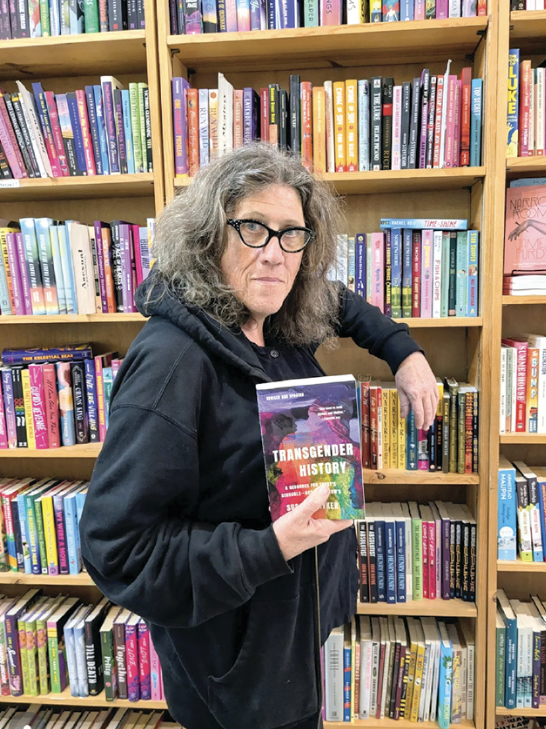
Suzanne Ford: You combine historical research with deeply personal experiences in the book. Was there a particular moment in your own life when you realized that the way society defines gender needed to change?
Susan Stryker: There certainly was a moment in my life, which I talk about in the book, when I realized that the world I had been thrown into, without ever having been asked, was organized in a way that didn’t seem like a good fit for who I understood myself to be. That realization came very early.
I think human beings in general should have a sense of curiosity about the world they’ve come into. For trans people, that curiosity can be connected to a feeling that the world isn’t organized for them. This isn’t a world structured in a way that makes it easy for me to be in it. So, where’s the problem? How can I fix it? What needs to change?
Some people might turn those questions inward and ask whether they’re bad, sick, wrong, sinful, or crazy. But I think most trans people feel they’re perfectly fine human beings who happen to have this question about what it means to feel the way they do about themselves.
Being trans can lead you toward realizing that many things that seem carved in stone, or even carved into your flesh, aren’t necessarily as stable or permanent as you might think.
Early on, being trans encouraged me to figure out what you can change and what you cannot. And there’s so much that can be changed about gender.
Tom LeNoble: The book begins with an encounter at Stanford involving opposing perspectives on gender. What did that experience teach you about the way we communicate across differences? Do you believe meaningful dialogue is still possible?
Susan Stryker: I certainly think there’s no upside in talking to some people. I’m not going to try to persuade a fascist that it’s okay if I’m alive. That’s a fight, not a discussion.
On the other hand, I think it’s important to understand what people are saying about you, how they’re making sense of things, and how they’re framing their arguments.
There are people who would rather that you didn’t exist, and there isn’t going to be a productive conversation with them.
But there are other people where, if you can find the grain of truth in whatever story they’re telling, even if they’re telling it in a bad or wrong way, you might be able to reframe it within a different story that makes more sense. I think that’s worthwhile.
At heart, I’m an educator and a storyteller. While I fully acknowledge that there are people I don’t want to talk to, there are others where I can sit down, listen, and perhaps learn something about where they’re coming from. Then I might have something to say in response that helps move the needle.
Tom LeNoble: San Francisco has played an extraordinary role in LGBTQ+ history, and you’ve been both a participant in and a historian of that evolution. How has this city influenced your work, and what makes its transgender history particularly important?
Susan Stryker: I think there’s some truth in that cliché that everything happens first in San Francisco, and then New York thinks they did it first [laughs].
People have come to San Francisco for a long time looking for space to be something they couldn’t be at home. That certainly plays into queer, trans, and LGBT history here. There’s also been a powerful history of working-class movements, labor movements, arts movements, and social movements. All of that has made San Francisco an inspiring place.
But I have a lot of sadness and trepidation about San Francisco these days. I feel that many of the things I really value about the city are being suffocated or pushed out. It’s a much more homogeneous place and a much wealthier place than the San Francisco I came to 43 years ago. I’m trying to orient myself to what San Francisco has become and is becoming, and how the political values I hold can continue to be part of the mix here.
When I think about trans history in San Francisco, one thing that gives me pause is how easily a celebratory transgender perspective can be folded into a more general model of inclusion.
We celebrate Transgender History Month. We have a Transgender District. Those are good things, and I don’t oppose them. But as easily as those things can be folded into a celebration of diversity, they can be pushed right back out.
I don’t think it’s enough to raise a transgender pride flag and say we’ve achieved something. There are real material needs that trans people have. There’s still anti-trans violence and prejudice. I believe people need to live in a society where their worth isn’t measured by how much money they have in the bank.
When I talk about the Compton’s Cafeteria Riot, I always say it’s more important to remember what people were rioting against than what they were rioting as. Yes, they were trans people, sex workers, people who were precariously housed or unhoused, and people involved in different kinds of informal economies. Those identities and circumstances are important. But they were rioting against the police.
I would argue that opposition to policing has been a primary driving force of LGBT history, not just transgender history. Our movements have emerged in resistance to powers of the state and society directed against us through prejudice or economic interests. We shouldn’t forget that history. If we reach a moment when our rights seem secured or recognized, we need to remember where the movement came from and what it was about.
I always tell people that a right is something somebody gives you, and, if they give it to you, they can take it away. Frederick Douglass said that “power concedes nothing without a demand.”
We need to be a strong, mobilized, proud, and defiant community that holds its own space. It’s not something somebody gives us. It’s something we claim.

Tom LeNoble: Your work has helped preserve stories that might otherwise have been forgotten. When you look back at the people who helped build the transgender rights movement, whose contributions do you believe deserve greater recognition?
Susan Stryker: I’ll take the easy way out and say all of them deserve more recognition. Some of my own writing has focused on politically active trans people, those who have been more visible in the public eye, and the relationship between trans issues and social movements.
But I think we need much more knowledge about the everyday lives of everyday people. That history can be harder to recover. You see the light that’s shining, but you don’t necessarily see what’s obscured by that light or what remains unilluminated nearby.
I’d like to see more of that ordinary, everyday transgender history become better known.
Tom LeNoble: Your book challenges assumptions about gender across the political spectrum. What misunderstandings do you encounter even among people who consider themselves supportive of transgender equality?
Susan Stryker: I’m sometimes surprised by how many people, both within the trans community and outside it, want to base transgender rights or respectability on a medical narrative. It’s as though someone has to say, “I got my diagnosis,” or, “I need this particular healthcare so I can be a normal person.”
That frames transgender rights as primarily about access to transition care rather than basic human rights. I think we need to break out of what I would call the medico-legal complex. There’s this very tight linkage between rights and medicalization, and I think it’s a straitjacket.
Everybody wants good healthcare. If you have issues related to being trans and it would help to talk to someone, that’s great. But the idea that how I live in my body, who I am to myself and others, and how I’m recognized in the world should somehow be allowed or not allowed based on my relationship with the medical establishment is deeply problematic.
The notion that engaging in a particular transition practice changes your civil status is a framework I think needs to be completely rethought.
Suzanne Ford: Many people want to be supportive of transgender family members, friends, colleagues, and neighbors but are uncertain about what to say or do. What does meaningful support look like beyond simply expressing acceptance?
Susan Stryker: Educating yourself. Talk to actual trans people. Ask hard questions. Find trans people who will reassure you that there are no stupid questions, and that you can ask anything if you’re asking from the right place. It’s important for people who aren’t trans, or who don’t have a connection to a trans person or community, to have opportunities to widen and inform their perspectives.
I also think it’s important for allies to do some of the hard work of reaching people that trans people can’t necessarily reach.
There are people who simply aren’t going to listen to me. They’ve already decided they disagree with whatever comes out of my mouth. They’ve stereotyped me as the radical transsexual from San Francisco spreading the woke mind virus.
If there are people who care about trans issues and can reach individuals who won’t listen to people like me, they should do that.
Tom LeNoble: Much of today’s conversation about gender focuses on laws, politics, and public controversy. What are we missing about the everyday human experiences of transgender people when the conversation becomes primarily political?
Susan Stryker: That gets back to the importance of everyday trans history and everyday trans lives. It’s so tiring to feel that your very existence is an issue for somebody else.
I think trans people need to be realistic and have their eyes open about the very real forces that are hostile to us, sometimes deadly hostile. We shouldn’t be asleep to that reality. We need to organize for our own care and protection.
That’s why mutual aid, self-support, taking care of ourselves, and finding spaces where we can be together are so important.
This is something I tried to do in my work in higher education, particularly in developing an interdisciplinary field of transgender studies. Part of my motivation was simply that I didn’t want to spend my life arguing with people about whether it was okay for me to be alive.
What if we started a different conversation? What if we talked among ourselves and invited anyone who was interested to join us, without centering the voices of people who don’t want us to be talking at all?
If you don’t like the conversation, start another conversation.
That’s been my approach all along. I still feel that way, not just about academic fields, but about social discourse more generally. We should do much more of that.
Tom LeNoble: Throughout your career, you have been a scholar, filmmaker, activist, and educator. What has motivated you to devote so much of your life to documenting history and expanding understanding, particularly during times when that work has been difficult or unpopular?
Susan Stryker: There’s a chapter in my book that is a story about how I became who I am. It explores why I care about all these questions, going back to when I was very young, even under five years old. I had questions that made me curious about the world.
I think there’s always a little “me-search” in the research one does as a historian. I had questions about myself. How is it that such a being as I could exist? I exist, and here I am, so how does this happen? Those are philosophical questions as well as historical ones.
I have a very clear memory of learning about surgery and hormones when I was ten years old, in the early 1970s. My immediate thought was that there was a history question there. There was a time before anesthesia and surgery. There was a time before hormones.
What would it have been like to be a person like me at a time when those things weren’t possible? Would a person like me even exist if society weren’t organized in a way that made certain paths forward possible? I went to those larger questions very early.
Part of why I’ve done the work I’ve done is that fundamental curiosity about what it means to be a trans person in this world. That never goes out of style. It’s never not relevant.
But there’s another part of the answer, and that’s that anti-trans discrimination and prejudice are real.
Up until around 1990, I was perceived as a straight white guy with a PhD from Berkeley. That’s several steps ahead in the race toward a comfortable upper-middle-class life. Then I transitioned as I was finishing my PhD. That gave me a very clear measuring stick for the societal impacts of transphobia, homophobia, and misogyny.
You could fall off the edge of the world, or at least that’s what it felt like 35 or 40 years ago when you came out as trans. For a while, I was just trying to make money however I could. I was making very little. I joke that I had a seven-year unpaid internship in experiential trans studies. That was my postdoctoral training. I learned a lot, but I was practically living on air for a while.
Part of the intellectual work I took on came from realizing that I didn’t have a six-figure job to lose by pursuing whatever I was interested in. And I felt there were both personal and political reasons to begin the long process of shifting the world around me to make it more accommodating to my being in it. Just get busy, one foot after another. That was my attitude.
Looking back after roughly 35 years, it all adds up to something. I’ve accumulated a body of work, but while I was doing it, I wasn’t thinking about building some grand legacy. I was simply asking, “What’s right in front of me to do? What’s the next step?”
Good times, bad times, hard times, fun times. You keep going.
Slow and steady wins the race toward creating the world you want to live in by doing the things you know how to do.
Suzanne Ford: San Francisco’s LGBTQ+ community has a remarkable history of supporting one another through adversity. As you consider the future, what responsibility do established organizations, community leaders, and individuals have to support younger transgender generations?
Susan Stryker: I want to push back on that question a little. It’s very clear to me, both from my lived experience and from what I know as a historian, that there’s a bit of fiction in the idea of an LGBTQIA+ community that has always had each other’s backs.
I remember going to meetings where I was told to sit down and shut up as a trans person. It wasn’t my turn. I needed to wait in line.
I’ve experienced feminist transphobia firsthand. I’ve experienced gay men who had deeply visceral reactions to the idea of someone modifying their genitals and then mapped an anti-trans politics onto that reaction.
I don’t want to say that the community has always been united, because it hasn’t. I think the community has, time and again, been quite willing to throw trans people under the bus.
I remember the 1993 March on Washington, when they wouldn’t put the word “trans” in the title. I remember the Human Rights Campaign actively undermining transgender political organizing. I’m no Pollyanna when it comes to the unity of the community.
Does that mean I don’t have friends, colleagues, and comrades across all the flavors of the rainbow? Of course not.
I love being part of broad, diverse queer, trans, and feminist communities. I think they’re incredibly important. But I also think it’s delicious when you find that sense of community.
It’s an important aspiration to hold in your mind, but I don’t want to be naive about the fact that divisions within the community continue to emerge, and that trans people are often on the short end of the stick.
Tom LeNoble: When you reflect on your life’s work, including your books, films, teaching, and activism, what impact matters most to you? Is there something you hope future generations will understand about your contributions that might not be obvious today?
Susan Stryker: About my contributions? No. Genuinely, no.
I love what I do. Of course, I’m pleased if I receive recognition for something, or if I can see that something I’ve done has helped someone, changed their mind, or made an impact. Of course that pleases me.
I want to use what I’ve learned, what I know, and whatever communication or analytical skills I have to put something into the world that might help move things in the direction I think they should go. If I can do that, I’m satisfied. I really am.
I also have a pure and simple belief that education is good. Learning is good. Being curious is good. Anything I can do that helps promote those qualities in people thrills me.
As for my hopes for the future, there are two things. First, I wish everybody could have a feeling of being autonomous and self-directing in their own lives, while also being part of a community that celebrates and acknowledges that. Second, I wish people just didn’t care quite so much about trans identities. You do you. I’ll do me. Let’s all go enjoy the street fair. The more we can get to that point, the happier I’ll be.
In the meantime, knowing our history becomes one way of moving us toward that goal.
Tom LeNoble: That reminds me of a personal experience. In 1973, a friend of mine returned from surgery with Dr. Stanley Biber in Trinidad, Colorado, and spent several weeks with me while I helped care for her. I remember asking her, “Now that you’ve done this, what is your greatest wish?” She told me, “I just want to be me, blend in with everybody else, and live my life.”
Susan Stryker: That’s beautiful. There’s a quote we used in an interview in Screaming Queens. One of the narrators, Amanda St. James, has the last word in the film.
She’s reflecting on her history in the Tenderloin, and she says something to the effect that you just don’t let anything turn you around. She says that, if she were to write her memoir, it would be called Wild Is the Wind, because that’s what it’s like. You’re just out there, and you’re free, and you’re yourself. That’s what we wanted to end on. You’re out there. You’re free. And you’re yourself.
Tom LeNoble: Your book asks readers to reconsider something many have always taken for granted. If we were sitting together twenty years from now, what would you hope had changed in how we understand gender, treat one another, and recognize our shared humanity?
Susan Stryker: I hope we could recognize our shared humanity, treat each other with kindness and respect, and know that many things people believe are some kind of painful natural inevitability are, in fact, within our capacity as human beings to transform in ways that are more affirming of life.
Tom LeNoble is an international speaker, confidential advisor, and resilience strategist who works with leaders navigating meaningful inflection points in life and leadership. He has held senior leadership roles at MCI, Walmart.com, Palm, and Facebook, and high growth startups. He is the author of the award-winning memoir “My Life in Business Suits, Hospital Gowns, and High Heels.” Through speaking, coaching, and writing, he explores resilience, leadership, and the choices that shape how we show up for others and for the communities we serve.
Suzanne Ford is the Executive Director of San Francisco Pride and the Co-President of InterPride, which is the international association that connects Pride organizations around the world.
Transgender Awareness Month
Published on November 19, 2026















Recent Comments