







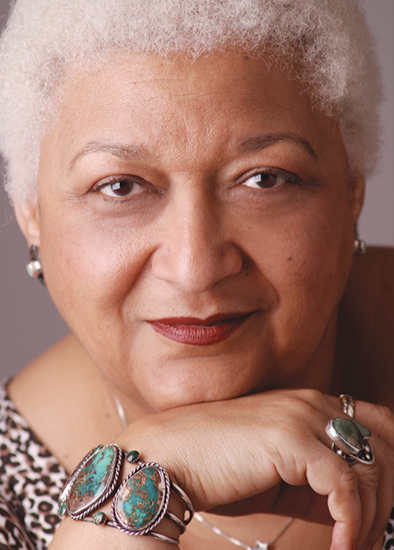
By Jewelle Gomez—
“Flamboyance and fortitude, femme and butch—not poses, not stereotypes, but a dance between two different kinds of women … .” Joan Nestle wrote this in A Persistent Desire: A Butch/Femme Reader (1992). The book was a suitable response to a rising noise from some early lesbian feminists who felt the ideas of “butch” and “femme” were simply ways we copied heterosexual models of behavior. Butch and femme, to them, were “roles” we put on like our neckties or lipstick, not identities deeply embedded in who we are and what we desire.
I was thrilled to have Joan’s exploration of an identity (femme) I’d always embraced, and her illumination of the idea of butches; these were the women I always scanned for whenever I entered a room. Over the decades, the femme/butch dyad has been more accepted, especially when women understood that no one was dictating that lesbians had to adhere to one end of the spectrum or the other. Just as there are a myriad of ways to be a woman, there is a full spectrum of ways to be a butch or a femme. (See Cheryl Clarke’s classic poem “Of Althea and Flaxie.”)
I have, in the past, called femmes the agents of guerrilla warfare. Nobody sees us coming because this culture easily dismisses anyone (of any gender) who fulfills the “feminine” ideal. But butches are usually the lightning rod; they are the ones targeted by men on the street because their sexuality seems so obvious—although I’ve known many heterosexual butch women!
Butches have been accosted for years in the women’s bathroom; the subtle blend of the two ends of the spectrum caused confusion then and now. Recently, my spouse Diane and I waited in line for a women’s restroom in one of those Broadway theaters that have elderly women attendants in the lavatory. As Diane waited for me at the door, a genteel white lady in her maybe 70s pointed out to Diane that this was the “ladies’ room” and the “gents’” was across the lobby. I then stepped out beside Diane before she could respond, and the attendant almost smiled as she said, “Oh, you’re a lady gent.” Somehow, she crossed whatever divides there were between us to create a word that was a nonjudgmental descriptor, while others in her position might have been calling security.
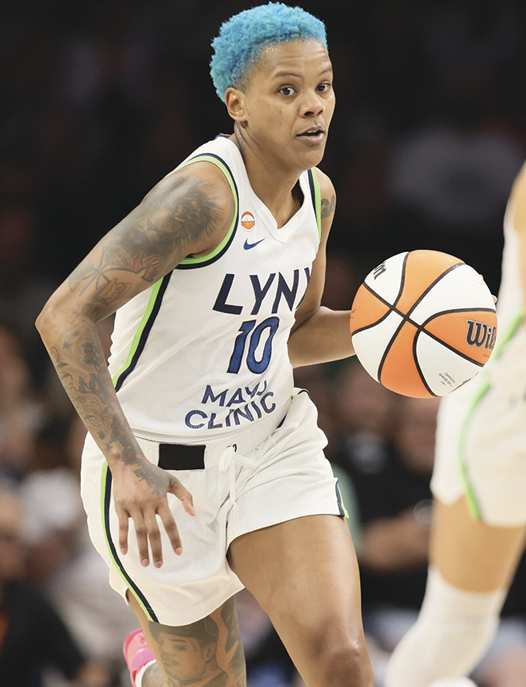
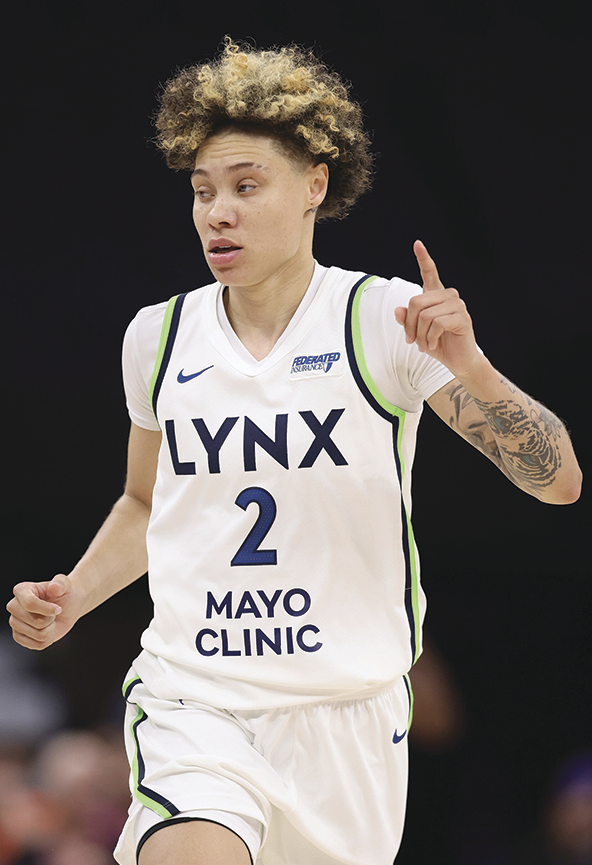
As I immerse myself in the basketball games of the WNBA, I realize that watching women racing up and down a court in shorts, sweating, strong and skilled, is like a dream come true. The players come in many shapes and sizes. I long to just stand next to a woman who’s 6’7” just because.
You can’t usually tell which player is a lesbian just by looking at her. So many of them have hair extensions and fake eyelashes, I guess as a way to not be so easily dismissed as lesbians. Not surprisingly, more WNBA players have come out than have NBA players, and recently there was an online chart claiming to show that WNBA teams with more out lesbians had better win records! I’m not betting any money on that, but why not?
The phenomenon of the Stud Budz brings the image of butches to center court. Courtney Williams and Natisha Hiedeman are former teammates, friends, and podcasters who are out butch lesbians—sometimes with pink afros. Their presence, and that of others on the court like Brittney Griner (and I’ll toss Breanna Stewart in there, although I’m not sure), signal a new dawn for butch lesbians. Then there’s eminent producer/actor Lena Waithe, a dashing groundbreaker with the direct stare any butch would be proud of.
I’m thrilled that the efforts to make lesbians invisible always fail and that butch lesbians can stand tall and be themselves—that is, beacons of accomplishment, charm, and pride.
Jewelle Gomez is a lesbian/feminist activist, novelist, poet, and playwright. She’s written for “The Advocate,” “Ms. Magazine,” “Black Scholar,” “The San Francisco Chronicle,” “The New York Times,” and “The Village Voice.” Follow her on Instagram and X @VampyreVamp
Leave Signs
Published on September 10, 2026












Recent Comments