








By Gary M. Kramer—
The new film of trans and non-binary writer/director Jane Schoenbrun, Teenage Sex and Death at Camp Miasma, is an astonishing homage to slasher films yet it also presents a sensitive queer love story. The movie won the Queer Palm at this year’s Cannes Film Festival and the audience award at Frameline50 earlier this summer.
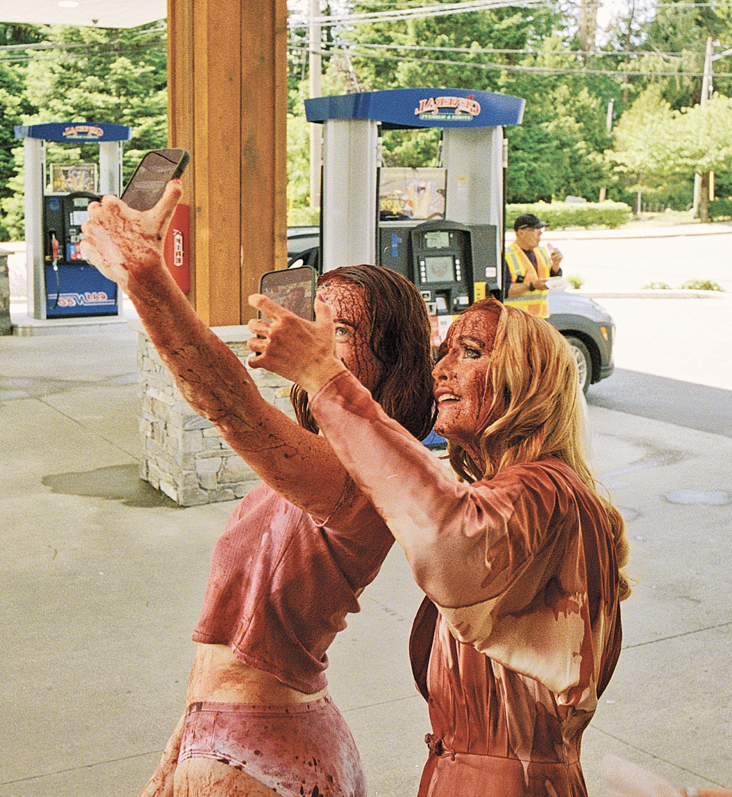
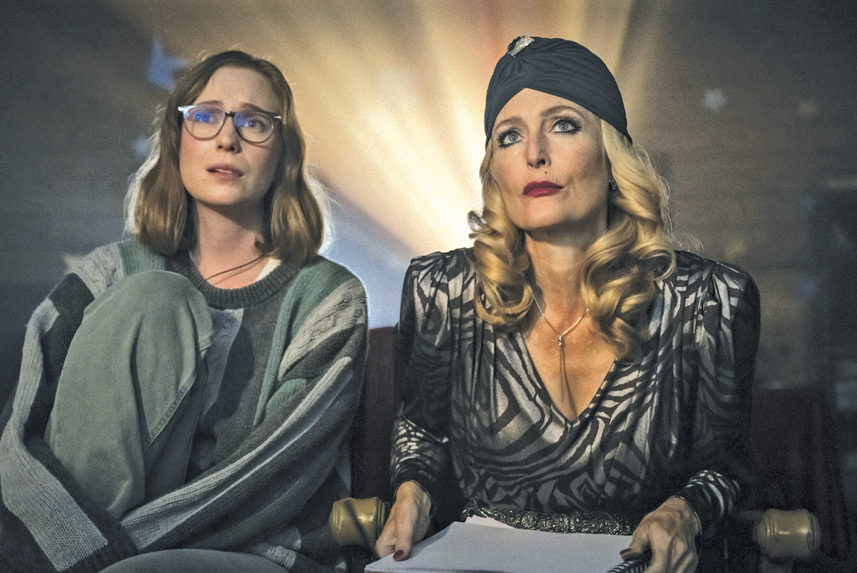
Schoenbrun has a deep appreciation for the horror genre. The opening credits of Teenage Sex and Death at Camp Miasma reveal how the original Camp Miasma film spawned sequels, toys, games, and even a New Yorker cartoon. The central plot has Kris (Hannah Einbinder), a filmmaker, meeting with the reclusive actress Billy (Gillian Anderson)—the final girl in the original film—to see if she will participate in the reboot of the franchise. What transpires between the two women becomes far more complicated than just a job interview. Billy may be seducing Kris, who wants to learn how Billy captured a certain look in her eye when her character is threatened by “Little Death” (Jack Haven), the killer of the Camp Miasma series. As the film folds in on itself, Kris’s relationship with Billy gets complicated.
Schoenbrun spoke with me for the San Franscisco Bay Times about making Teenage Sex and Death at Camp Miasma and the impact of slasher films.
Gary M. Kramer: Teenage Sex and Death at Camp Miasma is very strategic in how it acknowledges and portrays horror film tropes. Can you discuss how you incorporated everything from the killer’s heavy breathing to references to Psycho, to even a line about jump scares?
Jane Schoenbrun: It’s one of these genres with rituals that are so deeply ingrained in the genre that watching slasher movies can sometimes feel like sports. You are kind of waiting for the next kill, or you kind of know the order in which the characters are going to get killed. So much of the language of the slasher film—which comes from Hitchcock and The Texas Chainsaw Massacre, and Friday the 13th, etc.—are these well-worn tropes that are immediately distinguishable. Being self-aware of them in the film is nothing new. Scream was one of my favorite movies as a kid, and it was getting a lot of mileage out of acknowledging and sort of subverting these well-worn tropes of the slasher film.
That wasn’t necessarily all I wanted to do, although I think it is very fun to acknowledge the trope and then find a way to subvert it. As [I am] a writer and a fan of the genre, it becomes a way to communicate. But I had something specific that I wanted to communicate. It wasn’t just about pointing out all the clichés and then doing them. It was about putting it in the parlance of the movie—remaking something. Many of these tropes, from the girl running with her breasts bouncing in the woods, to the heavy-breathing killer leering from behind the camera at the coeds, are just dripping with Freudian meaning. I wanted to find ways to subvert and remake the way that those tropes have dealt with gender nonconformance. I wanted to update them so that, instead of being weird and misogynist and heterosexual, as those movies often are, there was something that was liberating and queer and playful in the way I was interpreting those well-worn tropes.
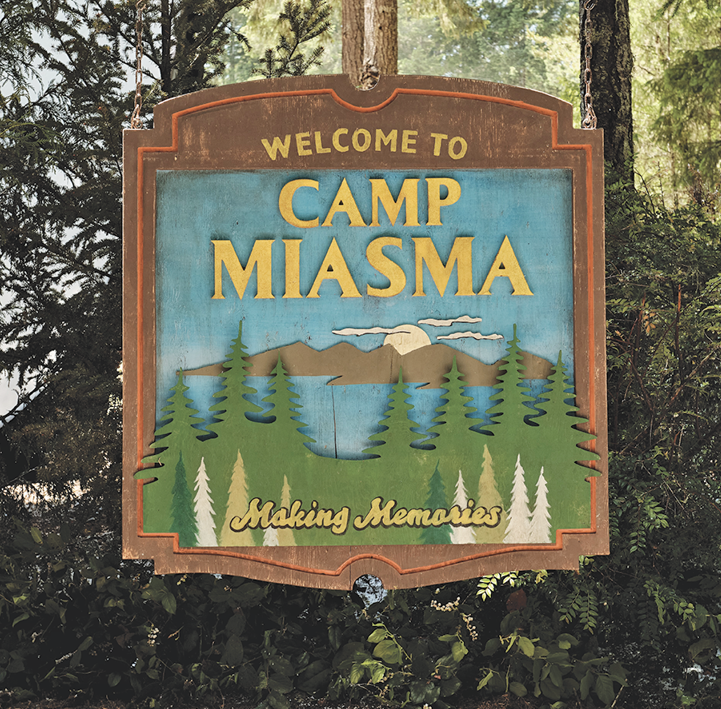
Gary M. Kramer: One of the many things I loved about your film was the production design, which had so many brilliant details. But I also admired the film shifting in and out of reality, in and out of the Camp Miasma films, and then blurring the lines between them. Can you talk about creating that?
Jane Schoenbrun: It’s like a form of filmmaking I’ve always enjoyed, where the characters are getting together to make a movie or write a book and then slowly the elements from the fiction within the fiction seep into fiction that we are watching. Barton Fink was a major influence for me. Swimming Pool was another, [as was] Persona, and Mulholland Drive, and David Lynch in general. I look for structures through which I can create a film language that allows me to express something through these well-worn genres that hasn’t been expressed before. [It is] this idea of movies within movies that become our movie, or change in certain ways; this liminality of the things that we’re watching being both real and fictional. The relationship between those two things being just something that’s oozing, or changing or constantly being subverted, has been in my work from the very beginning. I would go so far as to say that it’s like the building blocks structurally of how I’ve learned to communicate cinematically.
Gary M. Kramer: There is a very critical episode in the Camp Miasma film where Little Death’s origin story is recounted, and Kris explains it is transphobic. Your film-within-a-film can be read as a story about trans fear. But I also flash on the idea of transness when both Billy and Kris talk about dissociating during sex. What was your intention here?
Jane Schoenbrun: The movie came out of a period in my life when I was still early in my transition, but far enough along that I was starting to feel good in my body and myself for the first time in my life. I was starting to work on being able to have a non-dissociative relationship to sex, which was something that was never available to me before transition because I literally wasn’t the person who I was. And so much of the healing of that trauma and learning how to have a positive relationship to myself post-transition involved coming into myself sexually the way that many people I think, do when they are teenagers. I was experiencing that in my mid-30s. So much of it was about undoing an image of myself as a “monster” that I believe is very much something that was taught to me in the 90s by movies like Silence of the Lambs. If you trace this genre, the slasher film has always been obsessed with the gender-nonconforming killer, from Psycho to Dressed to Kill, to Leatherface in The Texas Chainsaw Massacre, to the deviance and sexual repression of a Michael Myers or a Jason Voorhees [in Halloween and Friday the 13th, respectively]. I think that those are movies that I found both comforting and also disturbing, because they showed me an image of transness that was inherently disgusting. But at least it was an image of transness. I was fascinated by those movies and drawn to those movies, but, ultimately, when it came time to learn how to see myself, I needed to destroy that image of Buffalo Bill in his woman suit, [in Silence of the Lambs.] I think, in many ways, that is psychically what I’m trying to do in the movie—to literally remake these tropes of the trans monster into something that, instead of being an object of fear and disgust, could be desirable in some way.
Gary M. Kramer: You absolutely link sex and death in the film with the killer character Little Death. What connections do you make with this? There is an idea of sin and punishment, but one could also read some of the action as empowerment.
Jane Schoenbrun: Very early on, I was reading a lot of [French philosopher Gilles] Deleuze, and I would describe it to myself as a Deleuze-ian slasher. There’s this idea in Deleuze of humans as desiring machines. The goal isn’t even necessarily to have desire fulfilled. It is to create the circumstances through which you can desire in a healthy, rich, and diverse way, which is kind of a sex-positive message at the end of the day. I found that so interesting when I would watch a slasher film—even though these films are, obviously, a ritual that is imbued with so much violence, and, as you say, sin, punishment, murder, blood, guts, misogyny, etc. But the process of watching these things wasn’t upsetting. It was, in many ways, joyful, right? There is something that feels libidinal, or celebratory, or ritualistic in watching a movie where people are getting chopped up and blood is spraying in geysers all over the place. It feels to me like some kind of fertility dance or something. I really wanted to make a movie where that line between fear and desire, which I think has always been a little screwy in the slasher film, was completely reversed, so that you’re never really scared of someone dying in the movie. In fact, death carries with it this almost, like, sublime pleasure. And that’s because it’s a movie. As the characters acknowledge as the movie goes on, “If it gets too real, you can turn it off.” It is very much a movie about play, and a movie about learning how to enjoy things that feel unsafe in a way that is safe.
Gary M. Kramer: The deaths in the film are mostly over-the-top with copious bloodletting. How did you come up with the violence and determine the right amount of bloodshed?
Jane Schoenbrun: My first two films were a lot darker and deal with psychic terrain that is pretty upsetting. This one is dealing with stuff that is essentially joyful and playful. Those first two films don’t have any blood in them; it’s all internal torment, and it’s disturbing in a very internal, interior way. This film came from a time when I was happy, and I wanted to make something that, like, was a little bit of a sigh, or an exhale, or letting my hair down. I remember that the first scene needed a literal fountain of blood spraying high up into the air, marking the territory that this is going to be a film that is very different from what I’ve done before. It is sticky and playful and filled with flesh and fluids in a way that my work hasn’t been to date.
Gary M. Kramer: How would you fare as a final girl?
Jane Schoenbrun: I don’t know that I’d make it to final girl. I’d be the stoner who is second to last.
Gary M. Kramer: Given all the candy consumed by the characters in Teenage Sex and Death at Camp Miasma, I have to ask: What is your favorite candy?
Jane Schoenbrun: Well, in the movie, I’m not lying when Hannah’s character says, “These are the best,” and shows the Jolly Rancher fruit chews. There are a lot of different types of Jolly Rancher gummies, but it’s those fruit chews specifically that hit like nothing else. And that’s not product placement. No candy brands were involved in this film. This is pure love of the game.
© 2026 Gary M. Kramer
Gary M. Kramer is the author of “Independent Queer Cinema: Reviews and Interviews,” and the co-editor of “Directory of World Cinema: Argentina.” He teaches Short Attention Span Cinema at the Bryn Mawr Film Institute, is a member of the Advisory Board for the journal Short Film Studies, and is the moderator for Cinema Salon, a weekly film discussion group. Follow him on IG @garyemkramer
Film
Published on August 13, 2026













Recent Comments