





By Stuart Gaffney and John Lewis—
In Part 1, we discussed the first of two cases pertaining to LGBTIQ rights that the U.S. Supreme Court will decide in the 2026–2027 term, St. Mary Catholic Parish v. Roy. This edition, we discuss the second case, International Partners for Ethical Care, Inc. v. Ferguson, to be heard December 7, 2026.
At issue in the second case is legislation the state of Washington enacted in 2023 “to address the health and safety risks to transgender or pregnant youth experiencing homelessness,” in particular, runaway youth. As recognized by the Washington legislature, “LGBTQ+ youth are at greater risk of experiencing homelessness compared to their heterosexual or cisgender peers and report experiencing higher rates of abuse and mental health issues.” Indeed, testimony before the legislature revealed “that LGBTQ+ youth account for at least 40% of youth experiencing homelessness in King County,” where Seattle is located.
Under state law, licensed homeless shelters are generally required “to contact parents within seventy-two hours of the youth’s arrival, unless there [are] compelling circumstances not to, e.g., when notifying the parent would subject the minor to abuse or neglect.” In those cases, the shelter notifies the state Department of Children, Youth, and Families, who, in turn, notifies the parents and “offer[s] services to the youth and the family designed to resolve the conflict … and accomplish a reunification of the family.”
When some trans or pregnant youth, however, learned that upon arrival the shelter would notify their parents, thereby revealing the exact location where they were, they would “leave the safety of shelters or avoid them altogether.” They would then end up on the streets, where they were at particularly high risk and less able to access mental health and other supportive services, and they and their families were deprived of valuable resources to attempt family reconciliation.
Recognizing the gravity of this problem, the Washington Legislature made a few minor changes to existing law that had the potential to unlock enormous benefits to both runaway trans and pregnant youth and their families. A key modification was that when a “youth seeking protected health care services—including gender-affirming care or reproductive health services—arrives at a licensed shelter,” the shelter, instead of directly notifying the parents, notifies the state Department of Children, Youth, and Families, who would then notify the parents.
The new law further requires that, along with this notification, the Department must offer to make “appropriate behavioral health services” referrals for the youth and offer both youth and their families “services designed to resolve the conflict and accomplish a reunification of the family.” And it requires the Department to offer these family reconciliation services within three days, excluding weekends and holidays.
The modifications make shelters a safe space for trans or pregnant youth so that they don’t “disappear back onto the streets,” and enable both them and their parents to have access to vital services the Department offers to try to facilitate a healthy and successful family reunification process that works for all.
Despite these obvious potential benefits, two anti-trans parental organizations (who characterize all gender affirming care as “duplicitous”) and five sets of parents (four of whom have gender nonconforming children whose gender identity they reject, and two of whom are very conservative Christians) brought suit challenging the new provisions. They also challenged Washington’s over forty-year-old law that allows any youth thirteen years and older in need of mental health care to “request and receive outpatient treatment without the consent of the adolescent’s parent.” That law, which is similar to laws in thirty other states, applies to all adolescents regarding all mental health care and contains nothing specific about gender affirming care.
Still, the plaintiffs make the outlandish claim that the Washington legislature “designed” the laws at issue in the case “to give runaway minors ‘gender affirming treatment’ without parental notice or consent.” The laws do no such thing. As the Department describes, plaintiffs both “misstat[e]” and “contort the law” and “massage the facts” to attempt to make a case.
Significantly, the issue currently before the Supreme Court is not the merits of the plaintiffs’ claims themselves. Instead, it’s whether the parents have the right to bring the lawsuit at all because none of them has suffered any sort of cognizable concrete injury, a prerequisite for bringing a federal lawsuit. The record is clear that none of the parents has “a transgender youth who has run away to a licensed shelter and received or sought gender affirming care or outpatient mental health treatment without parental consent.” None of the parental organizations has members who have runaway children who are part of the system. One set of parents does not even have a gender nonconforming child but simply does “not support the idea that a child can change from being a boy to a girl or from being a girl to a boy” because they believe “the Bible is the Word of God.”
A person cannot bring a federal lawsuit just because they don’t like a law or because they have religious beliefs against it when the law does not directly affect them in any way. That’s why the lower courts unanimously rejected the parents’ lawsuit, with the appellate court explaining that the parents’ “claims rely on an enormity of ‘ifs’” and that a “convoluted series of events” would have to transpire for them to be affected by the laws.
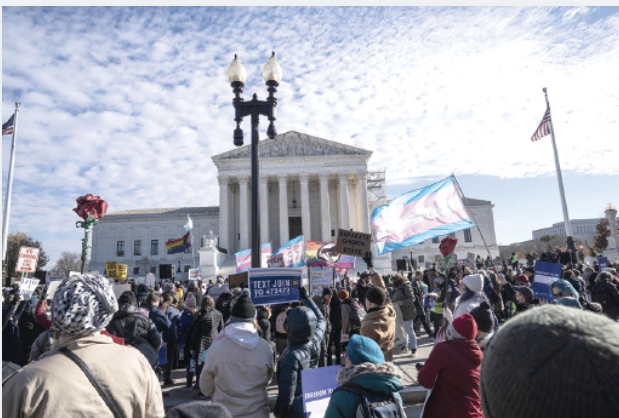
But sadly, the Supreme Court decided to hear the case, which is, of course, a matter of serious concern given the callous disregard for the wellbeing of trans youth that the very conservative supermajority has demonstrated over the last two terms. In the latest example, Mirabelli v. Bonta, which we discussed in the March 12 edition of the Bay Times, the supermajority on a different but related issue jettisoned concern for the protection of trans and gender nonbinary youth in favor of what it asserted were the rights of conservative Christian anti-trans parents.
The Court here should simply reject the lawsuit because the plaintiffs have suffered no legally cognizable harm, but there’s a real possibility it won’t. Stay tuned.
John Lewis and Stuart Gaffney, together for over three decades, were plaintiffs in the California case for equal marriage rights decided by the California Supreme Court in 2008. Their leadership in the grassroots organization Marriage Equality USA contributed to making same-sex marriage legal nationwide in 2015. Today, they continue to educate and advocate for marriage equality and LGBTIQ+ rights worldwide.
6/26 and Beyond
Published on October 22, 2026









Recent Comments