










By Heather Hodges—
Opera Parallèle’s new production, Salt & Spirit, draws musical inspiration from the 1931 work, The Carolina Low-Country, which is an illustrated collection of songs and essays about Charleston, South Carolina. Its many authors were a group of White Charlestonians who called themselves the Society for the Preservation of Spirituals. Many of them were members of what was euphemistically called the “planter class” and they counted among their members DuBose Heyward, author of the novel Porgy (1925) and a collaborator with George Gershwin on the 1935 opera adaptation, Porgy and Bess.

The unifying mission of the Society’s members was preserving the heritage of the historic Charleston region, including the nearby sea and barrier islands. Part of that cultural heritage, reflected in the dozens of spiritual songs included in Carolina Low-Country, belongs to the Gullah Geechee people.
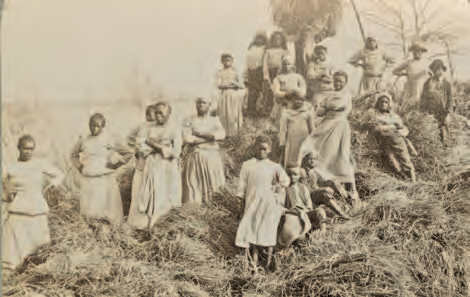
Who are the Gullah Geechee people? Gullah Geechee people are descended from Africans once enslaved along the Lower Atlantic coast of the United States. Many of their ancestors were trafficked from the Rice Coast of West Africa—modern day Senegal, Sierra Leone, and Liberia—directly into the Carolinas and Georgia. This region was the epicenter of American rice agriculture in the antebellum era. Stretching from Pender County, North Carolina, to St. Johns County, Florida, it is also nationally-recognized as the Gullah Geechee Cultural Heritage Corridor.
White plantation owners were often greatly outnumbered by Africans or absent for long times from their coastal and island plantations. The result was plantations that were highly Africanized cultural landscapes. Gullah Geechee ancestors arrived with a diverse range of cultural, linguistic, and spiritual practices. Eventually a new creole culture and language, now known as Gullah Geechee, emerged. Gullah Geechee people have been honored for the high number of African cultural retentions they have sustained for centuries. Well-known examples include sweetgrass basketmaking, the ring shout, and the Gullah language, an Atlantic English-based creole.
The word “Gullah” dates back to the colonial era. It was once used to describe enslaved people on the Carolina coast who had been trafficked from a specific part of Africa, likely modern-day Angola, at a time when the many Africans in the colonies were often identified by their ethnicity or their place of origin. Over time, “Gullah” came to be generally applied to a broader group of people enslaved in the South Carolina Lowcountry. The term “Geechee” was adopted in coastal Georgia to describe the enslaved people on its rice plantations and their descendants. The etymology of “Geechee” is less clear, but it is likely a geographic reference to the Ogeechee River near Savannah, a region dense with antebellum rice plantations.
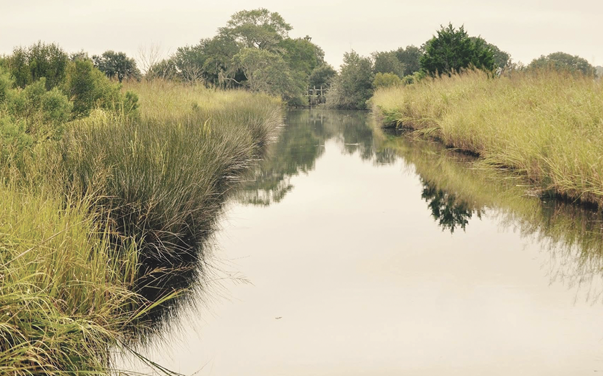
Gullah Geechee people can be understood in connection to their relationship to the land of the Lowcountry, rice cultivation, and their centuries of American coastal history and heritage. Theirs is a story told in the hundred-year-old praise houses that still stand on islands like St. Helena and Johns Island as testament to their vivid, spiritual life. It is also evidenced by the sweetgrass baskets that reflect ancient West African weaving traditions and that are made from natural materials found only along the coast. It is additionally evident in dishes like red rice, a Lowcountry favorite that calls to mind jollof rice and indelibly connects today’s Gullah Geechee chefs to the cooking pots of ancestors and contemporaries in West Africa. And it is also evidenced by the acres of rice fields that are still an indelible feature of our Lowcountry landscape. Drive down Highway 17, the old Savannah Highway, and you can still stand in them.
The old spirituals collected in Carolina Low-County, many of which carry themes of slavery, subjugation, and oppression, provide a lens into the complex spiritual, musical, and cultural life of the Gullah Geechee people. They are lamentations of Black suffering married to expressions of Christian faith. After Emancipation, spirituals remained an important cultural aspect of Gullah Geechee lifeways and their traditional songs formed an important canon that broadly shaped the future of African-American music. Notably, the song many people now know as “Kumbaya” was first recorded in the Gullah Geechee Corridor, in 1926, and also published in 1931 in Carolina Low-Country, where it was known by its original title, “Come By Yah” or “Come By Here.” “Yah,” also spelled as “yuh,” means “here” in Gullah and its lyrics are a searing cry for help: “Somebody need you, come by yuh, Oh, Lawd, come by yuh.”
The songs collected in the book also reflect the work the Society’s members did to write the lyrics as they heard them sung in the oral Gullah language. “Gullah” is an Atlantic English-based creole that is sometimes wrongly mischaracterized and demeaned as “broken English.” Twenty years ago, the De Gullah Nyew Testament was published. It reflects a groundbreaking, decades-long collaboration with Gullah speakers to document this beautiful, melodic creole language that reflects its blended African, Indigenous, and European roots.
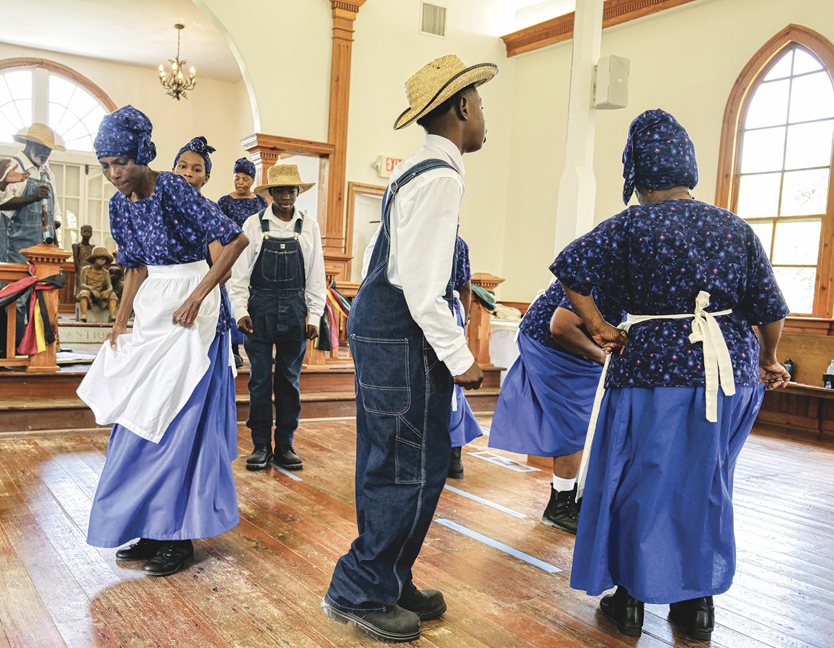
Gullah Geechee spiritual music and worship is also marked by “shouting”; a form of enthusiastic praise and music that often uses polyrhythmic hand clapping and audible footwork. In their old wooden praise houses, which often lacked fixed pews, the Gullah Geechee people also sometimes moved in a counter-clockwise ring, using “shuffling” movements combined with call-and-response singing of their spirituals and favorite hymns. This is now known as a “ring shout.” It is indeed a captivating, powerful musical expression. Novel works interpreting the musical culture of Gullah Geechee people of this era, like Salt & Spirit, provide new opportunities to educate people about Gullah Geechee culture and honor their influential musical legacy.
Salt & Spirit
Through November 21, 2026
Z Space, 450 Florida Street, San Francisco
For more information and tickets: https://operaparallele.org/
General tickets are $70 and Supported Access are $40.
Heather Hodges lives in New Orleans where she is a museum leader, writer, filmmaker, and champion for the traditional culture of the U.S. South. From 2017–2020, she was Executive Director of the Gullah Geechee Cultural Heritage Corridor. She is a producer of the 2026 album, “Believer I Know: Sacred African American Music and Rituals of Georgia and Louisiana.”
Arts & Entertainment
Published on November 19, 2026














Recent Comments