





By Gary M. Kramer—
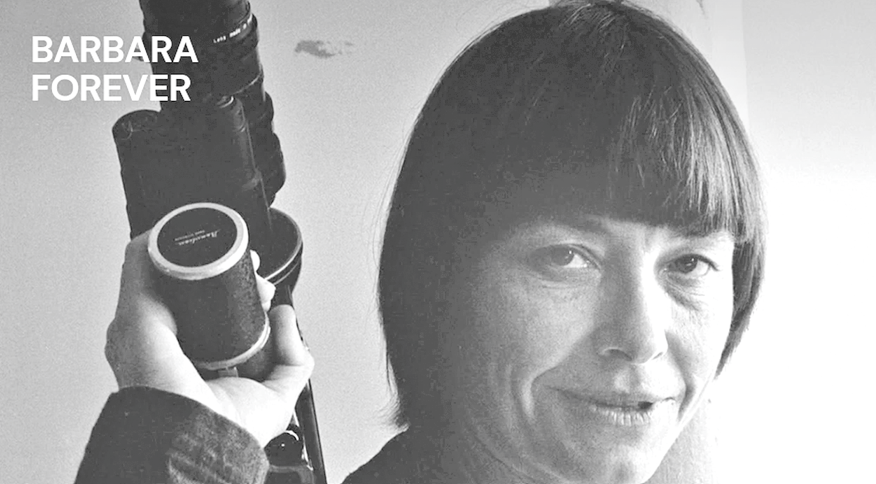
Barbara Forever is a warm, elegiac, and celebratory documentary about the groundbreaking lesbian avant-garde filmmaker Barbara Hammer, who passed away in 2019. Hammer documented herself and her lovers in her films and “opened a space for queerness” when there was little to no visibility for lesbians in cinema. Her shorts, such as Dyketactics, were invitations to explore female bodies and pleasure. Hammer’s significant body of work has been archived at the Beinecke Rare Book and Manuscript Library at Yale University, and Barbara Forever shows her spouse, Florrie Burke, managing that undertaking. The documentary also recounts Hammer’s claim that she “was born” when she became a lesbian.
Hammer lived and worked in San Francisco and New York City, creating films that were as experimental as lesbian and queer lives. She had a breakthrough with her first feature film, Nitrate Kisses, in 1992, and continued to make shorts right up until her death from cancer. Hammer talks with candor about trying to find a work/life balance, and it is engaging to watch her negotiate with a lover about filming her or meditating on horses and dying.
Barbara Forever is an illuminating portrait of the pioneering filmmaker. Out lesbian director Brydie O’Connor spoke with me for the San Francisco Bay Times about her fabulous new documentary, opening September 17 at the Roxie.
Gary M. Kramer: What was the first Barbara Hammer film you saw, and what do you remember about it?
Brydie O’Connor: The first Barbara Hammer film I saw was Dyketactics, and it was on a compilation DVD that Barbara sent me of her 1970s films. I remember thinking, “This is Barbara Hammer. I am seeing her. She is in front of and behind the camera, and she is putting her life and her experimental way of figuring out how to be a lesbian and a woman in the world at the time.” I really responded to that and was excited by how different her films from the 1970s were, especially the 13 she made in a two-year span. She was trying things and exploring herself and her form, and she genuinely inspired me to make my own films.
Gary M. Kramer: How did you work with Barbara and Florrie in shaping the film? What access did you have to her archive, and how did you select what episodes from her life you included?
Brydie O’Connor: I met Barbara through writing my thesis as an undergraduate. I was researching her work at the time. When I graduated and moved to New York, I went to her formal archive at Yale. I was interested in her life and her work and how she did it. When I was making my first short film in January 2019, I emailed her. I invited her for a coffee. She wrote back that she was at the very end of her life and wished me the best of luck in my career. I wasn’t aware of how sick she was at the time. She passed in March 2019. I sent an email to Florrie to share my condolences and to let her know how much Barbara meant to me. Florrie and I met for coffee, and I suggested we collaborate on a short film together, Love, Barbara, which is Barbara’s legacy through the lens of their love story. They were together for 31 years.
In the process of making Love, Barbara, I found over 35 hours of audio recordings of Barbara talking about her life. I was digitizing footage that she left in her home and studio that didn’t go to Yale. She filmed everything and was so curious about the world around her. I would go over a day a week and have what Florrie called “Hammer love fests,” and talk about Barbara. It grew organically from making the short to knowing that I wanted to make a feature because of how much material I was finding. The genesis of Barbara Forever was that she could narrate her own documentary posthumously from the audio recordings.
Gary M. Kramer: Your documentary mixes clips from her films and her life, interviews with her, and other narrative threads. Can you talk about how you assembled the film? Did you want to mirror Barbara’s style?
Brydie O’Connor: I knew from the beginning, when we were developing the project, that it would not be a cradle-to-grave biography. We would be using primarily Barbara’s images. We structured the film through this idea of living a lesbian life, and what it means to live a lesbian life from birth to death. Barbara defined that for herself when she came out as a lesbian, and she envisioned living beyond her death. I was excited to queer this idea of a life. We originally started working with the archival chapters of her films, which use her image and voice, and weaving in contemporary scenes of us living in Barbara’s future and seeing ways her legacies play out—an installation that Barbara goes into or a poignant moment with Florrie. I was playing with both her absence and presence in her work by threading in the contemporary scenes.
There were over 400 hours of footage, so everything we cut was to the idea: Why did Barbara turn the camera on herself and use her life, her body, relationships, community, and direct surroundings as an alternative method of history-making and then translate that experience through experimental cinema? That was Barbara’s way of translating how it felt to live a life in her shoes. Everything in the film speaks to that larger idea. That made me confident to create my own piece separate from Barbara’s style and work. Everyone can find their entry point to Barbara Hammer and her work through Barbara Forever and by exploring her canon of work. There is so much more to be explored in her own films. It’s exciting to have Barbara Forever in conversation with her filmography as well.
Gary M. Kramer: What observations do you have about her legacy?
Brydie O’Connor: Whenever someone feels inspired by Barbara, her work, and her way of living and creating, they are inspired to create in a way that feels honest and curious about themselves and the world around them. In the blueprint for Barbara is her achieving her vision for the future to some degree. She created a canon of work and wanted to be recognized. She put everything into her work. The line between her life and work was so blurred. She wanted to be recognized for that, and to live and exist, and be able to support herself.
She also had an expansive vision for the future of queer cinema and feminist art. She would be excited by all the things she didn’t have a chance to get to know about. One of the defining qualities of her as an artist is how curious she was and how open she was to the information she would receive. In that way, Barbara Forever is one piece of her legacy continuing, and everyone who sees it is a proliferation of her legacy continuing forward, which is why I’m excited to share the film.
Gary M. Kramer: Can you talk about her work/life balance? The personal is political, and she was putting herself out there long before social media.
Brydie O’Connor: Her archive felt so contemporary. I’ve been saying that, for Barbara, the personal was not only political but historical. So, to document the breadth of living a life and navigating the world and living and loving and pursuing a career and ambition and figuring it out, Barbara felt that documenting all of it was so important. That impulse was important to me to show in the film.
It’s quite special and rare to have a collection that shows a lesbian life in such depth since the late 1960s and such a three-dimensional portrait of a person and an artist as a reading of that archive. I wanted Barbara to come across as she did in the world when she was alive. She had such a huge personality and was ambitious and pushy, but she was tender and very self-reflective and self-aware. There were elements of her personality that allowed her to continue working over the course of six decades and during periods when she wasn’t getting the recognition she thought she deserved. I was interested in what it was about the way she kept pushing forward with a mentality of how to become a lesbian icon when the world doesn’t necessarily want a lesbian icon.
I spent the last ten years steeped in the Hammer world. I’m very grateful to get to know someone so intimately in such a specific way. I feel so close to Barbara, but I didn’t know her closely in her lifetime. I get to know her through her archive and the oral histories of people close to her.
Gary M. Kramer: It is very brave how she confronts her mortality on film, but it is also very Barbara; she never shied away from presenting herself. She is introspective and outgoing. What are your thoughts on this?
Brydie O’Connor: Barbara talked about living with cancer and illness as a card she was dealt, and she faced it with the vitality with which she lived her healthy life. She was curious about her condition because she was living with it for 13 years. Much like in the 1970s, she felt she was showing something people didn’t want to look at—nude lesbians making love or existing—and this is another instance of that. She was breaking the invisible barriers of what people feel comfortable looking at on screen. It is uncomfortable to look at a woman who is sick, and her body is failing her, and she’s dying. It is part of the human condition, and she felt like sharing those pieces of her life and experience. She says, “If I can become you and you can become me, you would know what it’s like.”
To create that shared experience through art and work creates locations of empathy and understanding and inspiration and breaks down the fear of what’s to come with sickness and one’s own mortality. We’re all dealing with that. It has opened up so many conversations when showing the film, and so many people relate so closely to that piece of what Barbara explored. It was very her to not shy away from things that make other people uncomfortable to engage with. It was so important to include—not as the end of Barbara Hammer, but as the way she approached her transition into becoming a part of our collective memory. She sped toward it with the same energy, curiosity, and depth of feeling that she did throughout her life.
© 2026 Gary M. Kramer
Gary M. Kramer is the author of “Independent Queer Cinema: Reviews and Interviews,” and the co-editor of “Directory of World Cinema: Argentina.” He teaches Short Attention Span Cinema at the Bryn Mawr Film Institute and is the moderator for Cinema Salon, a weekly film discussion group. Follow him on IG @garyemkramer
Film
Published on September 10, 2026









Recent Comments