




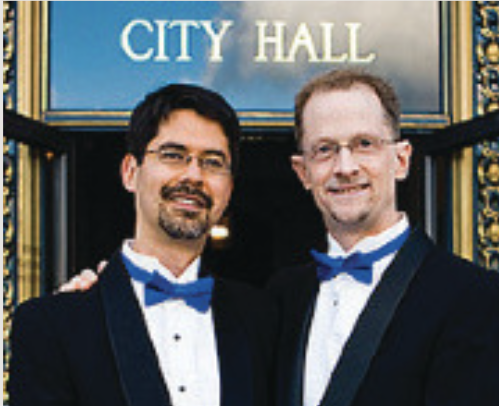
By Stuart Gaffney and John Lewis—
Imagine you’re at home having lunch on a Saturday afternoon when you hear a knock on the door. Not expecting anyone, you answer the door, part of your lunch still in hand, to find yourself confronted by two police officers, one of whom is recording your every move with a video camera in your face. The police officers force you to go to the station with them, not explaining why, and, a short time later, you find yourself being interrogated by the state security police.
That’s exactly what happened to a gay man who is a good friend of ours—for purposes of this column, we’ll call him Chris—who lives in a country where being gay has long been legal, but LGBTIQ rights are severely limited and gay freedom is increasingly under attack.
Inside the police station, Chris was, of course, anxious about why he was being detained and what was going on. Even though government repression of the LGBTIQ rights movement in his country had been increasing in recent years, gay people were not subject to mass arrests or sweeps at bars or clubs. Thus, he was taken aback by his interrogator’s simple initial query:
“Are you a homosexual?”
Chris paused for a moment, not knowing for sure why he was being interrogated and wanting to consider the implications of his answer for himself and others. He needed to think strategically in responding to the security police. He chose an equally simple and straightforward answer: “Yes.”
Despite feeling nervous and intimidated by the interrogation that was only just beginning, Chris experienced something else surprising as he answered: a palpable sense of pride well up from within him. Even though he had not come out to his family and his employer, he had just done so to the powerful state security police.
To us, Chris’s confidence and clarity at such an unexpected, tense, and vulnerable moment—and his complete embrace of himself as a gay person—embody the essence of Pride that we celebrate every year this month.
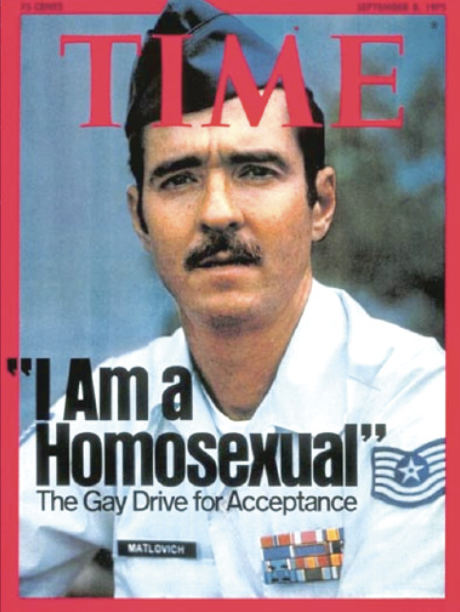
The entire exchange also reminded us of the stunning September 8, 1975, cover of Time magazine emblazed in massive bold type with the words of Sergeant Leonard Matlovich “I Am a Homosexual,” along with a photo of him in military uniform. Earlier that year, Matlovich had taken the bold step of writing those words in a memo to the Secretary of the Air Force to create the foundation for his ultimately unsuccessful legal challenge to the exclusion of gay people from the U.S. military.
The 1975 Time cover story substantially elevated the gay rights movement in America’s consciousness. It explored many different aspects of queer life and the movement 50 years ago, although, unquestionably, it was a product of its time. One quote that stood out to us was that of renowned lesbian and queer activist Barbara Gittings: “What the homosexual wants, and here he is neither willing to compromise nor morally required to compromise—is acceptance of homosexuality as a way of life fully on a par with heterosexuality.”
Today, we no longer refer to ourselves as “homosexuals” and don’t use the generic “he.” We seek, not just “acceptance” but embrace, and we strive to live on our own terms without heterosexuality as a referential norm. But the essential force of Gittings’s articulation of our collective commitment to ourselves and to our aspirations as a community continues to resonate today. It lies at the heart of Pride. Chris, even under interrogation by his country’s security police, was unwilling “to compromise” who he was as a queer person.
Chris was released from custody after the security police determined he was not a threat, and the police have not knocked on his door since. But the experience was traumatic, and he now knows he is subject to active surveillance.
Chris’s refusal to compromise who he was as a queer person also did something else important—it denied the state the power to control more broadly who he was as a human being, even as they detained him. It also enabled Chris to refuse to compromise his capacity to see the police and security officers who detained and interrogated him as his fellow human beings. Throughout the ordeal, Chris reflected on how, apart from their jobs, the police officers, like him, had personal lives and loved ones. He saw no evidence the police officers harbored malice against him personally and viewed them as simply doing what was required of them in their positions.
Chris saw the police officers as neither better nor worse than him, and he chose not to hate them. The resulting equanimity that arose within him amidst the anxiety enabled him to respond to their questions, not in anger, but with presence, thoughtfulness, and care to make sure crucially that he told the police nothing that they did not already know. As such, he did nothing to put any other queer people or allies at risk.
And who knows what other positive effects Chris’s actions that day may have had for himself or others? After all, one or more of the police officers may have been gay themselves, and Chris’s coming out may have inspired them. Or some of the officers might have become straight allies because of Chris. Without question, coming out is not always the best response in all circumstances, but, as Chris and myriad other courageous members of our community have demonstrated, Pride under pressure is powerful.
John Lewis and Stuart Gaffney, together for over three decades, were plaintiffs in the California case for equal marriage rights decided by the California Supreme Court in 2008. Their leadership in the grassroots organization Marriage Equality USA contributed to making same-sex marriage legal nationwide in 2015. Today, they continue to educate and advocate for marriage equality and LGBTIQ+ rights worldwide.
6/26 and Beyond
Published on June 25, 2026









Recent Comments