










By Stuart Gaffney and John Lewis—
On November 3, 2026, voters across the country again fulfilled the words that rang out upon the nationwide victory for marriage equality: Love wins!
In New Hampshire, Chris Pappas became the first openly gay man elected to the U.S. Senate. During his victory speech, he warmly thanked his “amazing husband” Vann Bentley to the roar of the crowd. Pappas described how Bentley had “always been by his side,” exclaiming, “win, lose, or draw, I’m the luckiest guy because I’m married to a man that I love.” And he savored the fact that “despite all the negative attacks and the lies … love and truth prevailed tonight.”
More broadly, the Democrats’ stunning midterm victories represented a “rebuke of unkindness and cruelty,” as U.S. Senator-elect Adam Hamilton, the first Democrat elected to the U.S. Senate from Kansas in 94 years, put it on election night. Over the last two years, that unkindness and cruelty have manifest in Republican policy and politics in myriad ways, including vilification of trans people and immigrants, horrific actions by ICE, starting an unprovoked war of choice, and corruption of the political system to enrich Trump cronies and the wealthiest in society.
During his victory speech in suburban Kansas City, Hamilton, a United Methodist minister praised supporters who wore campaign buttons that read “decency is on the ballot.” He proclaimed that simple human “decency doesn’t belittle people. It doesn’t benefit the rich at the expense of the poor. It doesn’t ignore the cries of the needy.” And these core values apply “whether you are a person of faith or not.”
Over 600 miles to the south in Austin, Texas, U.S. Senator-elect James Talarico took to the stage before throngs of elated supporters and spoke behind a podium adorned with a large “Love Thy Neighbor” campaign placard. He proclaimed: “We just showed that a politics of division is no match for a politics of love.” And integrating his Christian beliefs with broader secular values, he declared that loving thy neighbor includes “not just my neighbor who looks like me, not just my neighbor who prays like me, not just my neighbor who votes like me.” And Talarico’s life experience, from being a sixth-grade teacher in one of San Antonio’s most at-risk and low-income middle schools, to a progressive state legislator to a liberal seminarian, demonstrates that he truly means it.
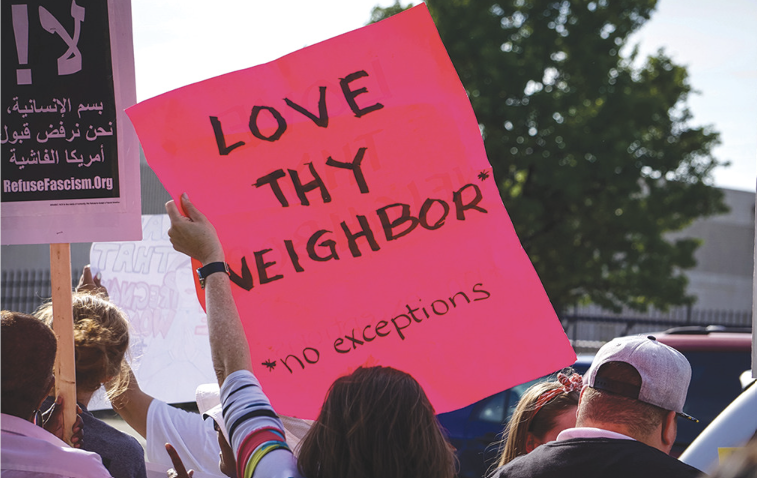
But the strength of the moral imperative to “love thy neighbor as thyself,” including one’s LGBTIQ+ neighbor, was put to the test before another branch of the federal government on election day: the U.S. Supreme Court. That morning, the Court heard oral argument in St. Mary Catholic Parish v. Roy, a case we discussed in the October 8, 2026, edition of the Bay Times (https://bit.ly/4sN7E2).
In that case, St. Mary Catholic Parish and the Archdiocese of Denver claim that they are entitled to receive money from Colorado’s publicly funded, universal pre-K school program, while at the same time violating the state’s anti-discrimination laws by barring pre-school children with LGBTIQ+ parents and gender-diverse pre-school children from attending their schools. Put simply, they want to practice “exclude thy neighbor,” instead of loving them—at taxpayers’ expense.
As both Hamilton and Talarico allude to in their election night speeches, the moral injunction “love thy neighbor” is embraced, not only as a Christian mandate, but also as a secular ideal. In fact, it is embodied in American law, most clearly through the equal protection clauses of the U.S. and state constitutions and federal and state anti-discrimination statutes.
At a bare minimum, loving thy neighbor means not intentionally discriminating against them or excluding them from government funded programs because of who they are. Colorado’s anti-discrimination law is just such a “love they neighbor” law. And if the Supreme Court in this case were to force Colorado to subsidize the Denver archdiocese’s blatant violation of the law, the harm exacted would be particularly egregious because those excluded would be preschoolers who are just four-years old.
But sadly, most legal observers seem to believe after oral argument that the Republican Supreme Court supermajority will do just that. And the fact that all six members of the supermajority were raised conservative Catholic, with Justice Neil Gorsuch educated in the schools of the Archdiocese of Denver itself, might play a role in that.
Nevertheless, Colorado Deputy Solicitor General (and Distinguished Law Professor) Helen Norton’s advocacy at the hearing was compelling. Particularly persuasive was how she responded when asked about the rights of religious organizations and people who opposed same-sex marriage, which were briefly discussed in the Supreme Court’s Obergefell nationwide marriage equality decision. Without skipping a beat, she pointed to another powerful passage from the opinion. It made clear that when even “sincere” opposition based on religion or otherwise “becomes enacted law and public policy, the necessary consequence is … an exclusion that … demeans or stigmatizes” same-sex couples and their children, “disparage[s] their choices and dimmish[es] their personhood.”
In other words, when it comes to how the equal protection clause demands that we relate to one another as a matter of the highest law of the land, the imperative to “love thy neighbor,” not exclude them, wins.
We hope that, despite the way the Republican supermajority seemed to be leaning at oral argument, it will heed the wisdom that newly elected leaders, such as Pappas, Hamilton, and Talarico, articulated election night, and enforce the constitution’s guarantees of full equality.
John Lewis and Stuart Gaffney, together for over three decades, were plaintiffs in the California case for equal marriage rights decided by the California Supreme Court in 2008. Their leadership in the grassroots organization Marriage Equality USA contributed to making same-sex marriage legal nationwide in 2015. Today, they continue to educate and advocate for marriage equality and LGBTIQ+ rights worldwide.
6/26 and Beyond
Published on November 19, 2026















Recent Comments